The Ludlow Massacre: When the National Guard Attacked a Tent Colony
Easter Monday 1914: Rockefeller-funded Guard troops attacked a Colorado mining camp. Nineteen died, including eleven children suffocated below a burned tent.
The Ludlow Massacre: When the National Guard Attacked a Tent Colony
The Ludlow Massacre is the clearest example in American history of the state acting as a direct instrument of corporate violence against civilians. On April 20, 1914 — Easter Monday — members of the Colorado National Guard and company-hired gunmen attacked a tent colony of striking coal miners and their families near Ludlow, Colorado. By the end of the day, two women and eleven children had been found suffocated in a pit beneath their tent. Nineteen people were killed in total. The coal mines were owned by Colorado Fuel and Iron Company, controlled by John D. Rockefeller Jr. By the end of the siege, Rockefeller was paying the National Guard soldiers directly.
Rockefeller’s Coal Fields Were Run Like a Private Government
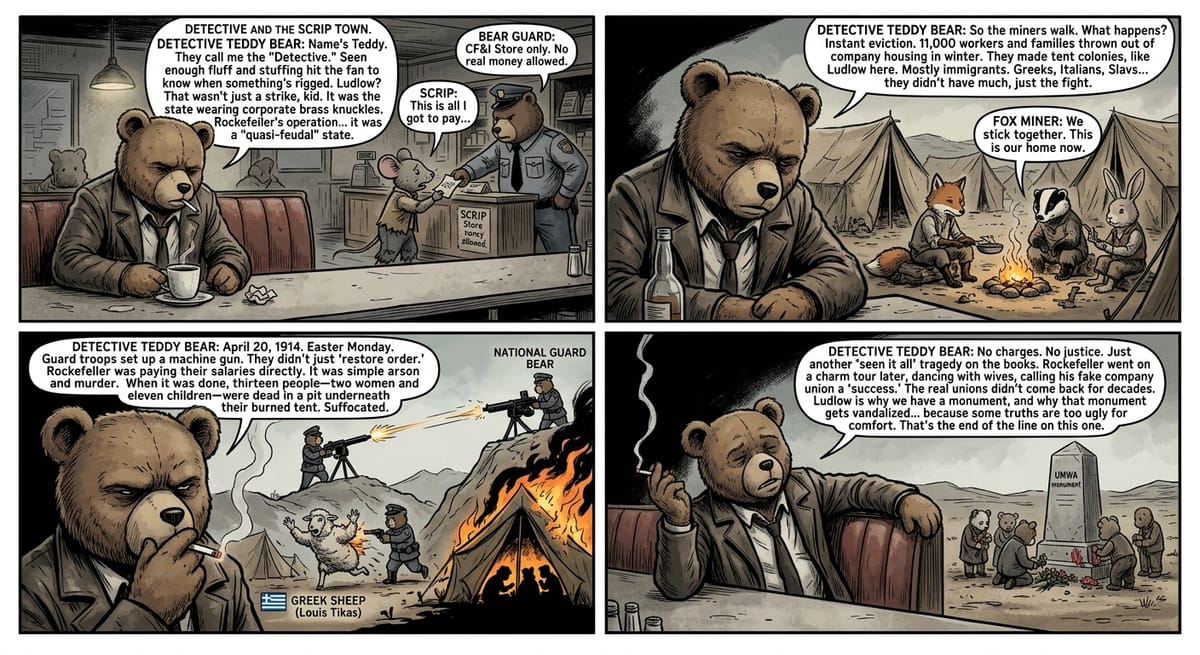
Coal mining in southern Colorado in 1913 was conducted under conditions that the United Mine Workers of America described as quasi-feudal, and the description was accurate. CF&I owned not just the mines but the towns built around them: the houses, the stores, the schools, the doctors, the churches, and the roads. Company guards had the authority to expel any resident, at any time, for any reason. Payment was in scrip, redeemable only at company stores. The state’s eight-hour workday law was routinely ignored.^1^
The UMW launched its organizing campaign in the southern Colorado fields in the summer of 1913. On September 23, 1913, roughly 11,000 miners walked off the job. CF&I immediately evicted them from company housing, which is why the striking miners and their families were living in tent colonies — ten of them, housing thousands of people — across the region by the fall of 1913.
Ludlow was the largest of these colonies, situated on open ground at a railroad junction north of Trinidad. Its residents were predominantly Greek, Italian, and Slavic immigrants, along with a smaller number of Mexican miners and their families. Mary Thomas, a Welsh immigrant known as “Mother Jones,” had been organizing in the area and spent time at Ludlow in the months before the attack.^2^
What Happened When the National Guard Opened Fire on Easter Monday
Relations between the tent colonies and the National Guard — called out by Governor Elias Ammons in October 1913, officially to restore order, in practice to protect CF&I’s operations — had deteriorated through the winter. By April 1914, the state had run out of money to pay the Guard, and Rockefeller was paying the soldiers directly.
On the morning of April 20, Guard troops positioned a machine gun on a ridge overlooking Ludlow and began firing into the colony. Miners returned fire from rifle pits dug around the colony’s perimeter. The battle lasted fourteen hours. During the fighting, a Greek miner named Louis Tikas — one of the colony’s leaders — was captured and executed by Guard officers. He was shot once in the back and beaten with rifle butts.^3^
As evening fell, members of the Guard entered the colony and set fire to the tents. The fires were not accidental. Investigators found that the guard had moved systematically through the colony, using torches and coal oil. In the smoldering ruins, searchers found a pit beneath one of the burned tents containing the bodies of two women — Patria Valdez and Cedelina Costa — and eleven children between the ages of three months and nine years. They had suffocated when the tent above them caught fire.
How Did John D. Rockefeller Jr. Respond to the Massacre of Children?
The Ludlow Massacre provoked a ten-day armed uprising across the southern Colorado coalfields — miners dynamited mines, burned buildings, and killed company guards in what became known as the Colorado Coalfield War. President Woodrow Wilson sent federal troops to restore order on April 30. The troops disarmed both sides. The strike continued until December 1914, when the UMW, bankrupt, called it off. The miners received none of their demands.
John D. Rockefeller Jr. initially testified before Congress that he had no knowledge of conditions at his mines and bore no responsibility for events there. This was implausible — Rockefeller had exchanged dozens of letters with CF&I management about the labor situation throughout the strike. Under pressure, he eventually hired Mackenzie King, a Canadian labor consultant who would later become Canada’s prime minister, to develop a company union plan that gave workers a thin simulation of representation without actual power.^4^
Rockefeller toured Colorado in 1915, shaking hands with miners and dancing with their wives, and declared the company union a great success. The United Mine Workers called it a sham. Genuine independent unions did not organize southern Colorado’s coal mines until the 1930s.
No Guard member was ever charged. The commanding officer, General John Chase, was never prosecuted. CF&I paid no damages to the families of the dead. Patria Valdez and her children, Louis Tikas, and the others who died at Ludlow are remembered with a monument at the site maintained by the UMWA. The monument has been vandalized repeatedly over the decades.
Ludlow stands as the extreme end of a pattern visible across the labor wars of this era — at Homestead where Carnegie sent Pinkertons, at Lattimer where deputies shot unarmed miners in the back, and at Blair Mountain where the Army threatened to bomb its own citizens from the air.
─────────
Part of America’s Labor Wars — ← Back to series hub
Sources:
- McGovern, George S., and Leonard F. Guttridge. The Great Coalfield War. University of Massachusetts Press, 1972.
- Martelle, Scott. Blood Passion: The Ludlow Massacre and Class War in the American West. Rutgers University Press, 2007.
- Andrews, Thomas G. Killing for Coal: America’s Deadliest Labor War. Harvard University Press, 2008.
- Gitelman, H.M. Legacy of the Ludlow Massacre: A Chapter in American Industrial Relations. University of Pennsylvania Press, 1988.