Martin Shkreli: The Most Hated Man in Pharma
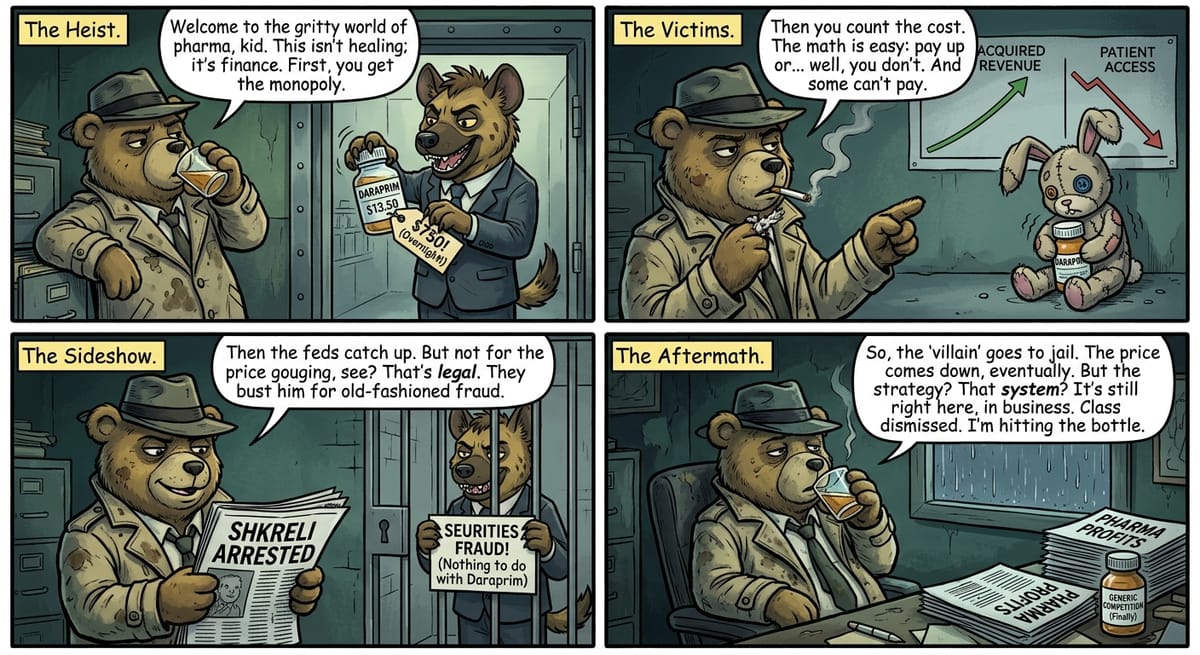
Martin Shkreli raised Daraprim's price from $13.50 to $750 overnight — a legal move that cut off HIV patients from a decades-old drug — then went to prison for unrelated securities fraud.
Martin Shkreli: The Most Hated Man in Pharma
Martin Shkreli’s 2015 decision to raise the price of a decades-old toxoplasmosis drug by 5,455% overnight made him the most visible symbol of pharmaceutical price gouging in American history — and he was separately convicted of securities fraud for conduct that had nothing to do with the drug.^1^ These two facts are routinely conflated, and separating them is the only way to understand what he actually did.
In September 2015, Turing Pharmaceuticals — led by 32-year-old CEO Martin Shkreli — raised the price of Daraprim, a 62-year-old antiparasitic drug used to treat toxoplasmosis, from $13.50 per pill to $750 per pill overnight, a 5,455% increase.^1^ Daraprim had no generic alternative in the United States; Turing had acquired the drug’s manufacturing rights specifically to gain the pricing power that came with a sole-source monopoly. The increase didn’t reflect new research, a manufacturing shortage, or any improvement in the drug. It reflected the conclusion that the American healthcare system would pay whatever Turing charged.
Part of Healthcare and Religious Fraud — ← Back to series hub
How Did Shkreli Build the Company That Could Pull This Off?
Martin Shkreli grew up in Sheepshead Bay, Brooklyn, the son of Albanian and Croatian immigrant parents who worked as janitors. He was intellectually precocious, had no conventional education in finance but taught himself investment analysis, and by his mid-twenties was managing a small hedge fund and building a reputation for aggressive, sometimes confrontational short-selling of pharmaceutical stocks. He founded Retrophin, a small pharmaceutical company, in 2011, and was fired by its board in 2014 for reasons that included allegations that he had used company assets to settle personal debts. He founded Turing Pharmaceuticals in 2015. The Daraprim acquisition — for $55 million — was the first major move at Turing, executed with the explicit strategy of acquiring drugs with no generic competition and maximizing price.
The Drug and the Patients It Couldn’t Reach
Daraprim (pyrimethamine) is used to treat toxoplasmosis, a parasitic infection that is manageable in healthy people but life-threatening in those with compromised immune systems — HIV/AIDS patients, cancer patients on chemotherapy, organ transplant recipients on immunosuppressants, and pregnant women in whom it can cause severe birth defects.^2^ These patients cannot simply skip treatment or switch medications; Daraprim is the standard of care, and its alternatives are limited and often less effective with worse side effect profiles.
Before the price increase, a hospital treating an HIV patient with toxoplasmosis might expect to pay a few hundred dollars for a course of Daraprim. After the price increase, the same course of treatment could cost tens of thousands of dollars.^1^ Several academic medical centers and hospitals that kept small inventories of Daraprim for rare cases described being unable to afford to maintain those inventories at the new price. Turing did establish a patient assistance program offering Daraprim at reduced cost to patients who qualified — but the program required patients to apply, demonstrate need, and navigate a bureaucratic process that is easier to clear for patients with stable housing and reliable internet access, harder for the most medically vulnerable patients with toxoplasmosis, who frequently have none of those things.
Shkreli’s Response Turned a Business Story Into a Cultural Event
Rather than releasing careful corporate statements emphasizing patient access programs and the company’s commitment to drug development, Shkreli went on social media and engaged directly with critics, mocking them, calling them poor, and inviting them to debate him. He called journalists stupid in interviews. He livestreamed himself playing videogames. He purchased the only copy of a Wu-Tang Clan album for $2 million and livestreamed himself listening to it. The persona attracted enormous media attention, which he seemed to actively enjoy. He appeared before a House Oversight Committee hearing in February 2016 and invoked his Fifth Amendment right against self-incrimination in response to every question, then called the members of Congress “imbeciles” on social media after the hearing concluded.
The Securities Fraud Conviction Had Nothing to Do With Daraprim
Federal prosecutors in Brooklyn charged Shkreli with securities fraud in December 2015 — three months after the Daraprim story broke — for conduct at MSMB Capital Management, a hedge fund he had run years earlier, and at Retrophin.^2^ The charges alleged that he had defrauded MSMB investors by misrepresenting the fund’s performance and using Retrophin assets to cover personal liabilities owed to MSMB investors. He was convicted in August 2017 on three counts of securities fraud and conspiracy. He was sentenced in March 2018 to seven years in federal prison and was released in May 2022 after serving approximately four years, given credit for good behavior and time served in home confinement.
What He Actually Represents in the Broader System
Shkreli’s notoriety made Daraprim into a symbol of pharmaceutical pricing excess, but the pricing strategy he used was not unusual.^3^ Dozens of companies had executed similar acquisitions — buying off-patent drugs with no generic competition and raising prices — before and after Turing acquired Daraprim. The difference was that Shkreli announced the strategy openly and then refused to apologize for it. Other executives doing the same thing had the good sense to say nothing interesting to journalists. The broader pattern is covered in depth in Pharmaceutical Price Gouging and Medicare and Medicaid Fraud.
The Daraprim price was reduced significantly by 2019, partly through competition from a compounding pharmacy that produced a cheaper alternative and partly through the reputational pressure of sustained attention. The broader strategy of acquiring sole-source drugs and maximizing price has continued at other companies without the Shkreli-level media coverage.
Shkreli went to prison for fraud.^4^ The pricing strategy that made him famous remains legal. Congress held multiple hearings, proposed multiple pieces of legislation targeting pharmaceutical pricing, and failed to pass any drug pricing reform until the Inflation Reduction Act of 2022 — seven years after the Daraprim incident — which addressed Medicare pricing but not the private market. The patients who needed Daraprim in 2015 and 2016, and who faced the pricing barrier Turing erected, did not benefit from the eventual regulatory response. The regulatory response came too late for them and addressed a different part of the problem.
─────────
Sources:
- Pollack, Andrew. “Drug Goes From $13.50 a Tablet to $750, Overnight.” The New York Times, September 20, 2015.
- United States v. Shkreli, No. 15-cr-637 (E.D.N.Y. 2017).
- Alpern, Jonathan D., William M. Stauffer, and Aaron S. Kesselheim. “High-Cost Generic Drugs — Implications for Patients and Policymakers.” New England Journal of Medicine, 2014.
- Facher, Lev. “How Pharma’s Favorite Price-Gouging Villain Got Away With It.” STAT News, March 10, 2022.