Medicare and Medicaid Fraud: Billions Stolen From Taxpayers
Medicare and Medicaid fraud costs roughly $100 billion a year — more than all bank robbery and investment fraud combined — paid by taxpayers and the patients whose identities are used to file the claims.
Medicare and Medicaid Fraud: Billions Stolen From Taxpayers
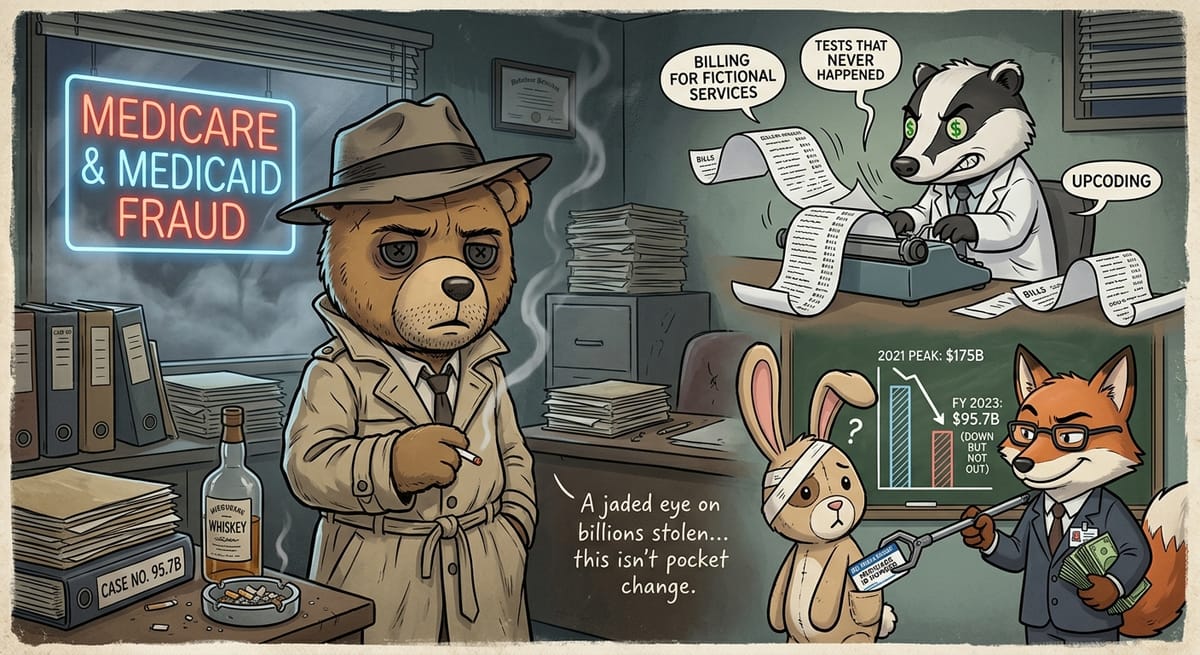
Medicare and Medicaid fraud costs Americans roughly $100 billion a year — more than every bank robbery, investment fraud, and corporate theft combined — and the victims include not just taxpayers but the patients whose identities are used to file the claims. The Department of Health and Human Services estimated that improper payments in Medicare and Medicaid totaled approximately $95.7 billion in fiscal year 2023, down from a peak of $175 billion in 2021 that reflected pandemic-era emergency payment expansion.^1^
Part of Healthcare and Religious Fraud — ← Back to series hub
Why Is the System So Easy to Defraud?
Medicare pays claims on a predominantly retrospective basis: a provider renders a service, submits a bill, and Medicare pays — typically without verifying in advance that the service was actually provided, that the patient actually received it, or that the billing codes accurately reflect what occurred.^4^ This “pay and chase” model exists for practical reasons: requiring advance verification of every claim would add enormous administrative friction to a system processing more than a billion claims per year. The tradeoff is that fraudulent claims are often paid before they’re detected.
Medicaid, the federal-state program covering lower-income Americans, has similar vulnerabilities at the state level, with enforcement capacity that varies significantly by state.
The fraud takes multiple forms. Billing for services not provided — “phantom billing” — involves submitting claims for appointments, tests, or procedures that never happened. Upcoding involves billing for a more expensive service than was actually provided, such as billing for a complex office visit when a brief consultation occurred. Unbundling involves billing separately for components of a service that should be billed together at a lower rate. Kickbacks for referrals — paying physicians to refer patients to specific labs, imaging centers, or facilities — are illegal under the federal Anti-Kickback Statute.
The Largest Corporate Cases Show the Scale of What’s Possible
Columbia/HCA, the largest for-profit hospital chain in the United States in the 1990s, paid $1.7 billion to the federal government in 2000 to settle Medicare fraud charges — the largest Medicare fraud settlement in history at the time.^2^ The company had billed Medicare for services not rendered, had improperly claimed community education expenses as patient care costs, and had paid kickbacks to physicians for patient referrals. The settlement was resolved with the company, not with individual executives, most of whom faced no criminal charges.
HCA (the same company, reorganized) continued to face fraud allegations in subsequent years, paying additional hundreds of millions in fraud-related settlements between 2000 and 2010. Fresenius Medical Care, the world’s largest dialysis provider, paid $231 million in 2000 to settle claims that it had billed Medicare for services not provided. DaVita, another major dialysis company, paid $895 million in 2015 to resolve allegations that it had paid kickbacks and billed for medically unnecessary treatments.
The South Florida and South Texas healthcare markets have historically been among the highest-fraud regions in the country, with networks of “clinics” that existed primarily as billing entities rather than patient care sites. The Miami Medicare fraud operations of the 1990s and 2000s were documented in detail by federal investigators — storefronts that billed for wheelchairs, home health services, and durable medical equipment never provided to patients whose Medicare numbers had been obtained through identity theft or complicit enrollment.
Strike Forces Changed What Prosecution Actually Looks Like
Beginning in 2007, the Department of Justice and HHS created Medicare Fraud Strike Forces in high-fraud geographic areas, initially in Miami and Los Angeles and eventually expanding to seven additional cities.^2^ The strike forces combined law enforcement agents with data analysts to identify billing anomalies, conduct undercover investigations, and execute coordinated takedowns of fraud networks.
The strike forces produced substantial results. In June 2018, coordinated enforcement actions across multiple strike force districts resulted in the charging of 601 defendants — including 165 medical professionals — for approximately $2 billion in fraudulent billing, at the time the largest healthcare fraud enforcement action in Department of Justice history. In September 2020, 345 defendants were charged across 51 federal districts for approximately $6 billion in fraudulent billing, including $4.5 billion in telemedicine fraud that had expanded dramatically with pandemic-era regulatory changes.
The Opioid Prescription Fraud Connection
Medicare and Medicaid fraud intersects with the opioid epidemic through fraudulent prescribing. Physicians who prescribed opioids for cash, physicians who prescribed without conducting meaningful evaluations, and “pill mills” that generated prescription volume without patient care billed insurance programs including Medicare and Medicaid for visits that were primarily or solely vehicles for generating prescription volume. The drug diversion — the opioids themselves — is a separate crime; the billing fraud is the healthcare fraud component of the same operation. The case of Fake Cancer Doctors shows how this fraudulent billing can cause direct patient harm beyond the financial loss.
Who Actually Pays the Price
The direct financial cost falls on federal and state governments — and therefore taxpayers. The less visible cost falls on patients whose Medicare numbers are used without their knowledge or consent, generating confusion in their records and occasionally creating coverage complications. The most severe patient harm comes from cases like Farid Fata’s — where the fraud involves actual treatment decisions, not just billing manipulation — but even phantom billing can harm patients whose medical records now show treatments they didn’t receive, complicating future care.
Recovery and enforcement have improved substantially since the 1990s. The False Claims Act, which allows private citizens to sue on behalf of the government and collect a portion of any recovery, generated $2.3 billion in federal healthcare fraud recoveries in 2022 alone.^2^ The whistleblower provisions have been among the most effective enforcement mechanisms, because insiders with knowledge of fraud have a financial incentive to report it. Strike forces, data analytics, and increased criminal prosecution of individual physicians and executives (not just institutions) have all contributed to increased enforcement intensity. The underlying vulnerability — a high-volume payment system that cannot verify every claim in real time — has not been and cannot be easily eliminated. For context on what happens when pharmaceutical companies exploit the same payment system through legal means, see Pharmaceutical Price Gouging.
─────────
Sources:
- U.S. Department of Health and Human Services. FY 2023 Medicare and Medicaid Improper Payments Report. HHS, 2023.
- U.S. Department of Justice. Health Care Fraud and Abuse Control Program Annual Report. DOJ, 2022.
- Rashbaum, William K. “Medicare Fraud, Simple and Lucrative.” The New York Times, July 8, 2009.
- Sparrow, Malcolm K. License to Steal: How Fraud Bleeds America’s Health Care System. Westview Press, 2000.