The Charleston Church Shooting: White Supremacy in a House of God
Dylann Roof killed nine Black parishioners at Emanuel AME Church in Charleston on June 17 2015. He wanted to start a race war. A failed FBI background check let him buy his gun.
The Charleston Church Shooting: White Supremacy in a House of God
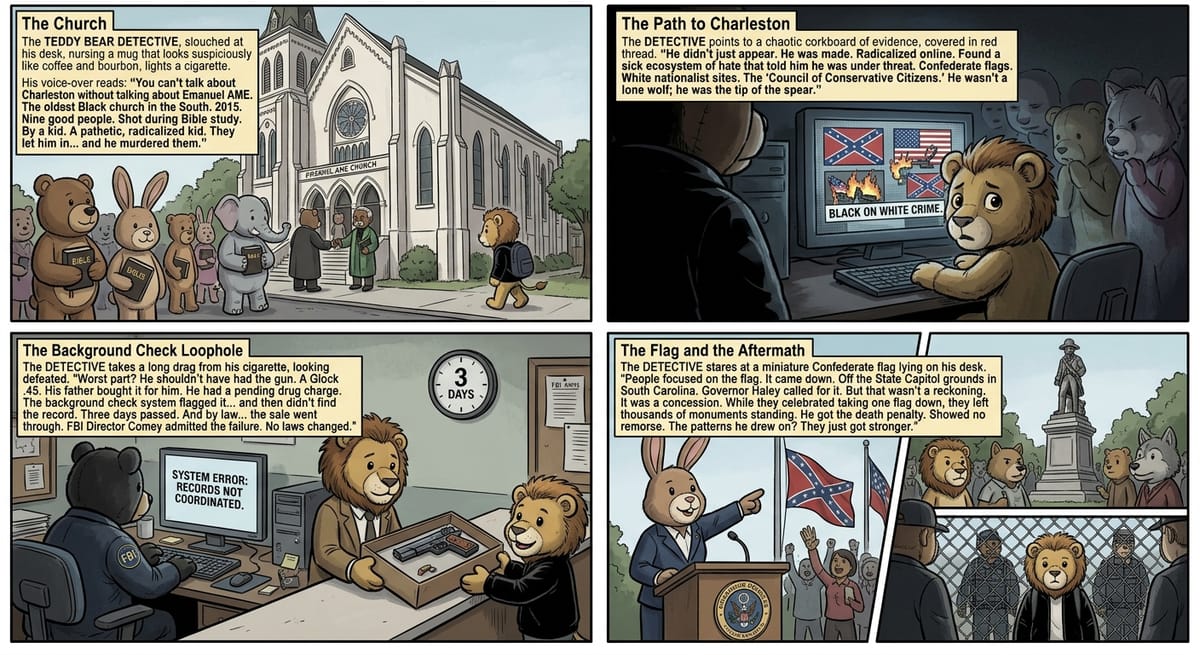
On June 17, 2015, Dylann Roof attended Bible study at Emanuel African Methodist Episcopal Church in Charleston, South Carolina — one of the oldest and most historically significant Black churches in America — sat for about an hour with twelve Black parishioners, then stood up and opened fire. He killed nine people. He was 21 years old, radicalized online, and wanted the attack to start a race war. It did not start a race war. It accelerated a national reckoning with the Confederate battle flag, and it accelerated absolutely nothing else of substance.^1^
Part of Modern Racial Violence — ← Back to series hub
The Nine People Dylann Roof Killed
Cynthia Marie Graham Hurd, 54, was a librarian who had worked for the Charleston County library system for 31 years. Susie Jackson, 87, was one of the older members of the congregation. Ethel Lee Lance, 70, was the sexton of the church. DePayne Middleton-Doctor, 49, was a pastor and college administrator. Clementa C. Pinckney, 41, was the senior pastor of Emanuel AME and a South Carolina state senator. Tywanza Sanders, 26, was the youngest victim and a recent graduate of Allen University. Daniel Simmons Sr., 74, was a pastor. Sharonda Coleman-Singleton, 45, was a pastor and a high school track coach. Myra Thompson, 59, was a Bible study teacher.
Felicia Sanders survived by lying still under the dead body of her son, Tywanza. Her granddaughter, a five-year-old girl, also survived by playing dead. Felicia Sanders later testified at Roof’s sentencing hearing.^1^
How Dylann Roof Was Radicalized
Dylann Storm Roof was born on April 3, 1994, in Columbia, South Carolina. He had dropped out of high school and had been living with his father intermittently. A friend later said Roof had been radicalized by internet forums after the 2012 Trayvon Martin case, when he went searching online for information about “Black on white crime” and found white supremacist websites.^2^
Roof maintained a personal website, “The Last Rhodesian,” where he posted photographs of himself with Confederate flags, burning American flags, and gun imagery, along with a manifesto stating that Black people were “taking over” America and that white people needed to act. It cited the Council of Conservative Citizens — a white nationalist organization with ties to mainstream Republican politics — as a source. He had visited Confederate historical sites in South Carolina in the months before the attack. He intended to attack the College of Charleston first but changed plans because the security there was too heavy.
The Background Check Failure That Let Roof Buy His Gun
Roof had a pending drug charge — an arrest in February 2015 for possession of Suboxone — that should have prevented his background check from clearing when his father purchased him the .45 caliber Glock pistol. The FBI’s National Instant Criminal Background Check System failed to find the pending charge because of a flaw in how federal and local records were coordinated. An FBI examiner had three days to research his background before the waiting period elapsed, did not complete the research in time, and the sale proceeded.^3^
FBI Director James Comey acknowledged the failure publicly after the shooting, stating that under a corrected process, Roof would not have been able to legally purchase the weapon. No legislation closing the background check gap passed in the years immediately following the shooting.
The Confederate Flag Came Down. The Conditions That Produced Roof Did Not.
After the shooting, photographs of Roof with Confederate battle flags renewed public attention to the continued display of the Confederate battle flag on the grounds of the South Carolina State Capitol in Columbia. The flag had been placed there in 1961 — corresponding precisely with the peak of civil rights activism in the South. Under significant pressure from activists and families of the victims, Governor Nikki Haley called for its removal. The South Carolina legislature voted to remove it on July 9, 2015. The flag came down on July 10.^4^
The removal was not a reckoning with white supremacy. It was a concession on one specific symbol. The Confederate monuments and flags in public spaces across the South — estimated in the thousands — remained largely in place. The Equal Justice Initiative’s report Lynching in America was published the same year; its recommendations about naming and acknowledging the history of racial terror were not adopted by any government.
Roof Was Convicted, Sentenced to Death, and Expressed No Regrets
Roof was tried in federal court and convicted in December 2016 on all 33 counts, including hate crimes and obstruction of religion resulting in death, and sentenced to death. He represented himself at the sentencing hearing after dismissing his lawyers.
At the sentencing hearing, survivors and family members of the nine victims addressed Roof. Felicia Sanders told him: “We welcomed you Wednesday night in our Bible study with open arms. You have killed some of the most beautiful people that I know. Every fiber in my body hurts.”^5^ Roof showed no expression and told the court he had no regrets. He is on death row at the Federal Correctional Complex in Terre Haute, Indiana.
What the Charleston Attack Demonstrated About the Pattern
Roof was not a lone wolf in the sense of being a unique phenomenon. He was radicalized by an ecosystem of white supremacist content available on the open internet, drew on arguments circulating in mainstream conservative media, and acted in a tradition of American racial terrorism targeting Black churches — churches that had been bombed, burned, and attacked continuously since Reconstruction. The 16th Street Baptist Church bombing in 1963, the wave of Black church burnings documented in 1995 and 1996, and the Charleston shooting share the same logic: Black religious institutions as targets of organized racial terror.
The FBI documented a 67 percent increase in hate crimes against Black people between 2014 and 2019. White supremacist groups posted record recruitment numbers during the same period. The patterns Roof drew on — internet radicalization, targeting of Black institutions, articulation of replacement theory — became more common after Charleston, not less. Understanding why requires understanding the broader white supremacist movement that Roof was a product of, not an outlier from.
─────────
Sources:
- Roose, Kevin. “A Most American Terrorist: The Making of Dylann Roof.” GQ, August 2017.
- Hawes, Jennifer Berry. Grace Will Lead Us Home: The Charleston Church Massacre and the Hard, Inspiring Journey to Forgiveness. St. Martin’s Press, 2019.
- U.S. Department of Justice. Report Regarding the Criminal Investigation into the Shooting Death of Nine Individuals at the Emanuel African Methodist Episcopal Church in Charleston, South Carolina. DOJ, 2017.
- Cook, Walter. “The Confederate Flag at the South Carolina Capitol.” South Carolina Department of Archives and History, 2015.
- United States v. Dylann Storm Roof, 4:15-cr-00472. U.S. District Court, District of South Carolina.