Medgar Evers: Assassinated in His Own Driveway
Medgar Evers was shot in his driveway in Jackson Mississippi on June 12 1963. His killer Byron De La Beckwith remained free for 30 years and boasted about it.
Medgar Evers: Assassinated in His Own Driveway
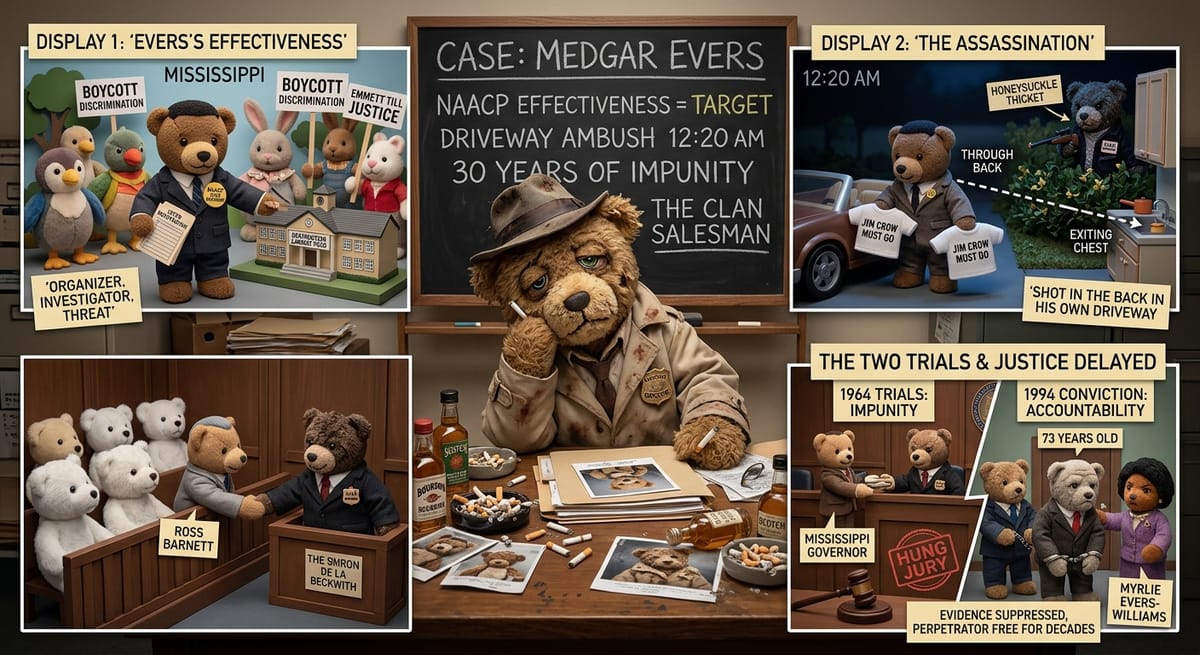
Medgar Evers was the NAACP’s most effective organizer in Mississippi — the man who investigated the Emmett Till murder, organized boycotts, and filed school desegregation lawsuits — and he was shot in the back in his own driveway at 12:20 a.m. on June 12, 1963, while carrying NAACP T-shirts that read “Jim Crow Must Go.” He was 37 years old. His wife Myrlie and their three children were inside the house. The man who killed him remained free for thirty years, ran for political office in Mississippi, and openly boasted about the murder.
Part of Blood of the Civil Rights Movement — ← Back to series hub
Who Medgar Evers Was Before He Was Killed
Medgar Wiley Evers was born on July 2, 1925, in Decatur, Mississippi. He served in the U.S. Army during World War II, including on D-Day at Normandy, and returned to Mississippi in 1945. In 1946, he and his brother Charles attempted to vote in the Democratic primary in Decatur. A group of white men with guns blocked them at the courthouse. He did not stop.^1^
He attended Alcorn Agricultural and Mechanical College on the GI Bill, graduating in 1952, then worked selling insurance in the Mississippi Delta — work that brought him into direct contact with the poverty and organized terror Black Mississippians lived under. In 1954, he applied to the University of Mississippi School of Law and was denied admission because of his race. That same year, he became the first field secretary of the NAACP in Mississippi.
As NAACP field secretary, Evers investigated lynchings and racial violence, organized voter registration drives, led boycotts of discriminatory businesses, and built the infrastructure of Black political life in the most dangerous state in the country. He investigated the murder of Emmett Till in 1955, organized around the cases of voting rights activists, and personally filed a legal challenge to segregated schools in Jackson.^2^
Why Evers Refused to Leave Mississippi Despite Death Threats
Evers received death threats routinely. His home address was publicly known. In May 1963, a Molotov cocktail was thrown at his home and burned the carport. His neighbors found a note threatening to kill him if he didn’t leave. His NAACP supervisors in New York encouraged him to relocate. He refused.
He was organizing a major economic boycott of white-owned businesses in Jackson in the spring of 1963, one of the most visible campaigns of the civil rights year. James Meredith’s enrollment at the University of Mississippi in September 1962, which Evers had helped make possible, had triggered riots requiring 23,000 federal troops. The Jackson movement was escalating.^3^
Byron De La Beckwith, a fertilizer salesman and Klan member from Greenwood, Mississippi, had purchased a rifle with a telescopic sight and been asking questions about Evers’s address and schedule. On June 11, 1963 — the night before the assassination — President Kennedy delivered his first major televised address on civil rights. Evers came home from watching it at a strategy meeting, got out of his car in his driveway, and was shot from behind a honeysuckle thicket across the street. The bullet went through Evers’s back, exited his chest, broke the kitchen window, hit the refrigerator, and came to rest on the kitchen counter.
Two Trials, Two Hung Juries, Thirty Years of Impunity
The 1964 trials produced hung juries both times. Mississippi Governor Ross Barnett came to the courthouse and shook Beckwith’s hand in front of jurors during the first trial. The physical evidence against Beckwith was substantial — his rifle was found near the scene, a fingerprint was matched — but no all-white Mississippi jury was going to convict a white man for killing the NAACP’s field secretary.^4^
Beckwith continued to live freely in Mississippi and later Tennessee, giving speeches to white supremacist organizations in which he referred to himself as the killer of Medgar Evers. He ran for lieutenant governor of Mississippi in 1967 and received more than 34,000 votes.
In 1989, Myrlie Evers-Williams learned that the Hinds County district attorney’s office had obtained new evidence, including testimony from Klansmen who had heard Beckwith boast about the murder. She pushed for a third trial. Beckwith was convicted on February 5, 1994 — he was 73 years old — and sentenced to life in prison. He died there on January 21, 2001.^5^
What Evers’s Death Left Behind
The assassination of Medgar Evers, like the Emmett Till murder eight years earlier, generated national attention and political shock — and, like that case, resulted in no immediate accountability. President Kennedy issued a statement. The civil rights bill Kennedy had announced the night of Evers’s murder moved through Congress under Lyndon Johnson’s presidency and became the Civil Rights Act of 1964.
Myrlie Evers-Williams became chairwoman of the NAACP in 1995 — the first woman to hold that position. She delivered the invocation at President Obama’s second inauguration in 2013, fifty years after her husband’s murder.
Medgar Evers is buried at Arlington National Cemetery, which he earned as a combat veteran. His home at 2332 Guynes Street in Jackson, Mississippi, is now a National Historic Landmark. The driveway is still there.
The pattern of accountability in Evers’s case — evidence suppressed, perpetrator free for decades, conviction only after a survivor’s persistent pressure — recurs throughout civil rights era racial terror. Understanding the institutional Klan activity that operated in Mississippi provides the necessary context for why Beckwith believed he would face no consequence.
─────────
Sources:
- Evers-Williams, Myrlie, and Manning Marable. The Autobiography of Medgar Evers: A Hero’s Life and Legacy Revealed Through His Writings, Letters, and Speeches. Basic Civitas, 2005.
- Nossiter, Adam. Of Long Memory: Mississippi and the Murder of Medgar Evers. Addison-Wesley, 1994.
- Dittmer, John. Local People: The Struggle for Civil Rights in Mississippi. University of Illinois Press, 1994.
- Vollers, Maryanne. Ghosts of Mississippi: The Murder of Medgar Evers, the Trials of Byron De La Beckwith, and the Haunting of the New South. Little, Brown, 1995.
- King, Anita. Quotations in Black. Greenwood Press, 1981.