Emmett Till: The Murder That Ignited a Movement
Emmett Till was 14 when he was abducted and killed in Mississippi in 1955. His mother's open casket decision turned a murder into a movement.
Emmett Till: The Murder That Ignited a Movement
Emmett Till was fourteen years old when he was abducted from his great-uncle’s home in Money, Mississippi, at 2:30 a.m. on August 28, 1955, beaten beyond recognition, shot in the head, and thrown into the Tallahatchie River. His mother, Mamie Till-Mobley, demanded an open casket. That decision — to force the world to see what had been done to her son — turned a Mississippi murder into the catalyst for the American civil rights movement.
Part of Blood of the Civil Rights Movement — ← Back to series hub
Who Was Emmett Till Before He Was Murdered?
Emmett Louis Till was born on July 25, 1941, in Chicago, Illinois, to Mamie and Louis Till. His cousins described him as funny, confident, a talker. He had survived polio as a child, which left him with a slight stutter. By summer 1955 he was heading into eighth grade.^1^
In late August 1955, he traveled by train with his cousin Wheeler Parker to visit their great-uncle Moses Wright, a sharecropper and preacher in Money, Mississippi. Mamie Till-Mobley said she had warned Emmett about Mississippi — that it was different from Chicago, that he needed to be careful around white people. He had grown up in a Northern city and had not absorbed the hypervigilance that Black Southerners developed as a survival mechanism.
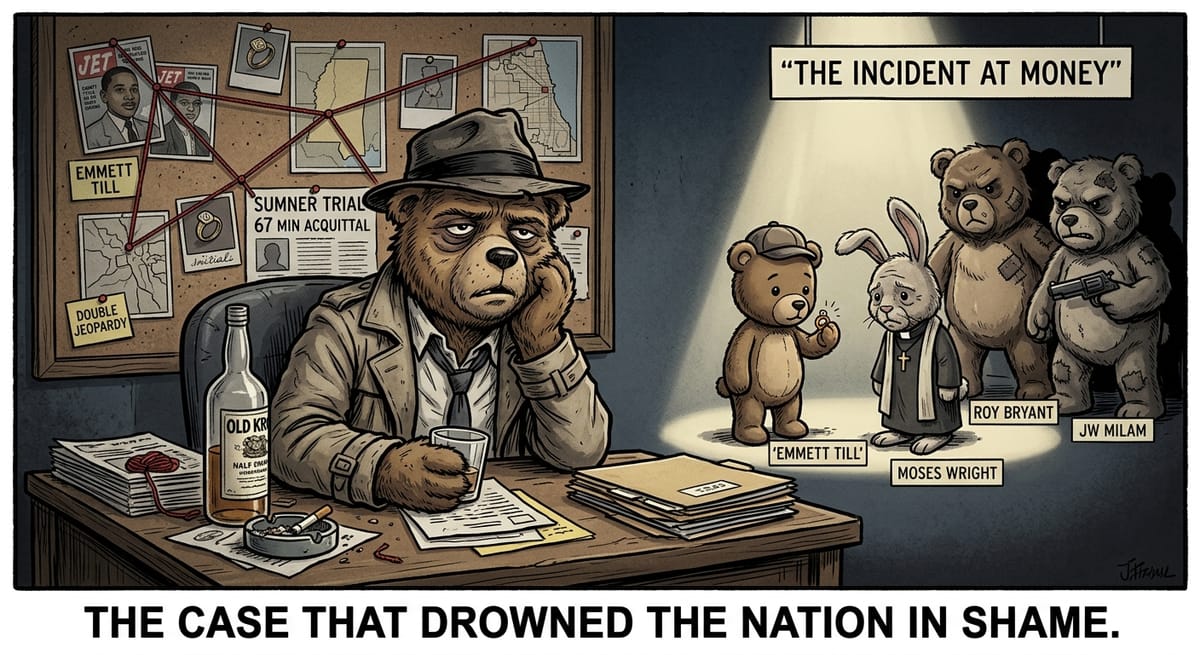
On August 24, Emmett went with a group of young people to Bryant’s Grocery and Meat Market in Money, owned by Roy and Carolyn Bryant. What happened inside is disputed and was re-disputed in 2022 when it emerged that Carolyn Bryant Donham’s original account — that Emmett had grabbed her, made verbal threats, and whistled at her — was recanted in a memoir withheld from publication. What is documented: Roy Bryant and his half-brother J.W. Milam came to Moses Wright’s home in the early hours of August 28.^2^
The Murder
Moses Wright told them Emmett was asleep. Bryant and Milam said they wanted the boy who “did the talking.” Wright and his wife Elizabeth begged them to stop. They took Emmett from his bed at gunpoint. The body found in the Tallahatchie River three days later was identifiable only by an initialed ring on his finger — his face had been beaten beyond recognition. The Tallahatchie County sheriff wanted to bury the body immediately in Mississippi. Mamie Till-Mobley insisted on having her son returned to Chicago.
The funeral was held on September 6, 1955, at Roberts Temple Church of God in Christ in Chicago. Mamie Till-Mobley had Emmett displayed in an open glass-topped coffin. An estimated 50,000 to 100,000 people came to view the body over four days. Jet magazine published photographs.^3^ The images did what years of lynching statistics had failed to accomplish — they made the violence impossible to abstract or explain away.
The Trial Produced an Acquittal in 67 Minutes
Roy Bryant and J.W. Milam were tried for murder in Sumner, Mississippi, in September 1955. Moses Wright — at considerable personal risk, in a Mississippi courtroom, before an all-white jury — stood up and pointed at the two defendants and said “Dar he.” Elizabeth Wright and Mamie Till-Mobley testified. The state presented its evidence.
The all-white jury deliberated for 67 minutes before acquitting both men. One juror told reporters they would have decided sooner if they hadn’t taken a break to drink a soda pop.^4^
Protected by double jeopardy, Bryant and Milam sold their story to journalist William Bradford Huie for $4,000. In the January 1956 issue of Look magazine, they described in detail how they had killed Emmett Till — the locations, the beating, the shooting, the weighing down of the body. They expressed no remorse. No legal consequence followed.
What Emmett Till’s Death Made Possible
Rosa Parks said she thought of Emmett Till the night she refused to give up her seat on a Montgomery bus on December 1, 1955 — three months after his murder. The Montgomery Bus Boycott began four days later. Fifteen-year-old Claudette Colvin, who had refused to give up her seat nine months before Parks, said she thought of Emmett Till. The photographs in Jet and Mamie Till-Mobley’s decision to force the world to see what had been done to her son created a concrete, visible, undeniable event — a child’s ruined face in an open casket, two men who admitted their guilt on the record in a national magazine.^5^
The Emmett Till Antilynching Act, making lynching a federal hate crime, was signed into law by President Biden on March 29, 2022 — sixty-seven years after the murder. In 2022, a grand jury in Leflore County, Mississippi, declined to indict Carolyn Bryant Donham after a sealed memoir in which she allegedly recanted her 1955 account became known to investigators; Mississippi law prevented the document from being subpoenaed. She died in April 2023.
Mamie Till-Mobley died on January 6, 2003, in Chicago. She spent the rest of her life after 1955 as an activist and educator. She wrote a memoir, Death of Innocence, published posthumously. She wanted people to know her son’s name, not just his death. Emmett Till. He was fourteen years old.
The violence against Till was part of the same racial terror infrastructure built during Reconstruction that had operated without federal interference for nearly a century. Understanding why a Mississippi jury could acquit known murderers in 67 minutes requires understanding how Black Codes and convict leasing institutionalized racial violence as law.
─────────
Sources:
- Till-Mobley, Mamie, and Christopher Benson. Death of Innocence: The Story of the Hate Crime That Changed America. Random House, 2003.
- Tyson, Timothy B. The Blood of Emmett Till. Simon & Schuster, 2017.
- Huie, William Bradford. “The Shocking Story of Approved Killing in Mississippi.” Look, January 24, 1956.
- Metress, Christopher, ed. The Lynching of Emmett Till: A Documentary Narrative. University of Virginia Press, 2002.
- Equal Justice Initiative. Lynching in America: Confronting the Legacy of Racial Terror. 3rd ed. EJI, 2017.