The Battle of Blair Mountain: America's Largest Armed Uprising Since the Civil War
In 1921, 10,000 West Virginia miners marched on a company-run county. The Army stopped them — deploying aircraft against American citizens for the first time.
The Battle of Blair Mountain: America’s Largest Armed Uprising Since the Civil War
The Battle of Blair Mountain was not a riot — it was an insurrection, and it has been systematically forgotten. In August and September of 1921, roughly 10,000 armed coal miners marched through the mountains of southern West Virginia toward Logan County, where a sheriff named Don Chafin had spent years enforcing a reign of terror against union organizers. They were stopped only when the federal government deployed biplanes and the Army threatened to bomb them from the air. It remains the largest armed labor uprising in American history after the Civil War.
Southern West Virginia’s Coal Operators Ran a Private Government
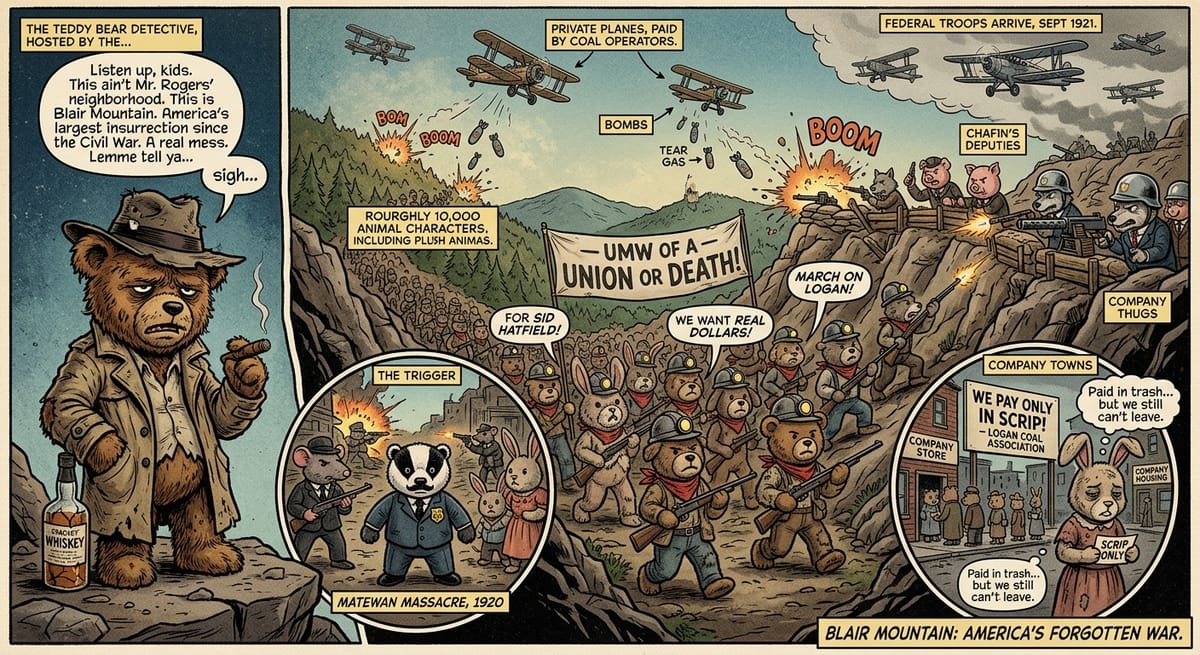
The coal operators of southern West Virginia ran what amounted to a private government. Miners in Mingo, Logan, and McDowell counties lived in company towns: company-owned houses, company-owned stores where they were paid in scrip instead of U.S. currency, company-owned doctors, company-owned churches. If you organized, you lost your house and your job in the same afternoon.
The United Mine Workers of America had been trying to organize the southern West Virginia fields since the 1890s. The northern fields — in counties like Kanawha — were organized and relatively stable. The southern counties were a different country. By 1920, the UMW had organized roughly 50,000 miners in West Virginia’s northern fields and almost none in the south. The coal operators intended to keep it that way.
Don Chafin, the Logan County sheriff, was paid directly by the Logan County Coal Operators Association — roughly $32,000 a year, on top of his government salary, to keep unions out.^1^ He employed a private army of deputies and ran the county like a fiefdom. Miners caught with union literature were beaten. Organizers were arrested on invented charges or simply run out of the county at gunpoint.
The Murder of Sid Hatfield Was the Match
The immediate trigger for the march on Blair Mountain was a two-year escalation that began on May 19, 1920, in the small town of Matewan, Mingo County. That afternoon, a group of Baldwin-Felts detective agents arrived to evict miners’ families from company houses — punishment for joining the UMW. Matewan’s police chief, Sid Hatfield, sided with the miners. A gunfight erupted in the street, killing seven Baldwin-Felts agents, two miners, and Matewan’s mayor.
Hatfield became a hero to miners across the region. On August 1, 1921, he was murdered on the steps of the McDowell County courthouse — shot by Baldwin-Felts agents while surrounded by witnesses, none of whom were ever convicted. Within days, miners began gathering in Kanawha County with rifles, pistols, and in some cases machine guns taken from armories. By late August, an estimated 10,000 to 15,000 armed men were moving south toward Logan County, intending to break Chafin’s grip on the southern coalfields and free organizers imprisoned in Mingo County.
What Did 10,000 Armed Veterans Marching on Blair Mountain Look Like?
The miners’ army was organized with military precision — most of the men were veterans of World War I, barely three years removed from the trenches of France. They established a command structure, set up field kitchens, and communicated by courier along a front that stretched for miles across the ridgelines of the Appalachian Mountains.
Chafin met them with roughly 2,000 deputies and armed volunteers dug into defensive positions along Blair Mountain’s ridge. The fighting lasted from September 1 to September 4, 1921. Both sides used rifles, machine guns, and hand grenades. Chafin’s forces hired private planes to drop homemade bombs and canisters of tear gas on the miners’ positions — the first time aerial bombing was used against American citizens on American soil.^2^
President Warren Harding ordered federal troops to the region and authorized the Army to use its own aircraft. Faced with the prospect of fighting the U.S. military, the miners’ army dispersed. Estimates of the dead range from 20 to 100 — the exact number was never officially established. More than 1,000 miners were indicted for treason and murder. Most charges were eventually dropped.
The Men Who Marched Were Not Radicals — They Were Coal Miners
The men who marched on Blair Mountain were coal miners — many of them immigrants from Italy, Hungary, and Poland, others Black miners who had come from the South — bound together by brutal working conditions and the shared experience of living under a corporate police state.^3^
Black miners participated in the march at a time when racial segregation defined nearly every other aspect of American life. The UMW’s southern West Virginia locals were integrated, a practical necessity in fields where Black miners made up a significant portion of the workforce. The enemy they shared was the coal operators and the armed men those operators employed.
The march also included veterans who had been told they were fighting for democracy in Europe. They had come home to company towns, company scrip, and company police — conditions not unlike those the Pullman workers had faced in their company town three decades earlier.
Blair Mountain Was a Tactical Defeat That Changed the Long-Term Equation
The UMW’s membership in southern West Virginia collapsed in the aftermath — the region remained largely unorganized through the 1920s. But the events of 1921 became part of the institutional memory of the American labor movement, and the New Deal legislation of the 1930s — particularly the National Labor Relations Act of 1935 — reflected, in part, the recognition that the alternative to legal protections for organizing was armed insurrection.^4^
The miners who survived the march mostly kept working in the same mines, under conditions that improved slowly across the following decades. Blair Mountain itself was nearly destroyed by mountaintop-removal coal mining in the 2000s, before a preservation campaign placed portions of the battlefield on the National Register of Historic Places in 2009.
The federal government has never formally acknowledged the aerial bombing of its own citizens during the battle. No monument to the miners stands at Blair Mountain. The pattern of private force backed by state power that defined Blair Mountain runs through the entire Labor Wars series — from Haymarket in 1886 to Ludlow in 1914 to the West Virginia coalfields in 1921.
─────────
Part of America’s Labor Wars — ← Back to series hub
Sources:
- Shogan, Robert. The Battle of Blair Mountain: The Story of America’s Largest Labor Uprising. Westview Press, 2004.
- Savage, Lon. Thunder in the Mountains: The West Virginia Mine War 1920–21. University of Pittsburgh Press, 1990.
- Corbin, David Alan. Life, Work, and Rebellion in the Coal Fields: The Southern West Virginia Miners, 1880–1922. University of Illinois Press, 1981.
- National Park Service. Blair Mountain Battlefield. National Register of Historic Places Nomination, 2009.