Labor and Corporate Violence in American History
Labor wars, corporate atrocities, government experiments: 17 articles documenting how industrial power transferred violence and risk onto those least able to refuse it.
Labor and Corporate Violence in American History
American history has a violence problem that is not primarily political. The most pervasive, most systematic, and most lethal forms of organized violence in American life have not been wars or mass shootings — they have been the everyday violence of industry: workers killed because safety cost money, experiments conducted on people who couldn’t refuse, neighborhoods poisoned because remediation cut into profit margins. The seventeen articles in this section document that violence across three distinct forms: the labor wars of the Gilded Age and Progressive Era, the corporate atrocities of the 20th century, and the government experiments that ran from the 1920s through the 1970s.
In This Series
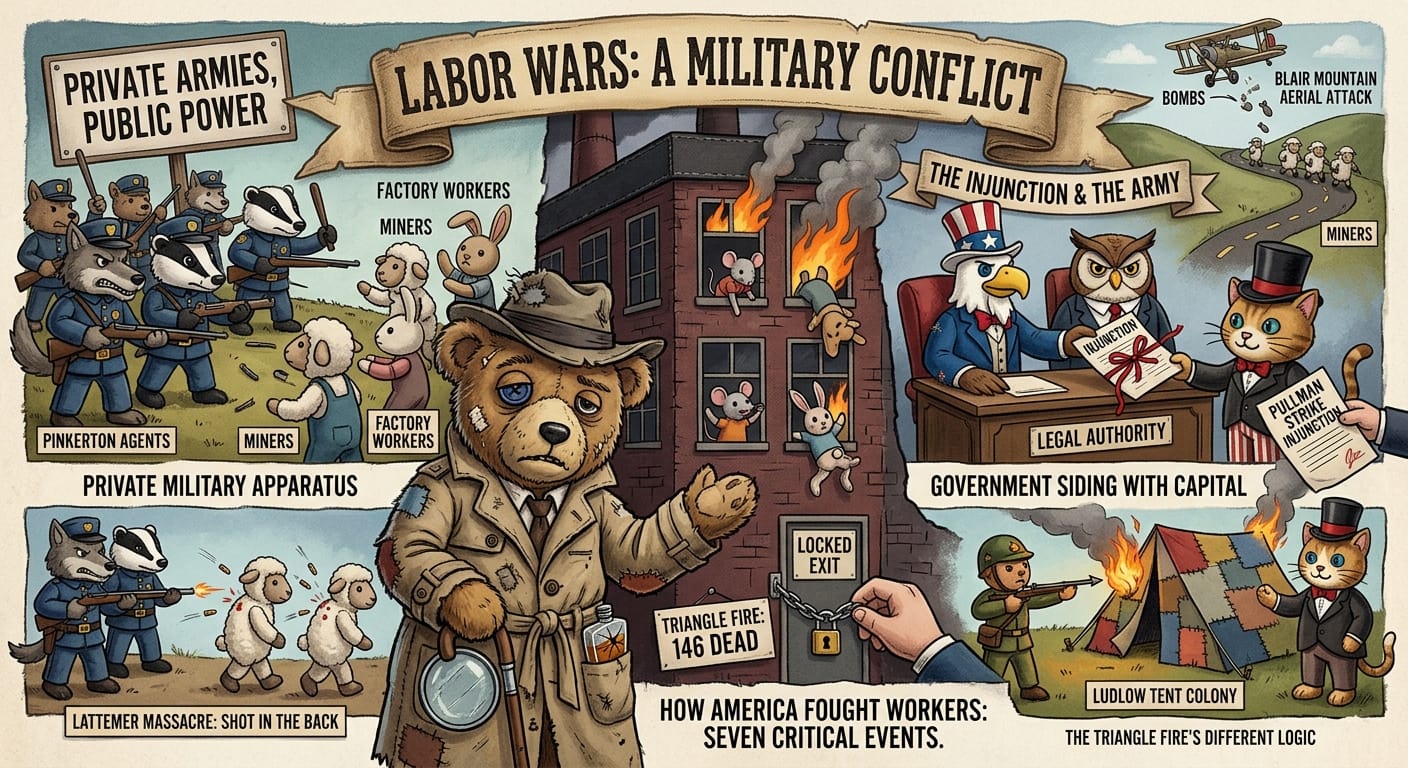
- Labor Wars: When Workers Fought Back and America Fought Harder — Seven events across 35 years: Haymarket, Homestead, Pullman, Triangle, Ludlow, Lattimer, Blair Mountain. The consistent pattern: workers organize, employers call in guns, government backs the guns.
- Corporate Atrocities: When Profit Kills — Radium dial painters, Love Canal, Bhopal, asbestos, tobacco, the opioid crisis. The concealment calculus ran the same way in every case: the expected cost of hiding the harm was lower than the expected cost of disclosing it.
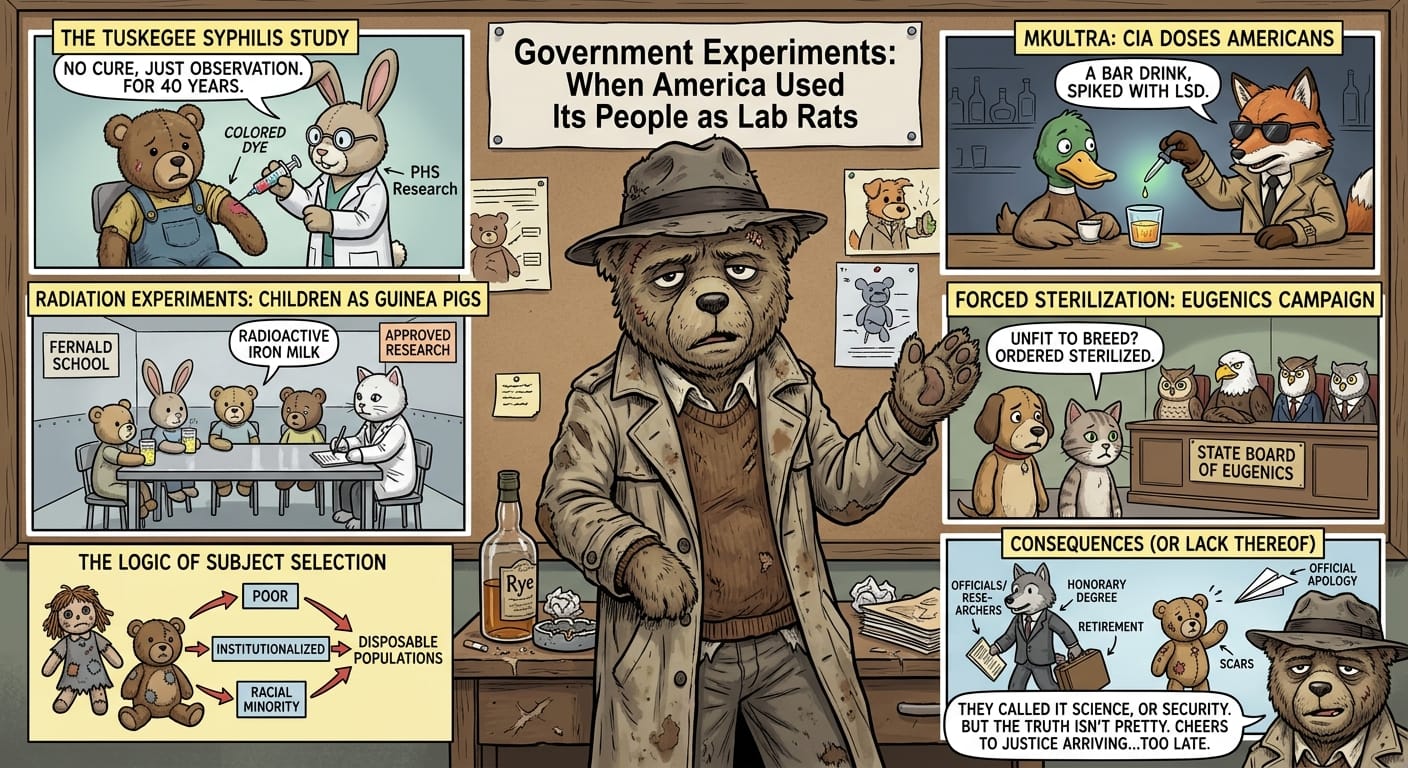
- Government Experiments: When America Used Its People as Lab Rats — Tuskegee, MKULTRA, Cold War radiation experiments, eugenics sterilization. The state conducting on its own citizens the same risk transfer that corporations performed — with coercive authority corporations lacked.
The Labor Wars Ran on Private Military Force
Between the 1880s and the 1920s, American employers maintained a private military apparatus — the Pinkerton Agency, the Baldwin-Felts detectives, the Coal and Iron Police — that existed to suppress workers who organized. These agencies hired out armed guards, planted labor spies, and broke strikes with violence that would be criminal if conducted by private citizens without employer sanction. They operated with near-total legal immunity.
The events in the labor wars series — Haymarket, Homestead, Pullman, Lattimer, Ludlow, Triangle, Blair Mountain — span 35 years and five industries, but they document a single consistent relationship: when workers organized, capital called in guns, and government backed the guns. At Ludlow in 1914, the Colorado National Guard was funded directly by Rockefeller and attacked a tent colony of mining families on Easter Monday. At Blair Mountain in 1921, the U.S. Army deployed biplanes with authorization to bomb American citizens.^1^
The violence was not random and it was not mutual. At Lattimer, 19 miners were shot in the back by deputies enforcing a sheriff’s order. At Triangle, 146 workers died because the factory owners had locked the exit doors. The one-sidedness of the killing was structural. Employers had property rights; workers had grievances. The legal system, through most of this period, treated the former as actionable and the latter as sedition.
The New Deal legislation of the 1930s — the National Labor Relations Act, the Fair Labor Standards Act — responded to this history by creating legal frameworks for collective bargaining and minimum workplace standards. Neither law was a gift. Both were the political consequences of four decades of workers being killed for asking to negotiate.
Corporate Atrocities Ran on the Concealment Calculus
The corporate atrocities documented in the second series are separated from the labor wars by several decades and a different mechanism. The employers who hired Pinkertons were trying to break unions. The companies that poisoned radium workers, contaminated Love Canal, killed thousands in Bhopal, covered up asbestos’s lethality, manufactured tobacco’s safety, and engineered the opioid crisis were engaged in a different calculation: the expected cost of concealment was lower than the expected cost of disclosure.
This calculation proved correct in almost every case. U.S. Radium Corporation settled the dial painters’ lawsuits for $10,000 per surviving plaintiff. Hooker Chemical sold the Love Canal site for $1 and walked away from the liability clause in the deed. Union Carbide’s Warren Anderson flew to India, was released on bail, and never returned to face criminal charges for a disaster that killed thousands.^2^ The tobacco companies paid $206 billion over 25 years and continued selling cigarettes.
The pattern across these cases — documented internal knowledge, deliberate concealment, selective funding of doubt research, regulatory capture — is not coincidental. Tobacco executives met with the PR firm Hill & Knowlton in 1953 and explicitly developed the strategy of manufacturing scientific controversy. That same strategy was subsequently deployed by the asbestos industry, by fossil fuel companies, by Purdue Pharma. It is a learnable playbook because it worked, and because the legal consequences for running it have been consistently insufficient to deter it.
Government Experiments Operated Where Corporations Couldn’t
The third series documents something distinct but structurally related: the U.S. government conducting on its own citizens the same kind of risk transfer that corporations performed — except that the government had coercive authority that corporations lacked, making the experiments harder to refuse and easier to hide.
Between 1932 and 1974, the Public Health Service watched 399 Black men in Macon County, Alabama, die of untreatable syphilis — in a study that continued for 25 years after penicillin could have cured them, at the cost of a single course of antibiotics and a commitment to treating Black Americans as patients rather than subjects.^3^ The CIA dosed American citizens with LSD in San Francisco bars, in federal prisons, at psychiatric hospitals — spending two decades and tens of millions of dollars establishing that mind control doesn’t work, while destroying the lives of the people they experimented on.
The eugenics sterilization campaign — which forcibly sterilized an estimated 65,000 Americans under state law between 1907 and the 1970s, with the explicit approval of the Supreme Court — is perhaps the most comprehensive: a government program designed to eliminate, one person at a time, the reproductive capacity of people deemed unfit by standards that reflected race, class, and disability more than any legitimate medical criterion.
These programs were not rogue operations. They were reviewed, funded, and sustained by federal agencies and their institutional partners. The scientists who ran them published in peer-reviewed journals and held academic appointments at Harvard, Columbia, and Johns Hopkins.
Who Absorbs the Cost in Every Case?
Across all three series, one pattern holds: the people who bear the risk are not the people who make the decisions, and the people who make the decisions rarely bear the consequences.
The workers who were shot at Lattimer were immigrant miners with no political power in Luzerne County, Pennsylvania. The women who lip-pointed their radium brushes were young Italian and Jewish immigrants in Essex County, New Jersey. The men in Tuskegee were Black sharecroppers in one of the poorest counties in Alabama. The residents of Love Canal were working-class homeowners who had no knowledge of what was buried under their neighborhood. The people of Bhopal were residents of a dense old city who had no say in Union Carbide’s safety decisions.^4^
This is not a coincidence. The selection of who gets exposed to industrial risk, who gets experimented on, and whose neighborhood absorbs corporate waste has followed the same gradient across a century: the people with the least power to object, the least access to legal recourse, and the least likelihood of being believed when they complain are consistently the ones who absorb the consequences of decisions made by people with money and institutional authority.
What Changed, and How Much
The regulatory and legal reforms that followed these events — the NLRA in 1935, the Occupational Safety and Health Act in 1970, the Belmont Report in 1979, the Superfund program in 1980, the opioid settlement in 2007 — each addressed specific documented failures. None of them resolved the underlying structural relationship between industrial power and legal accountability.
Asbestos remains legal in the United States for many applications. Buck v. Bell — the 1927 Supreme Court decision approving forced sterilization — has never been overturned. The Sackler family settled opioid claims for $4.5 billion and faced no criminal charges. The people who designed the Tuskegee study are dead; their institutional successors are not required to teach its history as a condition of federal research funding.^5^
These events are not ancient history. The opioid crisis is still killing people. Asbestos exposure is still killing people with mesothelioma, 40 to 50 years after the last exposure. Workers in meatpacking plants, agricultural labor, and construction face conditions that echo those of the Gilded Age labor wars in ways that the NLRA was not designed to address. The distance between the world that produced Blair Mountain and the world we inhabit is real — and it is not as large as we are taught to believe.
─────────
Sources:
- Shogan, Robert. The Battle of Blair Mountain. Westview Press, 2004.
- Lapierre, Dominique, and Javier Moro. Five Past Midnight in Bhopal. Warner Books, 2002.
- Jones, James H. Bad Blood: The Tuskegee Syphilis Experiment. Free Press, 1981.
- Gibbs, Lois Marie. Love Canal: The Story Continues. New Society Publishers, 1998.
- Keefe, Patrick Radden. Empire of Pain. Doubleday, 2021.
In This Section