Heaven's Gate: The Cult That Killed Themselves to Catch a Comet
In March 1997, 39 members of Heaven's Gate died in a San Diego mansion — dressed in matching Nike sneakers, convinced a spacecraft was coming to collect them.
Heaven’s Gate: The Cult That Killed Themselves to Catch a Comet
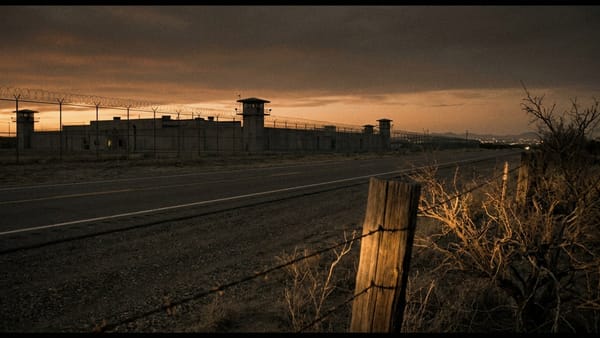
On March 26, 1997, police responding to an anonymous tip entered a rented mansion in the Rancho Santa Fe neighborhood of San Diego, California, and found thirty-nine people dead. They were lying on bunk beds and mattresses throughout the house, dressed identically in black shirts and sweatpants, with new Nike Decade sneakers on their feet and purple shrouds covering their faces. Each had a packed overnight bag beside them. Each had a five-dollar bill and three quarters in their pocket. They had died over a three-day period, in shifts, by ingesting phenobarbital mixed with applesauce and washing it down with vodka, then placing plastic bags over their heads. The dead ranged in age from twenty-six to seventy-two. They were members of a group called Heaven’s Gate, and they believed — with a sincerity that their careful, methodical preparation made impossible to dismiss as mere delusion — that they were leaving their human bodies to board a spacecraft traveling in the wake of Comet Hale-Bopp.^1^
Heaven’s Gate was the strangest American cult — not the deadliest, not the most abusive in its daily operations, but the one whose belief system was so far outside any conventional framework that the public couldn’t process it as anything other than madness. The group didn’t fit the cult template that Jonestown and Waco had established. There was no charismatic preacher screaming into a microphone. There was no compound surrounded by armed guards. There were thirty-nine quiet, articulate, technically skilled adults who had spent two decades developing a theology that synthesized Christianity, science fiction, and UFO mythology into a coherent (to them) system, and who chose to die with a calm that remains one of the most unsettling features of the case.^2^
How a Music Professor and a Nurse Built a UFO Theology
Heaven’s Gate was founded in the early 1970s by Marshall Applewhite, a music professor from Texas, and Bonnie Nettles, a nurse from Houston. Applewhite had been fired from the University of St. Thomas in Houston following a sexual relationship with a male student — a crisis that apparently triggered the spiritual seeking that led him to Nettles, whom he met in 1972 at a psychiatric hospital where he had checked himself in and she was working. Their connection was immediate, and they spent the following years developing the theology that would define Heaven’s Gate.^1^
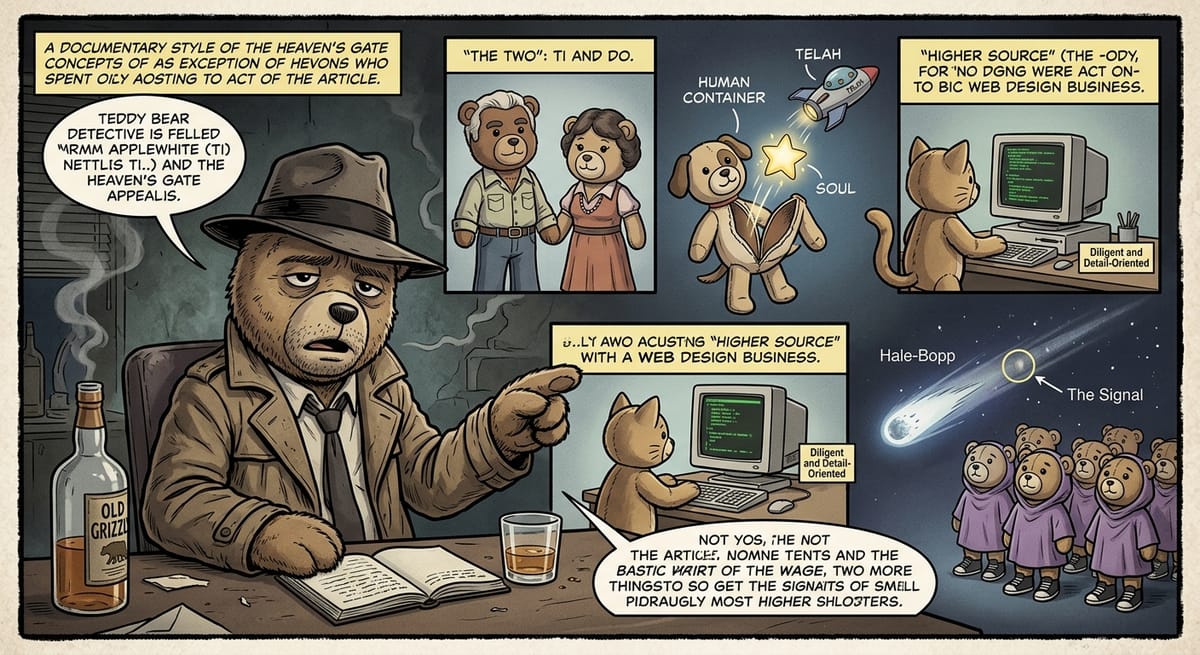
They called themselves “The Two” and later adopted the names Ti (Nettles) and Do (Applewhite), from the musical scale. Their core teaching was that human bodies were vehicles — “containers” — for souls that had originated in a higher realm they called “The Evolutionary Level Above Human,” or TELAH. Salvation consisted of shedding the human container and ascending to the next level, a process that required members to overcome all human attachments — family, sexuality, individuality, material possessions — under the guidance of a representative sent from the level above. Applewhite was that representative. The mechanism of transport was a spacecraft.^3^
The theology sounds absurd in summary, but it was developed and articulated with a seriousness that attracted members who were, by and large, intelligent, educated, and searching for meaning in ways that conventional religion hadn’t satisfied. The group’s early years were spent traveling across the country, holding meetings in campgrounds and rented halls, and recruiting members from the spiritual-seeker communities of the 1970s. They attracted media attention in 1975 when twenty people from a single town in Oregon joined the group and disappeared, generating a wave of press coverage that portrayed The Two as either dangerous cult leaders or harmless eccentrics, depending on the outlet.^1^
Twenty Years of Discipline Before the Exit
Between the mid-1970s and the late 1990s, Heaven’s Gate evolved from a nomadic group of seekers into a disciplined, insular community that operated with the organizational structure of a monastic order. Members adopted new names (typically combinations of letters followed by “-ody,” as in Jwnody or Srrody). They wore identical clothing. They cut their hair short and adopted a gender-neutral presentation. Several male members, including Applewhite, underwent voluntary castration — a procedure they pursued at a clinic in Mexico after being unable to find a willing surgeon in the United States.^2^
The group supported itself through a web design business called Higher Source, which operated out of whatever property the group was renting and produced competent, professional websites for corporate clients who had no idea their developers were members of a UFO cult. The business generated enough income to sustain the group modestly, and the quality of the work — survivors have described the group’s members as diligent, skilled, and detail-oriented — reflected the same discipline that characterized every other aspect of their daily life.^3^
Bonnie Nettles died of cancer in 1985, and her death created a theological problem for Applewhite: Ti had been his co-leader, and her departure from the physical plane required explanation. Applewhite concluded that Nettles had ascended to the next level ahead of the group and was preparing for their arrival. Her death didn’t shake the members’ faith — if anything, it reinforced the theology, because the body was a container, and Nettles had simply left hers.^1^
How Comet Hale-Bopp Became a Departure Signal
In 1996, the discovery of Comet Hale-Bopp provided Applewhite with the event he’d been waiting for. The comet, one of the brightest of the twentieth century, was visible to the naked eye for eighteen months. A rumor — amplified by the then-young internet and by a photograph later determined to be an imaging artifact — circulated that a spacecraft was traveling in the comet’s wake. Applewhite interpreted the comet as the signal that the group’s departure was imminent.^2^
The group rented the mansion in Rancho Santa Fe in October 1996. Over the following months, they prepared for what they called their “exit” — a term they used deliberately, avoiding the language of death in favor of the language of departure. They recorded farewell videos in which each member spoke calmly and, in many cases, joyfully about their decision to leave their bodies. The videos are available online and remain deeply disorienting to watch — not because the speakers seem coerced or desperate, but because they seem at peace in a way that defies the viewer’s expectation of what imminent suicide should look like.^1^
The deaths occurred between March 24 and March 26, 1997, in three groups. Each group ingested the phenobarbital-applesauce mixture, drank the vodka, lay down, and placed the plastic bag over their head. The surviving members of each shift tidied the bodies — arranging the purple shrouds, folding hands — before preparing for their own departure. The final two members were found without shrouds, having had no one to cover them.^3^
An anonymous tip from a former member who had received a package containing farewell materials led to the discovery. The San Diego County Medical Examiner’s Office processed the scene over several days, and the autopsies confirmed the cause of death as phenobarbital overdose combined with asphyxiation.
Was This Suicide, or Something Else?
Heaven’s Gate challenges the frameworks that Americans typically use to process cult deaths. At Jonestown, children were murdered and adults were coerced by a leader who was visibly unraveling. At Waco, a siege created conditions in which a deliberate exit was, arguably, a last resort. At Rancho Santa Fe, thirty-nine adults — none of them children, none of them under physical duress, none of them acting in the chaos of a crisis — chose to die according to a plan they had developed collaboratively over months, and they did so with a composure that makes coercion an inadequate explanation.^1^
The question the case poses is whether a belief system can be so encompassing that the decision to die in its service qualifies as rational within its own framework — and, if so, what that means for the concept of informed consent as it applies to cult membership. The Heaven’s Gate members were not ignorant of what they were doing. They understood that they were ending their physical lives. They simply didn’t interpret that ending as death in the way the outside world understood the term. For them, it was graduation.^2^
The legal system treated the deaths as suicides, which they were by any medical definition. No criminal charges were filed. The theological question — whether a group of adults who have been immersed in a belief system for twenty years are exercising free will when they act on that system’s premises — doesn’t have a legal answer, and the philosophical answer depends on premises about autonomy, coercion, and the nature of belief that reasonable people disagree about.
The website is still up. Surviving members who didn’t join the final exit maintain it as a resource for anyone seeking information about the group’s teachings. The domain, heavensgate.com, is one of the oldest continuously maintained websites on the internet. The sneakers were Nike Decades, a model that has since been discontinued. The comet passed. The spacecraft didn’t arrive. Thirty-nine people are dead, and the thing that killed them was a belief so complete that it didn’t leave room for doubt — which is, depending on your perspective, the most terrifying thing about the case or the most human.
Part of Major Cults — ← Back to series hub
─────────
Sources:
- Zeller, Benjamin E. Heaven’s Gate: America’s UFO Religion. NYU Press, 2014.
- Balch, Robert W. and Taylor, David. “Making Sense of the Heaven’s Gate Suicides.” In Cults, Religion, and Violence, Cambridge University Press, 2002.
- Perkins, Rodney and Jackson, Forrest. Cosmic Suicide: The Tragedy and Transcendence of Heaven’s Gate. Pentaradial Press, 1997.
- San Diego County Medical Examiner. Case reports, March 1997.
- San Diego Union-Tribune. Heaven’s Gate coverage archives, 1997.