Waco and David Koresh: The Siege That Defined an Era
A raid that had already lost its surprise went ahead anyway. Fifty-one days later the building burned with dozens of children inside, and Americans have been arguing about whose fault it was ever since.
Part of Major Cults: ← Back to series hub
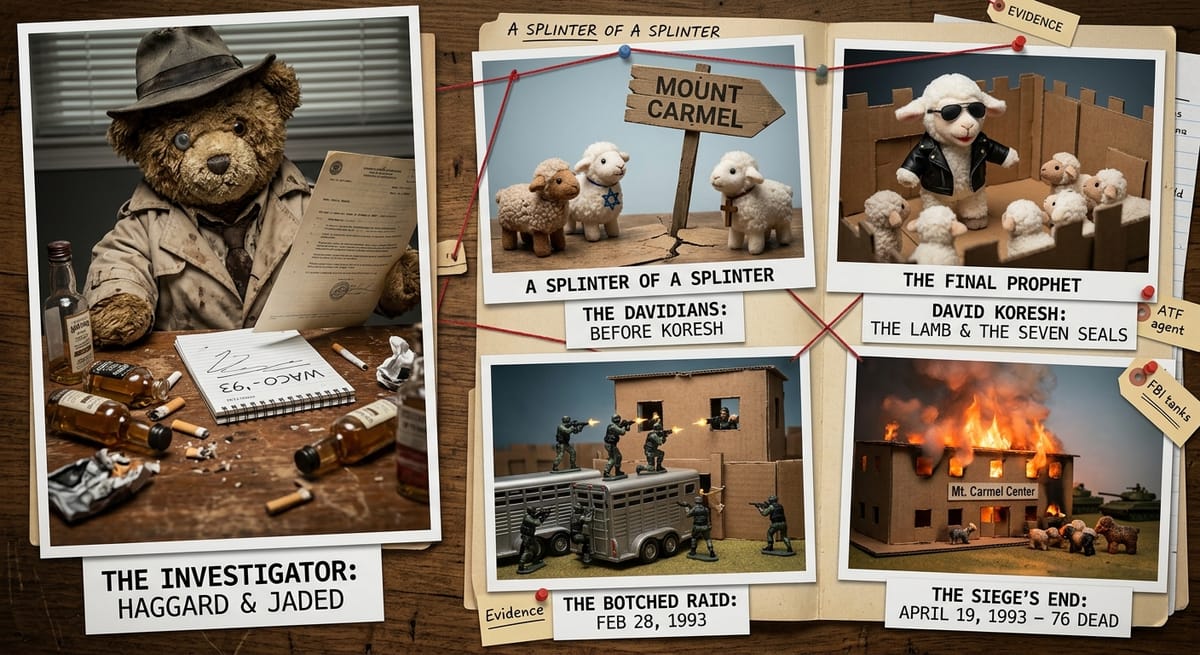
On April 19, 1993, fire destroyed the Branch Davidians' Mount Carmel Center outside Waco, Texas, ending a 51-day standoff that began with a failed raid by the Bureau of Alcohol, Tobacco and Firearms. At least 76 people died that day, David Koresh among them, and about two dozen of the dead were children.1 2 The official finding is that the Davidians set the fire themselves. Critics still argue the government's tanks and tear gas share the blame, and the siege became a founding grievance of the militia movement that produced the Oklahoma City bombing.2 3
To some, Waco was a law enforcement action against an armed apocalyptic sect whose leader was abusing children. To others, it was the government killing the very children it said it was saving. Both stories contain true things, which is why the argument has never ended.
What the Branch Davidians Were Before Koresh Arrived
The Branch Davidians were not Koresh's invention. They were a splinter of a splinter: the Davidians broke from the Seventh-day Adventist Church, and in 1955 Benjamin Roden's Branch group broke from the Davidians after the death of their founder, Victor Houteff. The movement had been waiting for the end of the world on a hill outside Waco for decades before Koresh showed up.1
Koresh was born Vernon Wayne Howell in Houston on August 17, 1959. Expelled from a Seventh-day Adventist congregation, he arrived at Mount Carmel in 1981 and became the protégé of Lois Roden, the group's prophet, which put him on a collision course with her son George.4 1 The feud got strange fast. George Roden dug up a former member's casket and challenged Howell to a resurrection contest; on November 3, 1987, Howell and seven armed followers went to photograph the body as evidence, and a gunfight with Roden followed. Seven of the "Rodenville Eight" were acquitted, the jury hung on Howell, and after Roden was committed to a mental hospital for an unrelated axe killing, Howell paid the back taxes and took the property.1
In 1990 he legally changed his name: David for the king, Koresh for the Hebrew name of Cyrus the Great, the Persian king the Bible calls a messiah.4 He taught that he was the final prophet, the one who would open the Seven Seals of Revelation. In a 1989 teaching he called the "New Light," he said God had told him to father a "House of David" with the women of the group, which meant married men gave up their wives to him.1 In February 1993 the Waco Tribune-Herald reported that he had taken underage "brides," some as young as 12 or 13, and had fathered at least a dozen children.1
The weapons were real too. The ATF's warrant affidavit described inert grenades, black powder and kits of AR-15 and M-16 parts, the kind that can be used to convert semi-automatic rifles into machine guns. Even the affidavit admitted that the parts, on their own, were not necessarily illegal.1
The ATF Went Ahead After Learning Koresh Knew It Was Coming
The plan, code-named "Showtime," depended on one thing: surprise.1 On the morning of February 28, 1993, it was already gone. A local TV crew that had been tipped off about the raid asked a mail carrier for directions to the compound, and the mail carrier happened to be Koresh's brother-in-law. Koresh then told the ATF's own undercover agent inside, Robert Rodriguez, that he knew agents were coming. Rodriguez made an excuse and left, and the raid commanders learned that Koresh knew. The raid went ahead anyway.1 5
The Treasury Department's review put it bluntly: "Despite knowing in advance that the element of surprise was lost, the raid commanders made the decision to go forward. This decision was brutally exploited by Koresh and his followers."5 Agents arrived in cattle trailers at about 9:45 a.m. Who fired first has never been settled. Agents testified that the Davidians did; one agent first told investigators he thought the opening shots came from agents firing at the Davidians' dogs.1
When the shooting stopped, four ATF agents were dead: Steve Willis, Robert Williams, Todd McKeehan and Conway LeBleu. The Treasury review counted 20 agents wounded. Six Davidians were dead.1 5 The Treasury review also found that the two field commanders, Phillip Chojnacki and Charles Sarabyn, altered the written raid plan after the disaster and tried to hide the changes from investigators.6
How 51 Days of Siege Made Things Worse
The FBI took over. Its negotiators had real early success: between February 28 and March 23, 35 people left Mount Carmel, many of them children. After March 23, only two more came out.2 Koresh kept promising to surrender and kept not doing it, eventually saying he would leave once he had finished writing his interpretation of the Seven Seals.1
Meanwhile the tactical side of the FBI worked against the negotiators. Agents cut the power, drove armored vehicles through the property, crushed the Davidians' cars and blasted the building all night with recordings that included jet engines, chanting and rabbits being slaughtered. Negotiators complained that the tactical commanders were undercutting them.1 Religious scholars warned the FBI that this kind of pressure would confirm Koresh's prophecy that the end-times battle had arrived. The Justice Department's own later report recorded the split.1
Why the FBI Chose CS Gas, and What It Didn't Know
Attorney General Janet Reno, newly appointed, approved the FBI's plan after being told the situation was deteriorating and that children inside were being abused. She later said her main worry was whether the tear gas could permanently harm the people inside, especially the children, and that she would never have approved the plan if she had been told it could be lethal. The expert who advised her said it could not cause death or permanent injury.2
On the morning of April 19, combat engineering vehicles punched holes in the walls and sprayed in CS, a liquid aerosol of tear gas dissolved in methylene chloride. FBI agents also fired tear gas rounds through the windows.1 2 CS is barred as a method of warfare under the Chemical Weapons Convention but legal for police at home.8 The Danforth investigation later reported that no forensic pathologist had found any indication the gas killed anyone. But one of its own toxicologists warned that, for people unable to leave a room, high levels of CS could "significantly contribute to or even cause lethal effects." A 1996 House report had gone further, saying CS in the enclosed concrete room where women and children gathered "could have been a proximate cause" of some of the deaths attributed to asphyxiation.2
Who Started the Fire at Waco?
The official finding is that the Davidians did. Just after noon, fires broke out in at least three places in the building at nearly the same time.1 2 FBI listening devices inside had recorded Davidians that morning talking about pouring fuel, and surviving Davidians later told investigators they saw others spreading it.2 The Special Counsel, former Senator John Danforth, concluded in November 2000 that the government "did not cause the fire" and "did not direct gunfire at the Branch Davidian complex."2 The Davidians, he wrote, "spread fuel throughout the main structure of the complex and ignited it in at least three places," and "killed some of their own people by gunfire, including at least five children."2
Danforth also found something the government had hidden for six years. At 8:08 that morning, an FBI agent had fired three pyrotechnic tear gas rounds, the kind that can start fires, at a concrete construction pit about 75 feet from the living quarters. Danforth concluded those rounds did not start the fire four hours later. He also found that certain FBI and Justice Department officials had failed to disclose the rounds to the Attorney General, Congress, the courts and the public until August 1999, and that some of them obstructed his investigation.2
Critics argue that the official account is too tidy. They point to the tanks that collapsed walls and may have blocked escape routes, to the flammable gas mixture, and to the years the government spent concealing the pyrotechnic rounds. Some argue that live rounds were fired by agents. That claim was investigated, and the Special Counsel rejected it.1 2 What is not disputed is that nine people got out, that no fire trucks were on site, and that the trucks dispatched were held at a checkpoint before being allowed through.1
The Names of the Dead
At least 76 people died on April 19. The Special Counsel put the total for both days at "at least 82," counting the six killed in the February raid but not the two unborn children, and said the exact number could not be known because of how the bodies burned in the concrete room where most of the women and children were found.2
Among them: David Koresh, 33. Steve Schneider, 43, his closest aide. Judy Schneider, 41. Mayanah Schneider, 2. Katherine Andrade, 24. Chanel Andrade, 1. Nicole Gent Little, 24, who was pregnant, and Dayland Gent, 3, and Page Gent, 1. Cyrus Koresh, 8, and Star Koresh, 6. Melissa Morrison, 6. Serenity Jones, 4, Chica Jones, 2, and Little One Jones, 2. Raymond Friesen, 76, the oldest. Of the dead named on the list compiled by survivor Clive Doyle and republished by KWTX, 22 were under 18.7
The four ATF agents killed on February 28 are remembered on a plaque at the site, where a small chapel built years later still serves the remaining Branch Davidians.1
What the Courts and the Government Concluded
Twelve surviving Davidians were indicted in August 1993; one pleaded guilty before trial. In February 1994 the jury acquitted all eleven defendants of murder and conspiracy, and four of every charge. Five were convicted of aiding and abetting the voluntary manslaughter of federal agents, and two others on weapons charges.9 In June 1994 Judge Walter Smith sentenced eight Davidians, including Ruth Riddle on a firearms count, to terms of five to 40 years.10 11 In 2000, after the Supreme Court ruled that a jury, not a judge, had to decide the machine gun question, Judge Walter Smith cut 25 years from five of the sentences. All the Davidians were out of prison by July 2007.1
The survivors and families sued. A federal advisory jury found in 2000 that the government had not acted negligently, and the courts entered a "take-nothing" judgment, upheld on appeal in 2003.1 In October 1995 the ATF decided that "dynamic entry" raids would be planned only after all other options had been considered.1
The Line From Waco to Oklahoma City
The most consequential fallout came two years to the day after the fire. On April 19, 1995, Timothy McVeigh bombed the Alfred P. Murrah Federal Building in Oklahoma City, killing 168 people, including 19 children. The FBI's own history of the case says McVeigh's hatred of the government intensified after the Waco standoff, and he cited Waco and Ruby Ridge as his reasons.3 1
The date became a symbol in anti-government circles, and Waco became shorthand for a whole worldview. For the libertarian right, it means government tyranny against a church. For law enforcement, it means a cult leader using his followers as human shields. For the families of the four agents and the Davidians alike, it means a catastrophe that institutions with the information and the authority to prevent it did not prevent.
Frequently Asked Questions
Who started the Waco fire? The official answer, from the Justice Department in 1993 and Special Counsel John Danforth in 2000, is that Davidians spread fuel and lit it in at least three places.2 Critics argue that the FBI's tanks, tear gas and concealed pyrotechnic rounds helped cause or worsen the disaster. Danforth found the pyrotechnic rounds were fired hours earlier at a separate concrete pit and did not start the fire.2
How many children died at Waco? About two dozen, and the exact count depends on who is counting. The survivors' list republished by KWTX names 22 people under 18 among the dead of April 19, and two of the women were pregnant.7 Published totals range from about 20 to 28.1
Why did the ATF raid the Branch Davidians? To serve search and arrest warrants on weapons charges, chiefly the suspicion that the group was converting semi-automatic rifles into machine guns and holding destructive devices. The affidavit also discussed alleged child abuse.1 2
Did the FBI shoot at the Davidians during the fire? The Special Counsel concluded it did not, and that the "flashes" critics saw in infrared footage were reflected sunlight. He did find that at least 20 Davidians had been shot, which he attributed to other Davidians.2
What happened to the survivors? Nine people escaped the fire. Several were later convicted of manslaughter or weapons charges, with sentences reduced in 2000, and all had been released by July 2007.1
Part of Major Cults: ← Back to series hub
Related reading: Standoffs and Sieges hub · Cults hub · Ruby Ridge · The Oklahoma City bombing
─────────
Sources:
- "Waco siege." Wikipedia (citing the Justice Department, Treasury and House reports, trial records and contemporary reporting). en.wikipedia.org
- Danforth, John C. Final Report to the Deputy Attorney General Concerning the 1993 Confrontation at the Mt. Carmel Complex, Waco, Texas. Office of Special Counsel, November 8, 2000. PDF
- Federal Bureau of Investigation. "Oklahoma City Bombing." FBI History, Famous Cases. fbi.gov
- "David Koresh." Wikipedia. en.wikipedia.org
- U.S. Department of the Treasury. Report of the Department of the Treasury on the Bureau of Alcohol, Tobacco, and Firearms Investigation of Vernon Wayne Howell Also Known as David Koresh, September 1993, "Conclusion." Wikisource
- Thomas, Pierre. "Waco Probe Faults ATF in Cult Raid." Washington Post, September 29, 1993. washingtonpost.com
- "30 Years Ago: FBI moves to end standoff at Mt. Carmel; Davidian leader among dozens killed in blazing inferno." KWTX, April 19, 2023 (includes the list of Davidians who died on April 19, 1993). kwtx.com
- "CS gas." Wikipedia (citing Article I, paragraph 5 of the Chemical Weapons Convention). en.wikipedia.org
- "Branch Davidians acquitted of murder conspiracy charges." UPI, February 26, 1994. upi.com
- "Davidians get sentences up to 40 years." UPI, June 17, 1994. upi.com
- United States v. Branch, 91 F.3d 699 (5th Cir. 1996). courtlistener.com
Further reading (books cited on the earlier versions of this page):
- Thibodeau, David, and Leon Whiteson. A Place Called Waco: A Survivor's Story. PublicAffairs, 1999 (reissued by Hachette Books in 2018 as Waco: A Survivor's Story).
- Reavis, Dick J. The Ashes of Waco: An Investigation. Simon & Schuster, 1995.
- Tabor, James D., and Eugene V. Gallagher. Why Waco? Cults and the Battle for Religious Freedom in America. University of California Press, 1995.
- Wright, Stuart A., ed. Armageddon in Waco: Critical Perspectives on the Branch Davidian Conflict. University of Chicago Press, 1995.