Jonestown: 918 Dead in the Jungle
On November 18, 1978, 918 Americans died in the Guyanese jungle — 304 of them children — in the largest deliberate mass death of U.S. civilians before 9/11.
Jonestown: 918 Dead in the Jungle
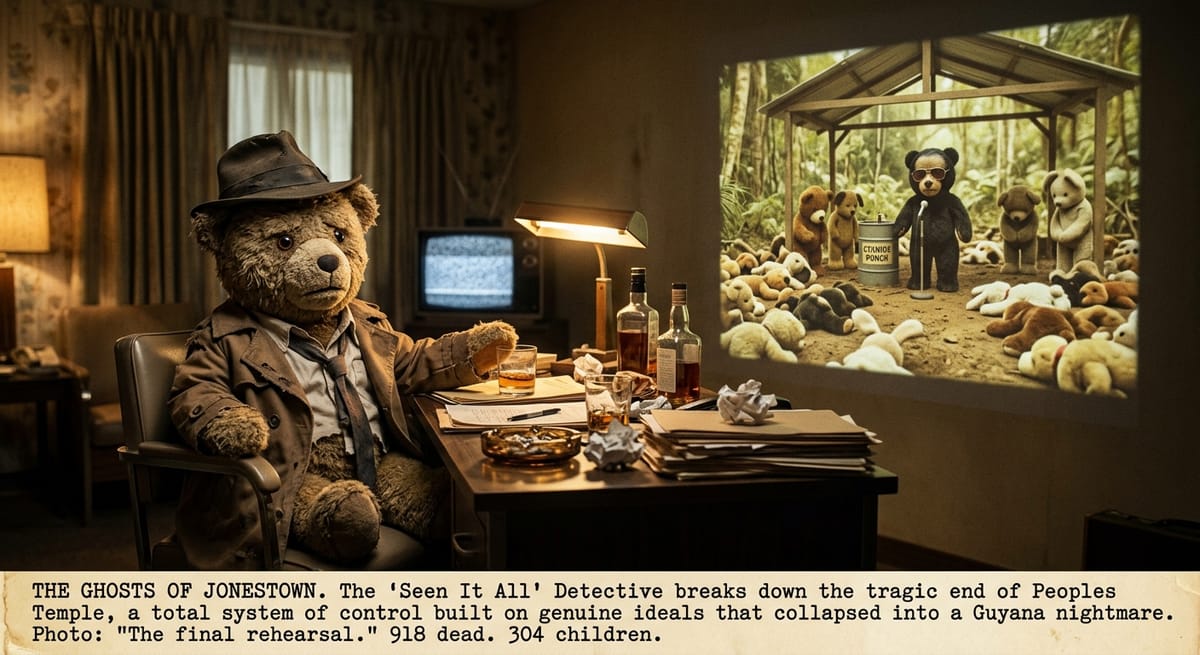
On November 18, 1978, in a remote agricultural settlement carved out of the Guyanese jungle, 918 Americans died in the largest deliberate mass death of American civilians prior to September 11, 2001. The dead included 304 children. They died from cyanide poisoning — most of them drinking a flavored punch laced with potassium cyanide and sedatives, though the degree to which the drinking was voluntary has been debated by survivors, investigators, and historians for nearly five decades. Some members were injected. Some were shot. Some appear to have been physically forced. The audio recording of the final hours, recovered from the pavilion where Jim Jones directed the event he called “revolutionary suicide,” captures screaming, crying children, and the voice of a man who had spent twenty years building toward this moment telling his followers that death was an act of protest against an unbearable world.^1^
Jonestown — formally the Peoples Temple Agricultural Project — was the endpoint of a movement that had begun in Indianapolis in the 1950s, migrated to Northern California, attracted thousands of members across racial and economic lines, and been endorsed by politicians, journalists, and civic leaders who either didn’t see what Jones was building or chose not to look. The massacre didn’t emerge from nowhere. It emerged from a system of control that had been visible, in pieces, for years — and that the institutions responsible for oversight had failed to interrupt at every stage.^2^
How Jim Jones Built a Totalitarian Church Out of Genuine Social Work
Jim Jones founded the Peoples Temple in Indianapolis in 1955, and the organization’s early years were, by most accounts, genuinely progressive. Jones preached racial integration during a period when Indianapolis was deeply segregated. He adopted children of multiple races. He ran social service programs — free meals, drug rehabilitation, employment assistance — that served communities the mainstream churches had abandoned. The Temple attracted Black members in particular, offering a space where racial equality was practiced rather than merely preached, and Jones positioned himself as a white pastor who had committed his life to the Black community.^1^
The sincerity of those early commitments has been debated, but their effects were real. By the time the Temple relocated to Ukiah, California, in 1965 — Jones claimed he’d chosen the location because it would survive nuclear war, though the reality was likely more pragmatic — the organization had built a membership base that was genuinely multiracial, genuinely engaged in social justice work, and genuinely loyal to a leader who presented himself as a prophet with supernatural healing abilities.^3^
The California years saw the Temple grow into a political force. Jones moved the headquarters to San Francisco in the early 1970s and leveraged his congregation’s size and organizational discipline into political influence that was significant by any measure. Temple members staffed phone banks, canvassed neighborhoods, and delivered votes in quantities that attracted the attention of politicians at every level. Harvey Milk, George Moscone, Willie Brown, and Rosalynn Carter all had documented contacts with Jones. He was appointed chairman of the San Francisco Housing Authority in 1976. The Temple was, on its public-facing surface, exactly what American progressive politics claimed to want: a multiracial, community-oriented organization that turned faith into action.^1^
Behind the surface, Jones was building a totalitarian system. He controlled members’ finances, confiscating paychecks and savings. He staged fake healings using chicken livers and other props. He conducted “catharsis sessions” in which members were publicly humiliated, beaten, and forced to confess fabricated transgressions. He demanded sexual access to both male and female members, framing compliance as spiritual devotion. He enforced isolation from family members outside the Temple and punished attempts to leave with threats, surveillance, and physical violence.^2^
The duality — genuine social service on the outside, totalitarian abuse on the inside — was the Temple’s defining characteristic, and it’s the reason the organization survived public scrutiny for as long as it did. Journalists who investigated received threats. Members who left were harassed. And the political figures who benefited from the Temple’s organizational capacity had every incentive to avoid looking too closely at the organization that was delivering their voters.
Why Jones Moved a Thousand People to the Guyanese Jungle
By 1977, the walls were closing in. The magazine New West was preparing an exposé based on interviews with defectors, and Jones — who had been monitoring media inquiries through a network of informants — decided to accelerate the relocation plan he’d been developing for years. The Peoples Temple had leased nearly four thousand acres of jungle in the Guyanese interior, ostensibly for an agricultural project. In the summer of 1977, Jones and approximately a thousand followers moved to the settlement.^1^
Jonestown was presented to its residents as a utopia — a socialist paradise free from the racism and corruption of the United States. The reality was a labor camp. Members worked six-day weeks in tropical heat, clearing jungle, farming, and building infrastructure. Food was inadequate. Medical care was minimal. Armed guards patrolled the perimeter. Jones, whose drug use had escalated dramatically, broadcast rambling addresses over the compound’s loudspeaker system at all hours, conducting loyalty tests and rehearsing mass suicide — events he called “White Nights” — with increasing frequency.^3^
Members who attempted to leave were punished. Those who succeeded and reached the United States reported conditions that prompted Congressman Leo Ryan of California to organize a fact-finding delegation. Ryan flew to Georgetown, Guyana, in November 1978 with a group that included journalists, congressional staff, and Concerned Relatives — a support group of former members and family members who had been trying to draw attention to conditions in Jonestown for months.^2^
What Happened on November 18, 1978
Ryan’s delegation arrived at Jonestown on November 17 and spent the night. Several Temple members passed notes to the delegation asking to leave. On the morning of November 18, as Ryan prepared to depart the settlement with the defectors, a Temple member attacked Ryan with a knife. The delegation fled to the Port Kaituma airstrip, seven miles away. As they boarded two small planes, a truck carrying armed Temple members arrived at the airstrip and opened fire. Ryan, three journalists — Don Harris, Bob Brown, and Greg Robinson — and one defector, Patricia Parks, were killed. Several others were wounded.^1^
Back at Jonestown, Jones assembled the community at the central pavilion. The audio recording that captured the next forty-four minutes is the primary source document for what happened. Jones told the assembled members that Ryan’s party had been attacked and that the Guyanese military would retaliate. He told them that their enemies would torture their children. He told them that the only dignified option was revolutionary suicide — a concept he had been rehearsing with them for months.^3^
The cyanide was mixed into vats of grape-flavored punch. Children were given the poison first — administered by syringe into the mouths of infants, given in cups to older children by their parents, in some cases forced. Adults drank next. Some did so willingly, having been conditioned by years of White Night rehearsals and ideological preparation. Others resisted and were physically restrained and injected. A few escaped into the jungle.^1^
Jones died of a gunshot wound to the head. Whether it was self-inflicted or administered by an aide has never been definitively established. By the time Guyanese military forces reached the compound the following day, 918 people were dead — bodies piled on top of each other in the pavilion and scattered across the grounds. The tropical heat began decomposition immediately, and the logistics of recovering, identifying, and repatriating the remains stretched over weeks and involved the largest peacetime deployment of U.S. military mortuary services in history.^2^
Why the System Saw It Coming and Did Nothing
The Jonestown massacre was not an unforeseeable event. It was the predictable conclusion of a pattern that had been documented, reported, and ignored by the institutions that had the authority to intervene.
Defectors had been reporting abuses to law enforcement and media for years. The Concerned Relatives group had written to Congress, the State Department, and the FCC (Jones held a ham radio license) detailing conditions in Jonestown — forced labor, medical neglect, physical punishment, suicide rehearsals. The U.S. Embassy in Georgetown had received reports from consular officials who visited the settlement and observed conditions that raised concerns.^1^
The political connections that Jones had cultivated during the Temple’s California years provided insulation that deflected scrutiny at critical moments. The politicians who had accepted the Temple’s organizational support were reluctant to investigate an ally. The law enforcement agencies that received defector reports treated them as domestic disputes rather than criminal complaints. The State Department treated the situation as a diplomatic inconvenience rather than a human rights emergency.^3^
The fundamental failure was one of categorization. The Peoples Temple was treated as a church — an organization protected by the First Amendment and insulated by the cultural assumption that religious communities are self-governing entities whose internal affairs are not the business of the state. The mechanisms of control that Jones employed — financial exploitation, sexual coercion, physical violence, isolation, rehearsed suicide — were criminal acts, but they occurred within a framework that the legal system classified as religious practice, and the classification provided cover that a secular organization would never have enjoyed.^2^
The Phrase “Drinking the Kool-Aid” Buries What Actually Happened
The phrase “drinking the Kool-Aid” — which entered American English as a synonym for blind obedience — trivializes the deaths of 918 people, 304 of them children, most of whom had no meaningful choice in the matter. The phrase persists because it serves a function: it allows the public to process Jonestown as a story about foolish people who followed a madman, rather than as a story about institutional failure, political complicity, and the structural vulnerability of marginalized communities to charismatic exploitation.^1^
The members of the Peoples Temple were not fools. They were, disproportionately, Black Americans who had been systematically failed by every institution that was supposed to serve them — churches that practiced segregation, governments that enforced it, communities that tolerated it — and who found in the Temple a space that appeared to offer what America wouldn’t: equality, community, and purpose. Jim Jones exploited that need with a precision that was criminal, and the system that should have stopped him didn’t, because the people he was exploiting were the same people the system had never prioritized in the first place.
918 names. 304 of them children. The jungle has reclaimed the settlement. The audio recording is still available, and it is exactly as unbearable as you’d expect. The institutional failures that made Jonestown possible — the deference to religious authority, the political complicity, the willingness to look away from abuse within marginalized communities — have been studied, documented, and discussed. They have not been structurally resolved.
Part of Major Cults — ← Back to series hub
─────────
Sources:
- Reiterman, Tim and Jacobs, John. Raven: The Untold Story of the Rev. Jim Jones and His People. Dutton, 1982.
- Scheeres, Julia. A Thousand Lives: The Untold Story of Jonestown. Free Press, 2011.
- Moore, Rebecca. Understanding Jonestown and Peoples Temple. Praeger, 2009.
- Federal Bureau of Investigation. Jonestown case files (RYMUR), declassified.
- San Francisco Chronicle. Peoples Temple coverage archives, 1972-1978.