Reagan and the War on Drugs: How a Slogan Became a Machine
Reagan quadrupled the drug enforcement budget between 1981 and 1989 while slashing treatment. The mandatory minimums Just Say No and military policing he built ran for three decades after he left.
Reagan and the War on Drugs: How a Slogan Became a Machine
Ronald Reagan did not invent the War on Drugs — Richard Nixon did, in 1971. What Reagan did was take Nixon’s rhetorical framework, attach a national emergency to it, and convert it from a political slogan into an institutional machine.^1^ Between 1981 and 1989, the Reagan administration restructured federal drug enforcement, passed legislation that created the mandatory minimum sentencing era, and deployed the language of war — moral clarity, total commitment, no negotiation — to transform a public health crisis into a law enforcement crusade. The consequences are still being counted.
Reagan Quadrupled the Drug Budget and Shifted It Entirely Toward Enforcement
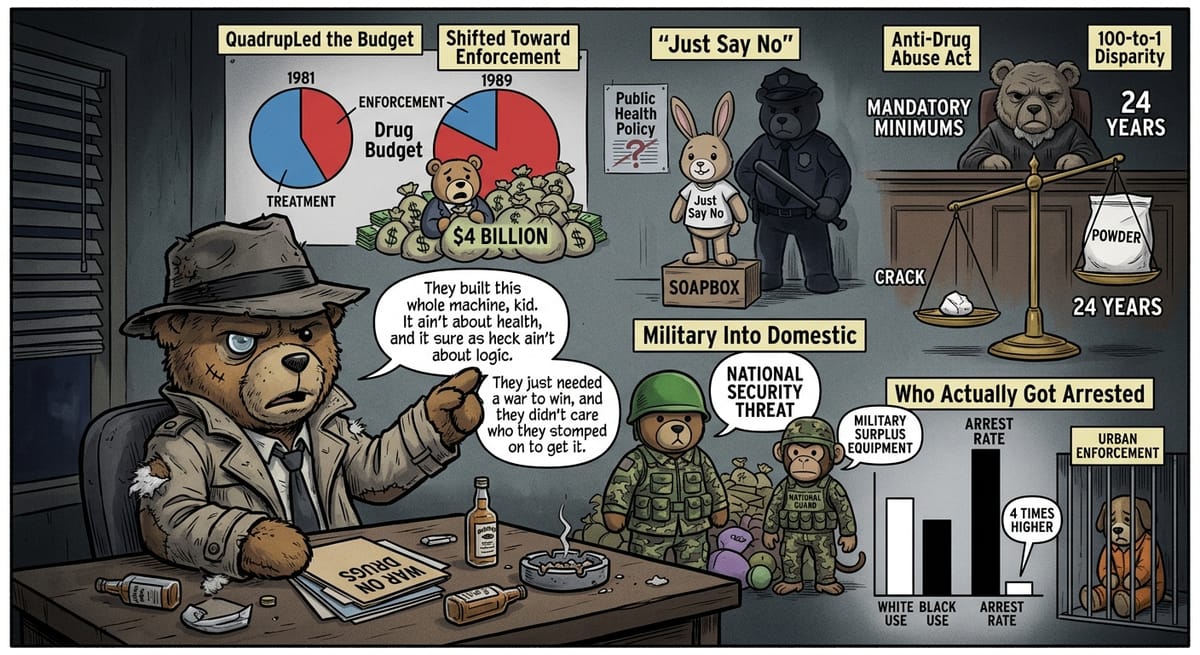
When Reagan took office in January 1981, the federal drug enforcement budget was approximately $1.5 billion annually. By the time he left office in January 1989, it had grown to more than $4 billion.^1^ That quadrupling was not uniform. Dan Baum’s 1996 book Smoke and Mirrors shows that the Reagan era shifted the balance decisively toward criminal enforcement and away from treatment: in the 1981 budget, treatment and prevention received roughly equal funding to enforcement. By 1986, enforcement was consuming two-thirds of the drug budget.
This was a deliberate policy choice. Reagan’s domestic policy team viewed addiction primarily as a moral failure and drug trafficking as a criminal threat requiring military-style response, not a public health problem requiring medical infrastructure. That framing determined where money went, what agencies expanded, and what legislation Congress was asked to pass.
“Just Say No” Was Effective Marketing and Useless Public Health Policy
Nancy Reagan’s “Just Say No” campaign, launched in 1982, became the public face of Reagan-era drug policy. The campaign’s core message — that drug use was a choice, and the right choice was refusal — was effective marketing and nearly useless public health intervention. Studies of drug prevention programs in the early 1980s consistently found that awareness campaigns without accompanying economic opportunity, mental health resources, or addiction treatment produced no measurable reduction in drug use.^4^
The campaign also served as rhetorical cover for enforcement expansion. If drugs were a simple moral choice and the right choice was obvious, then people who made the wrong choice were not sick — they were criminal. That logic justified enforcement over treatment in budget allocation, and versions of it are still operative in drug policy debates today.
The 1986 Anti-Drug Abuse Act Created the Sentencing Architecture That Lasted 24 Years
The single most consequential legislative event of the Reagan drug era was the Anti-Drug Abuse Act, signed into law on October 27, 1986. The law established mandatory minimum prison sentences for drug offenses, with the specific architecture of those minimums — the 100-to-1 sentencing disparity between crack cocaine and powder cocaine — defining the racial dimensions of the War on Drugs for the next generation.
The law passed six weeks after the death of Len Bias, the University of Maryland basketball star whose cocaine-related death on June 19, 1986 had generated enormous congressional pressure to act. The bill moved through Congress with almost no committee hearings, no expert testimony on the likely effects of mandatory sentencing, and no analysis of the racial distribution of enforcement. The House passed it 392-16. The Senate passed it 97-2.
The 100-to-1 disparity was not based on pharmacology. Crack cocaine and powder cocaine are chemically identical, producing the same effects through different delivery mechanisms. The disparity was based on impressions drawn from early 1986 media coverage that was heavy on anecdote and light on data. By the time researchers had the longitudinal data to evaluate those assumptions, the law had been on the books for nearly a decade and had produced a generation of mandatory minimum sentences.^2^
Reagan Pushed the Military Into Domestic Drug Enforcement
Reagan’s drug war also pushed the boundaries of military involvement in domestic law enforcement. The Posse Comitatus Act of 1878 prohibits the use of federal military forces in civilian law enforcement. In 1981, Congress amended the act to allow military assets — ships, planes, intelligence — to support drug interdiction. The National Guard was increasingly deployed in drug enforcement operations throughout the decade, and in 1986, Reagan signed National Security Decision Directive 221, which classified drug trafficking as a national security threat — providing legal cover for deeper military involvement in what had previously been a civilian law enforcement domain.
The practical effect was to militarize the drug war’s tools and posture. Police departments received military surplus equipment. Interdiction became the dominant paradigm for both border enforcement and local policing. SWAT team deployments, which had numbered in the hundreds annually in the early 1980s, were growing toward the tens of thousands by the late 1980s, driven largely by drug enforcement. Criminologist Peter Kraska documented this militarization trend in his 2001 edited volume Militarizing the American Criminal Justice System, tracing the parallel growth of drug war funding and paramilitary police capacity.^3^
Who Actually Got Arrested — and Why It Looked Nothing Like Who Used Drugs
By the late 1980s, the pattern of drug war enforcement was well-documented: Black Americans were arrested, charged, and imprisoned for drug offenses at rates dramatically disproportionate to their share of drug use. The National Household Survey on Drug Abuse, conducted throughout the 1980s, consistently found that white Americans used illegal drugs at rates roughly equivalent to or higher than Black Americans.^4^ In 1989, the arrest rate for drug offenses among Black Americans was more than four times the rate among white Americans, according to FBI Uniform Crime Report statistics.
The disparity was not driven by behavior. It was driven by where police looked. Drug enforcement in the Reagan era was concentrated in urban areas, policed heavily and with few legal resources to push back against aggressive tactics. Suburban and rural drug markets — where white Americans bought and used drugs at comparable rates — received far less enforcement attention. The result was a criminal justice system that processed drug criminality through a lens that was explicitly geographic and implicitly racial.
Containment
The Reagan administration did not set out to build a mass incarceration system. What it built was a set of tools — mandatory minimums, expanded enforcement budgets, military-style rhetoric and equipment — that interacted with an existing enforcement pattern to produce that outcome. By 1990, the federal prison population had increased 65 percent since Reagan took office. State prison populations had grown even faster. The people filling those prisons were overwhelmingly poor, overwhelmingly from cities, and overwhelmingly Black and Latino. Reagan left office in 1989. The machine he built ran for another three decades.
Part of The Crack Epidemic — ← Back to series hub
─────────
Sources:
- Baum, Dan. Smoke and Mirrors: The War on Drugs and the Politics of Failure. Little, Brown, 1996.
- Alexander, Michelle. The New Jim Crow: Mass Incarceration in the Age of Colorblindness. The New Press, 2010.
- Kraska, Peter, ed. Militarizing the American Criminal Justice System. Northeastern University Press, 2001.
- Massing, Michael. The Fix. Simon & Schuster, 1998.
- Musto, David. The American Disease: Origins of Narcotic Control. Oxford University Press, 1987.