Freeway Rick Ross: The Biggest Crack Dealer in American History
Ricky Donnell Ross moved more than $600 million in crack cocaine through Los Angeles in the 1980s by buying directly from Contra-connected Nicaraguan suppliers — undercutting every competitor.
Freeway Rick Ross: The Biggest Crack Dealer in American History
Ricky Donnell Ross did not set out to become the most prolific crack cocaine distributor in American history. He grew up in South Central Los Angeles wanting to be a tennis player — and was good enough that a scholarship seemed reachable, until a paperwork problem ended his college eligibility in 1979.^1^ What he built over the next decade was not just a drug operation. It was a supply chain, a distribution network, and a pricing system that reshaped the crack economy of an entire city.
Ross’s Advantage Was Wholesale Price, Not Street Muscle
Ricky Ross was born in Troup, Texas, in 1960, and moved to Los Angeles as a child. He attended Dorsey High School, where his tennis game attracted notice — a scholarship to California State University, Los Angeles was within reach until it emerged that he had not learned to read fluently enough to meet admissions requirements. The discovery ended his athletic path and left him at 19 with no obvious direction. By 1979 he had made his first drug sale. Within two years, he had a supplier.
That supplier was Danilo Blandón, a Nicaraguan national whose network was tied to Contra rebel financing in Nicaragua — a connection that would later become the subject of congressional inquiry. Ross met Blandón around 1982. The partnership would prove to be the central transaction of the crack epidemic in Los Angeles.
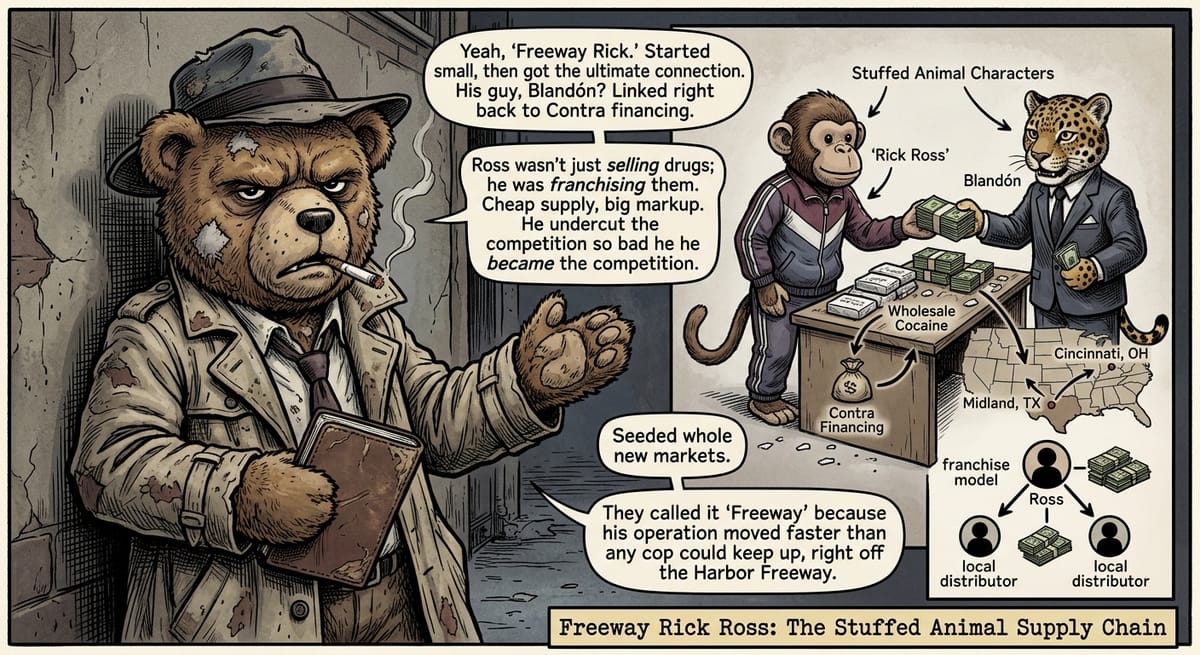
Blandón’s connection gave Ross access to cocaine at prices that undercut every other supplier in Los Angeles. Where street distributors in the early 1980s were paying $35,000 to $40,000 per kilogram of cocaine, Ross was paying as low as $10,000 to $12,000 per kilogram at the peak of his operation, according to trial testimony and reporting by Gary Webb in the San Jose Mercury News in 1996.^1^ That margin made everything else possible.
His Distribution Network Seeded Markets Across the Country
Ross converted the powder to crack and moved it through a network of sub-distributors spread across South Central, Compton, Inglewood, and neighboring cities. At the height of his operation in the mid-1980s, investigators estimated that Ross was selling between $2 million and $3 million worth of crack per day, and had moved more than $600 million worth of product through his network over the decade. He employed hundreds of people across multiple cities, and his pricing — cheap, consistent, and reliable — effectively set the market rate for crack in Los Angeles.
He earned the nickname “Freeway Rick” because he operated near the Harbor Freeway, though it was also shorthand for the scale of what he had built — a road that ran in every direction, moving product faster than anyone had done before him.
What made Ross different from other major distributors was not just volume. His network exported Los Angeles crack to cities across the country — Midland, Texas; Cincinnati, Ohio; Kansas City, Missouri — seeding local operations that had not yet developed crack markets of their own. Federal prosecutors who tracked his operation later described it as a franchise model: Ross provided product, pricing, and enough infrastructure that local distributors could establish operations without the setup costs that had previously made entry into drug distribution difficult. Cities that might have developed crack economies more slowly instead received a supply chain that was already mature and efficient. The acceleration mattered because the harm — addiction, violence, incarceration — accelerated with it.
How Did the Government’s Own Informant Become His Supplier — Then Arrest Him Again?
Ross was arrested in 1989 and sentenced to federal prison. He was released in 1994 after cooperating with federal prosecutors against Blandón and others. Blandón himself received a sentence of less than a year despite having been identified as Ross’s primary supplier — a disparity that would not go unnoticed.
Ross was arrested again in 1995 in a sting operation engineered by Blandón, who was by then working as a paid DEA informant. The man who had supplied Ross with cocaine for years, at prices that made his empire possible, was now the instrument of his second arrest. In 1996, Ross was sentenced to life in prison under federal mandatory minimum statutes — the same 100-to-1 crack sentencing structure that Congress had passed in 1986. That sentence was reduced in 2009 after appellate review, and he was released after serving twelve years.^2^
Gary Webb’s 1996 series in the San Jose Mercury News, “Dark Alliance,” tied Blandón’s network — and by extension Ross’s operation — to CIA-connected Contra financing, igniting a national controversy covered in full in that piece.
Containment
Ricky Ross’s operation ended. The crack trade in Los Angeles did not end with him. The network he built outlasted him because the conditions that made it possible — cheap supply, concentrated poverty, minimal legal risk for street-level workers relative to their income alternatives — continued to hold. What Ross demonstrated is that a supply chain advantage, applied to a product with extreme addiction properties and sold into an economically desperate community, can achieve scale that a formal business would envy. The fact that what he built was also destroying the neighborhoods that sustained it is the part that doesn’t make the franchise model look as clean.
Part of The Crack Epidemic — ← Back to series hub
─────────
Sources:
- Webb, Gary. Dark Alliance: The CIA, the Contras, and the Crack Cocaine Explosion. Seven Stories Press, 1998.
- Parenti, Christian. Lockdown America: Police and Prisons in the Age of Crisis. Verso, 1999.
- Cockburn, Alexander and Jeffrey St. Clair. Whiteout: The CIA, Drugs and the Press. Verso, 1998.
- United States Senate Select Committee on Intelligence. Report on Alleged CIA Knowledge of Contra Drug Trafficking. U.S. Government Printing Office, 1998.
- Reinarman, Craig and Harry Levine, eds. Crack in America: Demon Drugs and Social Justice. University of California Press, 1997.