Len Bias and the 1986 Drug Laws: How One Death Changed Sentencing
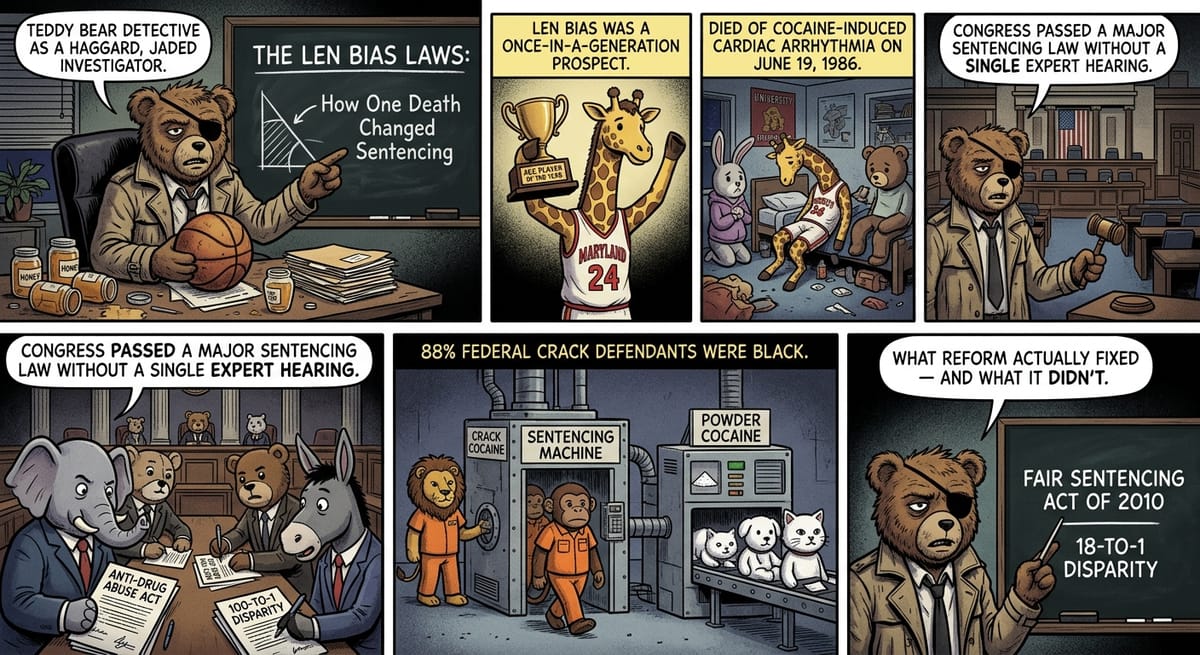
Len Bias died from powder cocaine in June 1986. Six weeks later Congress passed mandatory minimums with a 100-to-1 crack disparity — with no hearings no experts and no analysis of who would pay.
Len Bias and the 1986 Drug Laws: How One Death Changed Sentencing
Len Bias, the University of Maryland forward and second overall pick in the 1986 NBA Draft, died of a cocaine-induced cardiac arrhythmia on June 19, 1986 — two days after being selected by the Boston Celtics.^1^ His death did not cause the Anti-Drug Abuse Act of 1986. But it provided the emotional detonator for legislation that had been building pressure for months, and Congress used it to pass some of the harshest drug sentencing laws in American history within six weeks, with almost no deliberation, no expert testimony, and no analysis of who would actually be affected.
Len Bias Was a Once-in-a-Generation Prospect
Bias grew up in Landover, Maryland, and played his college ball at the University of Maryland from 1982 to 1986. By his senior year, he was one of the best players in the country — a 6‘8” forward averaging 23.2 points per game, named ACC Player of the Year. The Boston Celtics selected him second overall on June 17, 1986. Two days later, in a dormitory room at College Park, Bias collapsed after using cocaine with teammates and friends. He was pronounced dead at Leland Memorial Hospital on the morning of June 19.
The medical examiner determined the cause of death to be cocaine intoxication. The precise form — powder, not crack — would become a detail almost entirely lost in the political response. Len Bias became the symbol of the crack epidemic despite dying from powder cocaine, and the law that passed in his wake drew its harshest provisions around crack rather than the drug that actually killed him.^2^
Congress Passed a Major Sentencing Law Without a Single Expert Hearing
House Speaker Tip O’Neill was at his home in Massachusetts when he read about Bias’s death. He returned to Washington and told his caucus that Congress needed to act — fast. The political logic was plain: an election was coming in November 1986, the crack epidemic was front-page news, and constituent pressure to “do something” was intense.
The bill moved through Congress with almost none of the normal deliberative process. There were essentially no committee hearings on the mandatory minimum sentencing provisions.^2^ No pharmacologists testified about the relative addiction profiles of crack versus powder cocaine. No criminologists testified about the likely effects of mandatory minimums on drug use rates or prison populations. No one in a position of legislative authority appears to have asked whether the 100-to-1 disparity between crack and powder cocaine sentencing thresholds was supported by scientific evidence, because the answer — it was not — would have complicated the momentum.
The House passed the bill 392-16. The Senate passed it 97-2. Reagan signed it on October 27, 1986. The law established a five-year mandatory minimum sentence for possession of five grams of crack cocaine, or for trafficking in 50 grams. For powder cocaine, the thresholds were 500 grams and five kilograms, respectively.
The 100-to-1 Disparity Drove Mass Incarceration for a Generation
The 100-to-1 disparity was the law’s defining feature, and its effects were immediate and measurable. Because crack cocaine was concentrated in Black urban communities while powder cocaine was more evenly distributed across racial lines, the disparity subjected Black defendants to mandatory minimum sentences at rates far exceeding those applied to white defendants charged with equivalent drug behavior.
By 1995, the U.S. Sentencing Commission reported that 88 percent of federal defendants convicted of crack cocaine offenses were Black, while only 27 percent of powder cocaine defendants were Black.^3^ The average sentence for a federal crack cocaine conviction was 128 months — nearly 11 years. The average for a powder cocaine conviction was 85 months. The commission recommended that Congress eliminate the disparity. Congress overruled the recommendation in a 1995 vote — the only time in history that Congress has overruled a Sentencing Commission recommendation.
The law also included mandatory minimums for marijuana and other drugs, expanded asset forfeiture provisions, and created new categories of federal offense. But the crack provisions drove the mass incarceration surge that characterized the next fifteen years of federal prosecution.
The Bias Family’s Grief Became Public Property
The Bias family’s grief became public almost immediately. His mother, Lonise Bias, became a drug prevention speaker and anti-drug advocate, traveling the country for decades after his death. A younger brother, Jay Bias, was killed in a shooting in Landover in 1990 — a sequence of losses that turned the family into a case study in the concentrated grief that violent death brings to Black families in America.
The University of Maryland retired Bias’s number 34 in 1988. The Boston Celtics, who had reportedly called him the best forward prospect the organization had ever seen, declined from NBA champions in 1986 to a rebuilding franchise by the late 1980s as Larry Bird’s injuries mounted with no young talent in the pipeline.
What Reform Actually Fixed — and What It Didn’t
The Fair Sentencing Act of 2010, signed by President Barack Obama on August 3, 2010, reduced the crack-to-powder sentencing disparity from 100-to-1 to 18-to-1 and eliminated the five-year mandatory minimum for simple possession of crack cocaine.^5^ The change was meaningful but not retroactive — people already serving sentences under the old law did not automatically receive reductions, though some were later able to petition under the First Step Act of 2018, which made the Fair Sentencing Act’s provisions retroactive.
The 18-to-1 disparity that replaced the 100-to-1 ratio was not based on any pharmacological evidence for differential harm. It was a political compromise, not a scientific conclusion.
Containment
Len Bias died because of a choice he made in a dormitory room two days after the best moment of his professional life. The law that passed in the aftermath of his death affected hundreds of thousands of people who never met him and had nothing to do with that night. The young men who went to federal prison under mandatory minimums triggered by five grams of crack were not responsible for his death, and the deterrent effect of their sentences on drug use was minimal — the research on mandatory minimums consistently shows that sentence length has little effect on drug trafficking behavior. What the law did was take a tragedy and convert it into policy architecture that served political needs in 1986 and served prison populations for years after.
Part of The Crack Epidemic — ← Back to series hub
─────────
Sources:
- Lewis, Michael. “The Ballad of Len Bias.” ESPN The Magazine, 2009.
- U.S. Sentencing Commission. Special Report to Congress: Cocaine and Federal Sentencing Policy. Government Printing Office, 1995.
- Alexander, Michelle. The New Jim Crow: Mass Incarceration in the Age of Colorblindness. The New Press, 2010.
- Baum, Dan. Smoke and Mirrors: The War on Drugs and the Politics of Failure. Little, Brown, 1996.
- Provine, Doris Marie. Unequal Under Law: Race in the War on Drugs. University of Chicago Press, 2007.