Theranos: Elizabeth Holmes and the Fake Blood Test
Elizabeth Holmes built a $9 billion blood-testing company whose core technology didn't work — while real patients received inaccurate results for cancer HIV and thyroid conditions. She got 11 years.
Theranos: Elizabeth Holmes and the Fake Blood Test
Elizabeth Holmes founded Theranos in 2003 at age 19, dropped out of Stanford, and built a blood-testing company valued at $9 billion that couldn’t actually run most of the tests it was selling to patients. The Theranos corporate fraud ran from roughly 2010 through 2016, during which real patients made real medical decisions based on results from a machine that didn’t work — while Holmes collected $945 million from investors who believed her claims.
Part of Corporate Fraud — ← Back to series hub
Who Elizabeth Holmes Was Selling
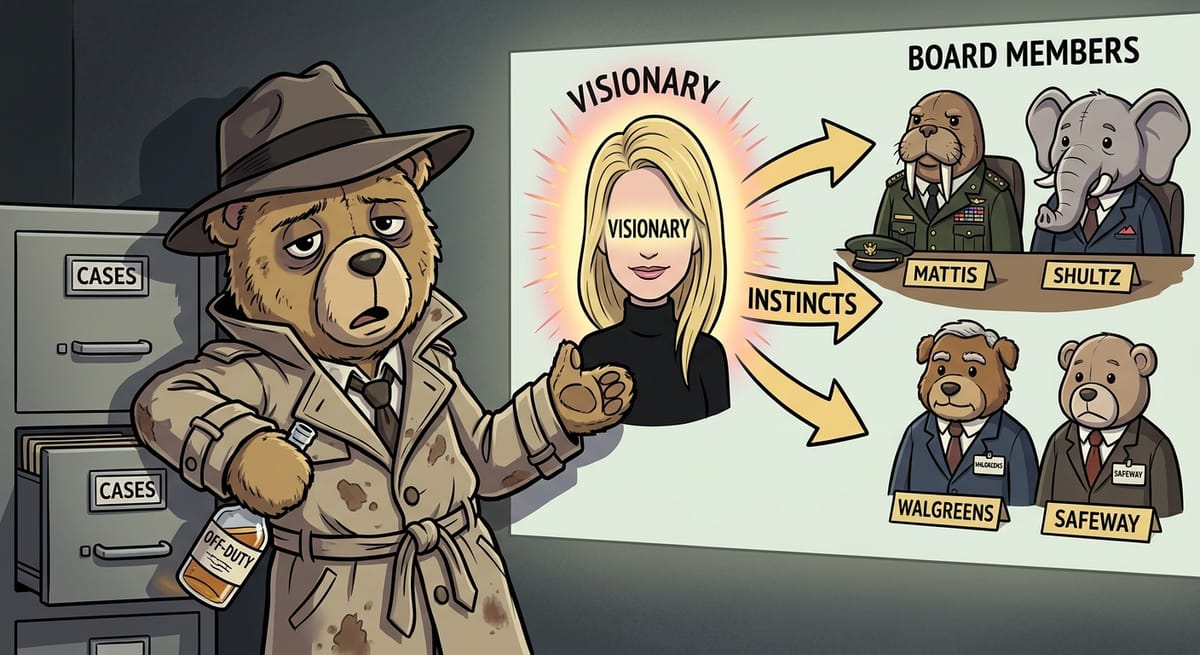
Holmes’s story sold because it fit a familiar American narrative: the young visionary who trusts instincts over credentialed experts and builds something impossible through force of will. She recruited a board of directors that included former Secretary of State George Shultz, former Secretary of Defense James Mattis, former Secretary of State Henry Kissinger, and former Senate Majority Leader Bill Frist — men who lent the company institutional credibility without the technical expertise to evaluate what it was actually doing.^1^ By 2015, Theranos had partnerships with Walgreens and Safeway, operating wellness centers where patients could have their blood drawn and tested using what they were told was Theranos technology.
Holmes’s mentor and romantic partner was Ramesh “Sunny” Balwani, 19 years her senior, who joined Theranos as President and COO in 2009. Balwani managed day-to-day operations, ran the technology teams, and was deeply involved in the decisions that turned ambition into fraud.
What the Edison Machine Could Actually Do
The Edison machine could run only a small number of tests, and even those produced unreliable results. Theranos was running most of its tests on conventional Siemens laboratory equipment, diluting blood samples to get them to work with machines designed for standard draw volumes. The dilution process introduced errors. Former employees later described knowing that test results were inaccurate and being told not to raise concerns.^1^
Blood tests are used to diagnose cancer, monitor medication levels, screen for HIV, and detect dozens of other conditions where an incorrect result leads directly to incorrect medical decisions. Theranos tests were being used by real patients making real medical decisions. One doctor described receiving a Theranos result showing a patient’s PSA level had spiked dramatically, triggering a cancer scare that led to a painful biopsy that turned out to be unnecessary.
Wall Street Journal reporter John Carreyrou began publishing investigative pieces in October 2015 based on information from former employees willing to speak despite nondisclosure agreements. His reporting forced the story into the open despite an aggressive legal campaign by Theranos — including lawyer David Boies — to suppress and intimidate sources.
How the Fraud Collapsed Under Regulatory Scrutiny
The Centers for Medicare and Medicaid Services inspected Theranos’s Newark, California laboratory in late 2015 following Carreyrou’s reporting. Their findings in January 2016 identified deficiencies so severe that CMS threatened to revoke the lab’s certification, ban Holmes from operating any clinical laboratory for two years, and impose fines.^2^ Theranos voided or corrected years of blood test results — affecting tens of thousands of patients.
By mid-2016, Walgreens had ended its partnership with Theranos. Safeway, which had spent $350 million building out wellness centers for a Theranos partnership that never fully launched, wrote the investment off. The company’s valuation fell from $9 billion to effectively zero.
The SEC charged Holmes and Balwani with fraud in June 2018. Holmes was convicted in January 2022 on four counts of fraud and conspiracy and began serving an 11-year, 3-month federal prison sentence in May 2023. Balwani was convicted in July 2022 on all 12 counts he faced — including charges related to defrauding patients specifically — and was sentenced to nearly 13 years.^2^
Who Paid and What They Lost
Investors lost approximately $945 million. That includes Rupert Murdoch ($125 million), the DeVos family ($100 million), and retail investors whose wealth managers had placed money in funds holding Theranos shares. The patients who received inaccurate test results aren’t listed as fraud victims in legal proceedings because they didn’t give Theranos money. What they gave was their blood and their trust.
The structure here parallels the FTX collapse: in both cases, ordinary end-users — patients in one, retail crypto investors in the other — bore harms that didn’t appear in the official victim accounting, because the fraud prosecution focused on the financial relationship rather than the downstream damage.
Prestige Was the Product
Holmes’s conviction didn’t settle the cultural question her story exposed. Silicon Valley’s “fake it till you make it” ethos — the belief that projecting certainty creates the conditions for certainty to become real — is not itself illegal. Holmes crossed the line clearly, knowingly, and repeatedly. But the ecosystem that funded Theranos without demanding verification, that treated due diligence as an imposition on visionary momentum, and that rewarded storytelling over evidence — that ecosystem remained intact after she went to prison.
Theranos worked because prestigious institutions vouched for it. The board of retired secretaries of state couldn’t evaluate a blood test, but they could make investors and partners feel safe. George Shultz had dismissed concerns raised by his own grandson Tyler Shultz — a Theranos employee who reported falsified data to the state medical board in 2014. The board forwarded his complaint to Theranos, which responded by threatening to sue him. The institution meant to catch the fraud told the fraudsters that someone was watching. That pattern — oversight bodies protecting the entities they oversee — recurs across corporate fraud history, from Arthur Andersen’s relationship with Enron to the SEC’s repeated failures to act on Bernie Madoff. The machinery of prestige protects itself first.
─────────
Sources:
- Carreyrou, John. Bad Blood: Secrets and Lies in a Silicon Valley Startup. Knopf, 2018.
- United States v. Holmes, No. 5:18-cr-00258-EJD (N.D. Cal. 2022).
- Centers for Medicare & Medicaid Services. Survey and Certification Letter: Theranos, Inc. January 25, 2016.
- Parloff, Roger. “This CEO Is Out for Blood.” Fortune, June 12, 2014.