Butch Cassidy and the Sundance Kid: The Outlaws Who Ran to Bolivia
Butch Cassidy and the Sundance Kid robbed banks across the West then fled to Bolivia — where most historians believe they died in 1908.
Butch Cassidy and the Sundance Kid: The Outlaws Who Ran to Bolivia
Butch Cassidy and the Sundance Kid robbed at least a dozen banks and trains across the American West before fleeing to South America in 1902 — and most of what people think they know about them comes from a Paul Newman film made 60 years after they died. The documented record is more interesting than the movie.
Robert Leroy Parker was born April 13, 1866, in Beaver, Utah, the eldest of 13 children in a devout Mormon family. He took the name Butch Cassidy as an alias — Butch from a stint as a butcher, Cassidy from a cattle rustler named Mike Cassidy who mentored him in his teens. Harry Longabaugh, born around 1867 in Mont Clare, Pennsylvania, earned the name Sundance Kid after being jailed in Sundance, Wyoming in 1887 for horse theft. Two men who chose their identities carefully, who understood that a name was a kind of armor.
Part of Outlaw Legends — ← Back to series hub
The Wild Bunch Operated Like a Small Business — Until It Didn’t
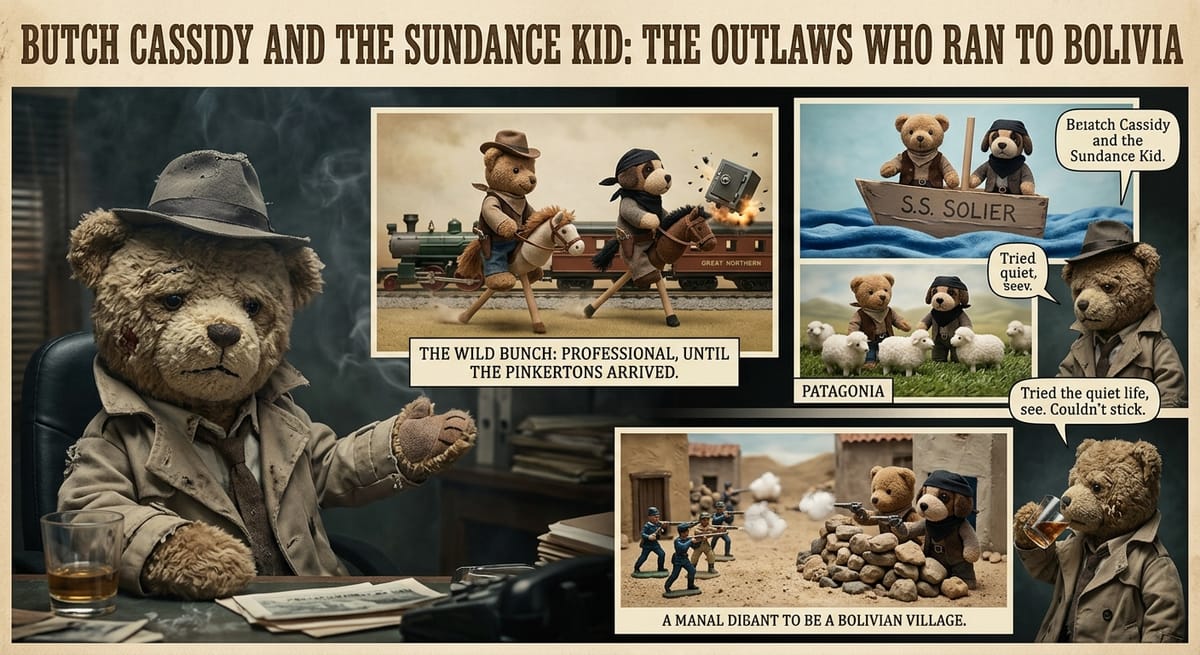
The loosely organized gang known as the Wild Bunch — also called the Hole-in-the-Wall Gang for their use of a canyon hideout in Johnson County, Wyoming — operated between roughly 1896 and 1901. At various times it included Longabaugh, Parker, Harvey “Kid Curry” Logan, Ben Kilpatrick, Will Carver, and Elzy Lay. Unlike some outlaw gangs, they were reasonably professional by the standards of the time: they scouted targets, used relay horses for escapes, and avoided unnecessary violence when they could.
Cassidy’s biographers credit him with robbing at least a dozen banks and trains. The documented list includes the San Miguel Valley Bank in Telluride, Colorado on June 24, 1889, where Cassidy and accomplices took $21,000. The Belle Fourche, South Dakota bank robbery in June 1897 was messier — one robber’s horse bolted, the gang was identified, and several were captured briefly before escaping. The Winnemucca, Nevada bank job on September 19, 1900 netted $32,640 from the First National Bank. The Wild Bunch sent a photograph of themselves to the bank afterward.^1^
The Great Northern train robbery near Wagner, Montana on July 3, 1901 — which netted approximately $65,000 in unsigned bank notes — was one of their last major American jobs and proved harder to escape than earlier ones. Union Pacific Railroad had hired the Pinkerton National Detective Agency in 1900 specifically to pursue the Wild Bunch, and the Pinkertons were methodical. By 1901, the heat was enough that Cassidy and Longabaugh, along with Longabaugh’s companion Etta Place, left for South America.^2^
The South American Chapter That Didn’t Save Them
The three arrived in Buenos Aires, Argentina in February 1902. They filed a land claim for a 12,000-acre ranch near Cholila in Patagonia, raised sheep and cattle, and by most accounts tried to live quietly for several years. Pinkerton agent Frank Dimaio tracked them to Argentina in 1903 but couldn’t get local authorities to cooperate with extradition.
The ranch period ended around 1905 or 1906, when Bolivian authorities appeared to have identified them. Etta Place returned to the United States — her fate after that is genuinely unknown, one of the more compelling mysteries of the story. Cassidy and Longabaugh moved north into Bolivia, where they worked briefly for the Concordia Tin Mines near La Paz before returning to robbery.^3^
On November 3, 1908, two men identified as Norteamericanos robbed a payroll courier for the Aramayo, Franke & Company silver mine at Huaca Huañusca in southern Bolivia, taking approximately 15,000 Bolivianos in cash. Three days later, Bolivian soldiers cornered two men matching their descriptions in the village of San Vicente. A firefight lasted through the night of November 6–7, 1908. In the morning, both men were dead — one from multiple gunshot wounds, one from a single bullet to the head, apparently self-inflicted.^4^
The soldiers and witnesses described the men as foreigners. The Pinkerton Agency confirmed, based on the description and physical evidence, that the dead men were Parker and Longabaugh. Most historians accept this conclusion.
Did Butch Cassidy Survive Bolivia?
The “Butch and Sundance survived” theory has persisted for over a century, fueled by family accounts — Parker’s sister Lula Parker Betenson claimed until her death in 1980 that Butch returned to the United States and lived quietly until 1937 — and the absence of confirmed identification of the bodies, which were buried in San Vicente in an unmarked grave.
The Betenson account is detailed enough to take seriously. She describes a 1925 visit from her brother and is specific about the conversation. But family loyalty and wishful thinking are powerful forces, and the documentary evidence — the Bolivian military report, the Pinkerton files, the timing and location — points toward San Vicente as the end. A 2008 DNA analysis of remains exhumed from the San Vicente cemetery was inconclusive; the bodies couldn’t be confirmed as Parker and Longabaugh, but couldn’t be ruled out either.^5^
The ambiguity is almost certainly part of the legend’s durability. An outlaw who escapes cleanly, goes home, grows old — that’s a satisfying story. An outlaw shot by soldiers in a Bolivian mining village is a different kind of ending.
What the Closing Frontier Actually Cost Them
The partnership of Parker and Longabaugh worked partly because they were different in important ways. Cassidy was reportedly sociable, funny, and genuinely reluctant to kill — his biographers find no confirmed killing directly attributed to him, which distinguishes him from most outlaw gang leaders of the period. Longabaugh was harder, more volatile, more willing to use violence. Kid Curry Logan, the Wild Bunch’s most violent member, killed at least nine men and was not aboard the ship to Argentina.
What they were running from was not just the Pinkerton Agency but the end of a particular kind of American geography. The frontier West that had made outlaw gangs possible — the vast distances, the limited law enforcement, the sympathetic local populations who resented railroad corporations — was closing by 1900. The 1890 census had declared the frontier officially closed. Railroads now had telegraph systems that could relay descriptions of robbers across hundreds of miles in minutes. Photographs made identification permanent. The Wild Bunch’s decision to mail a photograph to a bank they’d just robbed is either audacious or suicidal depending on how you read the historical moment.
South America was a frontier that still existed. It didn’t save them, but it gave them seven or eight more years than staying in Wyoming would have. That same closing frontier had already pushed Jesse James to his death and ended the Dalton Gang at Coffeyville. The technology — telegraph, photography, organized detective agencies — was systematically eliminating the geography that outlaw gangs depended on.
─────────
Sources:
- Pointer, Larry. In Search of Butch Cassidy. University of Oklahoma Press, 1977.
- Meadows, Anne. Digging Up Butch and Sundance. University of Nebraska Press, 2003.
- Kirby, Edward M. The Rise and Fall of the Sundance Kid. Western Publications, 1983.
- Ernst, Donna B. The Sundance Kid: The Life of Harry Alonzo Longabaugh. University of Oklahoma Press, 2009.
- Patterson, Richard. Butch Cassidy: A Biography. University of Nebraska Press, 1998.