Mexican Super Labs: How Meth Production Went Industrial
When U.S. law closed domestic meth labs in 2005 Mexican cartels built super labs producing 100 pounds of meth per day at 90-100 percent purity — cheaper and more dangerous than anything before.
Mexican Super Labs: How Meth Production Went Industrial
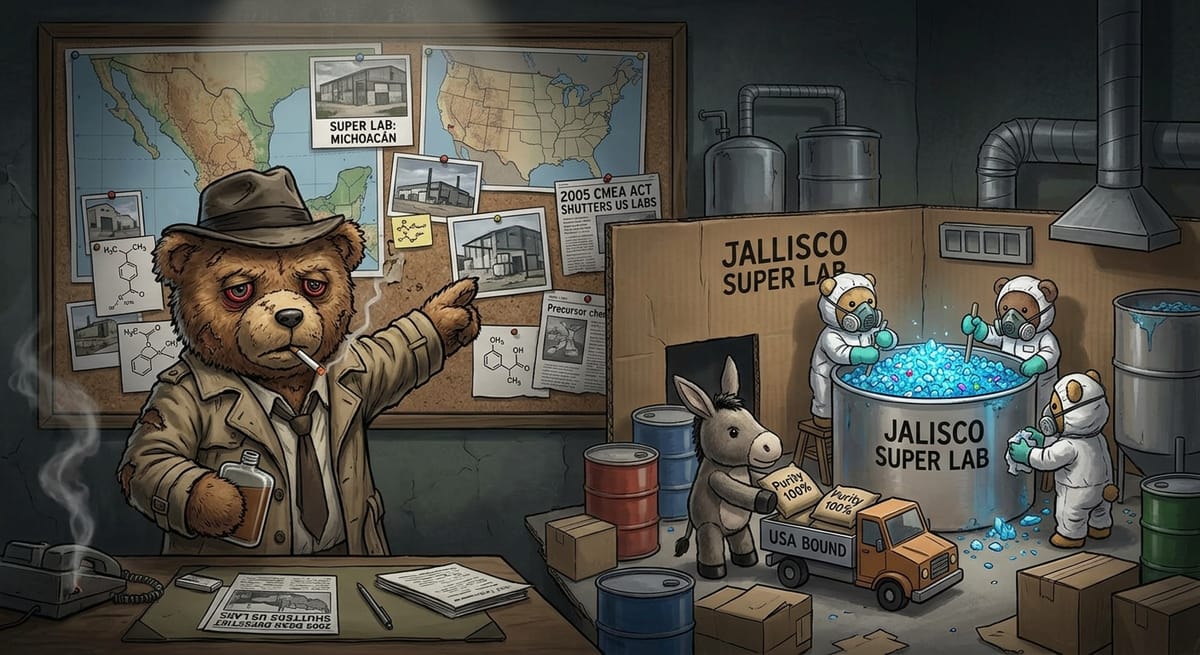
When the United States passed the Combat Methamphetamine Epidemic Act in 2005 and collapsed the domestic lab infrastructure that had supplied much of the country’s meth market, the supply did not disappear — it moved to Mexico and scaled up. Mexican drug trafficking organizations had already recognized that methamphetamine was a high-margin product and that the U.S. market was enormous and structurally underserved. A single “super lab” could produce 100 pounds of methamphetamine per day. The domestic labs they replaced had measured output in ounces.^1^
Part of Meth and the Opioid Crisis — ← Back to series hub
Why Mexico Was Perfectly Positioned to Fill the Gap
Mexico had three advantages over domestic meth producers that made the transition to industrial-scale production straightforward. First, Mexico’s proximity to the United States provided a distribution infrastructure that already existed for cocaine and heroin — the same border crossings, transport networks, and wholesale relationships could move meth with minimal additional overhead. Second, pseudoephedrine, restricted in the United States after 2005, remained more freely available in Mexico, sourced from chemical suppliers in Asia — primarily China and India — until Mexico tightened its own precursor controls in 2008. Third, the cartels had capital: Sinaloa’s cocaine revenues generated cash that could fund large-scale chemical acquisition and production facility construction.
The critical period was 2004 to 2008. U.S. domestic lab seizures were declining rapidly as pseudoephedrine restrictions took effect. Mexican production was scaling up rapidly to compensate. DEA intelligence tracking from this period documented the Sinaloa Cartel’s meth production expansion across several Mexican states, with Michoacán, Sinaloa, and Jalisco as primary production regions.^2^
What a Super Lab Actually Produces
The term “super lab” has a specific DEA definition: a clandestine meth lab capable of producing 10 pounds or more of methamphetamine in a single production cycle. At the extreme end, Mexican super labs operated by Sinaloa and other cartels in the 2000s and 2010s were far larger — industrial facilities with sophisticated chemical engineering, ventilation systems, and waste management infrastructure. A large super lab in Guadalajara or Culiacán could process hundreds of kilograms in a single run.
The chemistry used by Mexican super labs evolved in response to precursor availability. When pseudoephedrine became harder to source in large quantities, producers shifted toward alternative synthesis routes — including methods using phenylacetic acid and other precursors that were less controlled. The DEA’s Diversion Control Division tracked this shift from 2008 onward, documenting the chemistry changes that allowed production to continue despite precursor restrictions.
The purity of Mexican super lab meth was dramatically higher than what domestic producers had achieved. Throughout the domestic lab era, street meth typically contained 40 to 60 percent methamphetamine hydrochloride. Mexican super labs, using industrial processes, consistently produced product at 90 to 100 percent purity — a level that, when distributed at higher purity levels than users expected, increased overdose risk.^1^
How Price Collapse Turned Meth Into a National Drug
One of the most important economic consequences of Mexican industrial production was price collapse. The National Drug Intelligence Center tracked methamphetamine price data through the 2000s and 2010s. In 2005, the average retail price of methamphetamine in the United States was approximately $250 per gram. By 2010, it had dropped to approximately $100 per gram in many markets. By 2015, prices in some markets had fallen to $20 to $40 per gram.^3^
Lower prices expanded the market. Meth was no longer just a rural drug or a West Coast drug. By the mid-2010s, it was moving into cities and communities — including Black urban communities — that had previously been primarily served by crack cocaine and heroin. The DEA’s 2018 National Drug Threat Assessment documented meth’s expanding geographic and demographic reach, noting significant increases in meth-involved overdose deaths in states and demographics that had not previously been primary meth markets.
How the Jalisco Cartel Accelerated the Price War
The Jalisco New Generation Cartel — CJNG, from its Spanish initials — emerged as a significant meth producer in the 2010s, challenging Sinaloa’s dominance and accelerating production competition that drove prices even lower. CJNG, founded by Nemesio Oseguera Cervantes (“El Mencho”), grew rapidly after 2010 and became one of the DEA’s highest-priority targets by 2015. The competition between CJNG and Sinaloa produced violence in Mexico and also produced increased supply pressure on the U.S. market — each organization seeking to maintain or expand market share in what had become a commodity business.^4^
Why Border Interdiction Can’t Solve an Industrial Supply Problem
The primary U.S. response to Mexican super lab production was border interdiction — seizing meth shipments at ports of entry, Border Patrol checkpoints, and through interior enforcement operations. Between 2010 and 2018, methamphetamine seizures at the southern border increased approximately 650 percent, from around 3,800 kilograms to more than 24,000 kilograms per year.^1^
Those seizures, however large, represent a fraction of total production. The RAND Corporation, which has modeled drug market economics, has consistently found that supply-side interdiction at current levels is insufficient to materially affect retail availability or price. When interdiction removes a significant portion of the supply chain, producers compensate by increasing production, which the industrial scale and profitability of super lab operations makes straightforward. Removing individual loads does not change the underlying economics.
The Mexican super lab system is not a problem that ended or is trending toward resolution. As of the early 2020s, methamphetamine seized at the U.S. border is at record volumes, prices remain near historic lows, and the drug is reaching demographic and geographic markets that were previously less affected. The Combat Methamphetamine Epidemic Act eliminated the domestic meth lab era. It handed the market to a more efficient, more productive, and more dangerous supplier. That is not an argument against regulating precursors — it is a description of how the drug market responds when enforcement closes one door without addressing the demand behind it. Fentanyl followed the same logic at much greater scale and with much more lethal results.
─────────
Sources:
- Drug Enforcement Administration. 2018 National Drug Threat Assessment. U.S. Department of Justice, 2018.
- National Drug Intelligence Center. Methamphetamine Drug Threat Assessment. U.S. Department of Justice, 2005.
- Reding, Nick. Methland: The Death and Life of an American Small Town. Bloomsbury, 2009.
- Grillo, Ioan. El Narco: Inside Mexico’s Criminal Insurgency. Bloomsbury, 2011.
- RAND Corporation. Improving the Measurement of Drug-Trafficker Profits and Drug Prices. RAND, 2013.