Meth and Opioids: America's Other Drug Wars
The meth and opioid crises killed differently than crack — in rural trailers and suburban bedrooms rather than city streets. Together they pushed annual overdose deaths past 107000 by 2021.
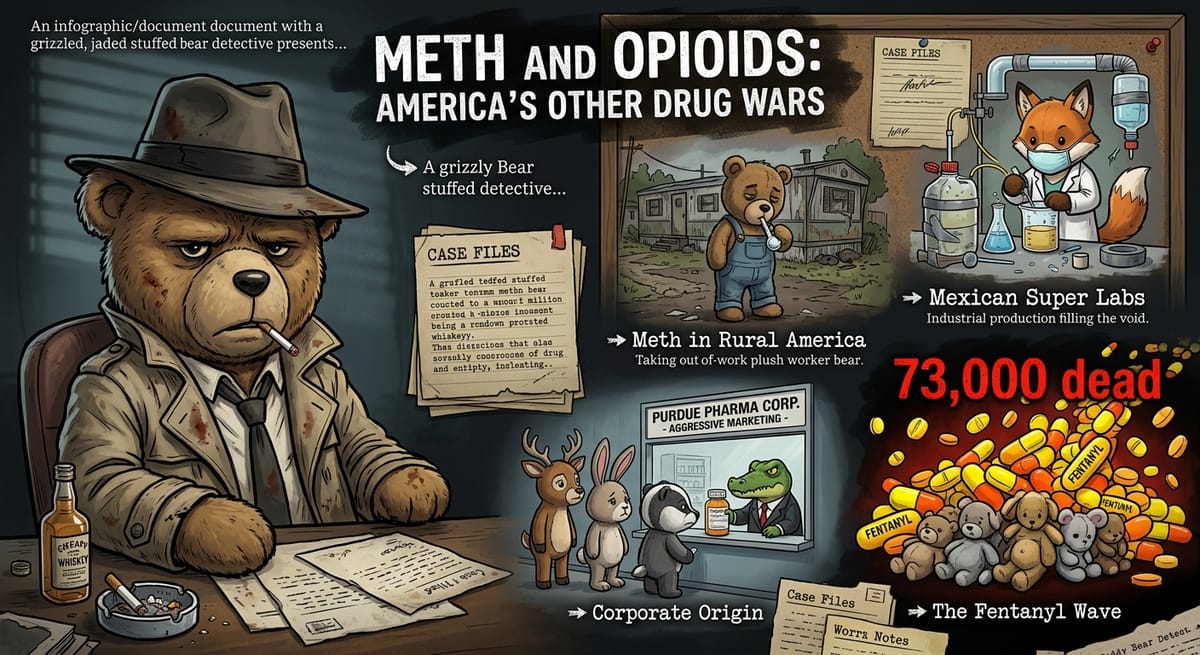
Meth and Opioids: America’s Other Drug Wars
The crack epidemic of the 1980s and 1990s is the drug crisis most Americans have a template for. It came with images, a political narrative, a set of policy responses. The meth and opioid crises that followed were different in geography, demographics, and origin — and the differences mattered, both in how they were experienced and in how the political system responded. Together, they killed more than 500,000 Americans between 1999 and 2019 from opioids alone, and pushed total annual overdose deaths past 107,000 by 2021.^1^
← Back to the Drug Trade section hub
In This Series
- The Opioid Crisis: How Purdue Pharma Started an Epidemic — The marketing fraud, the Sackler family, and the transition to heroin and fentanyl
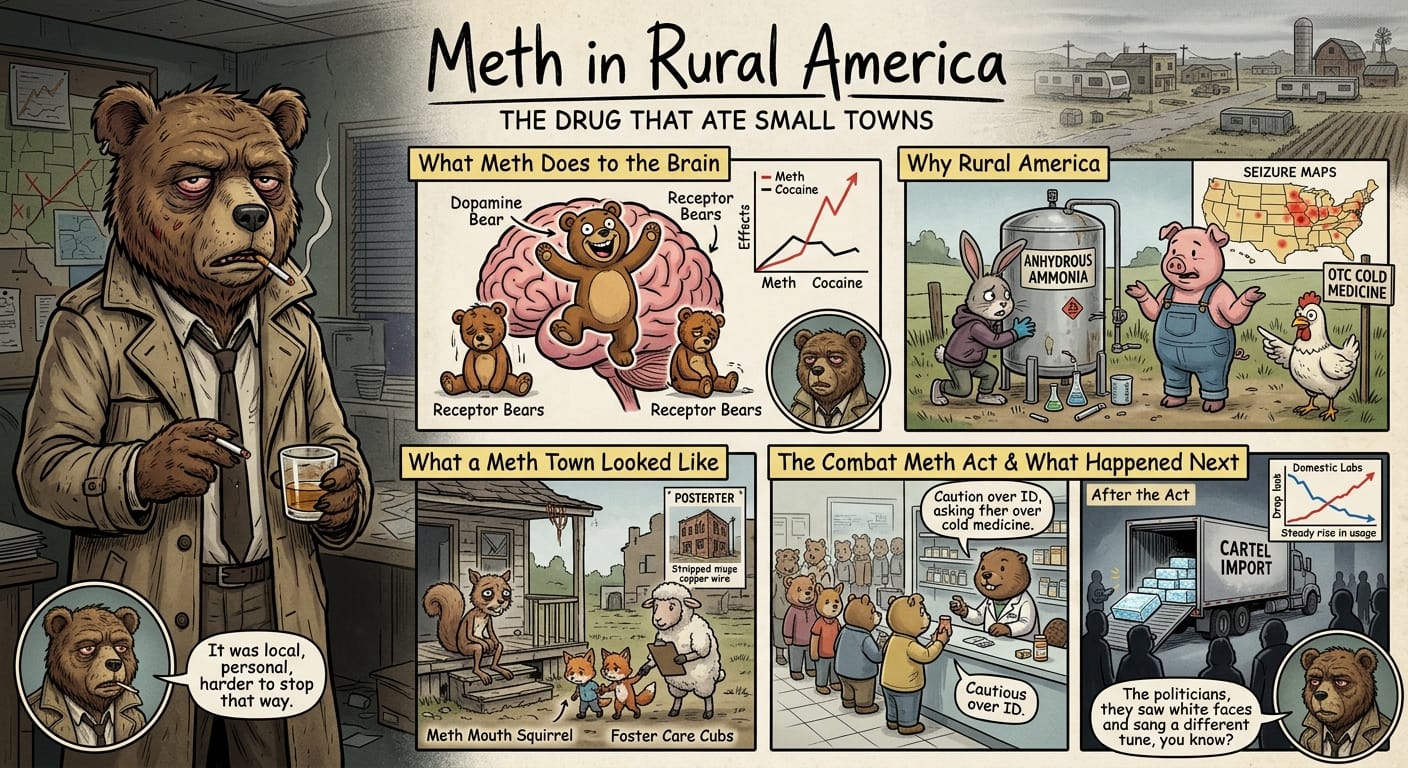
- Meth in Rural America: The Drug That Ate Small Towns — How economic collapse and farm chemistry produced the domestic lab era
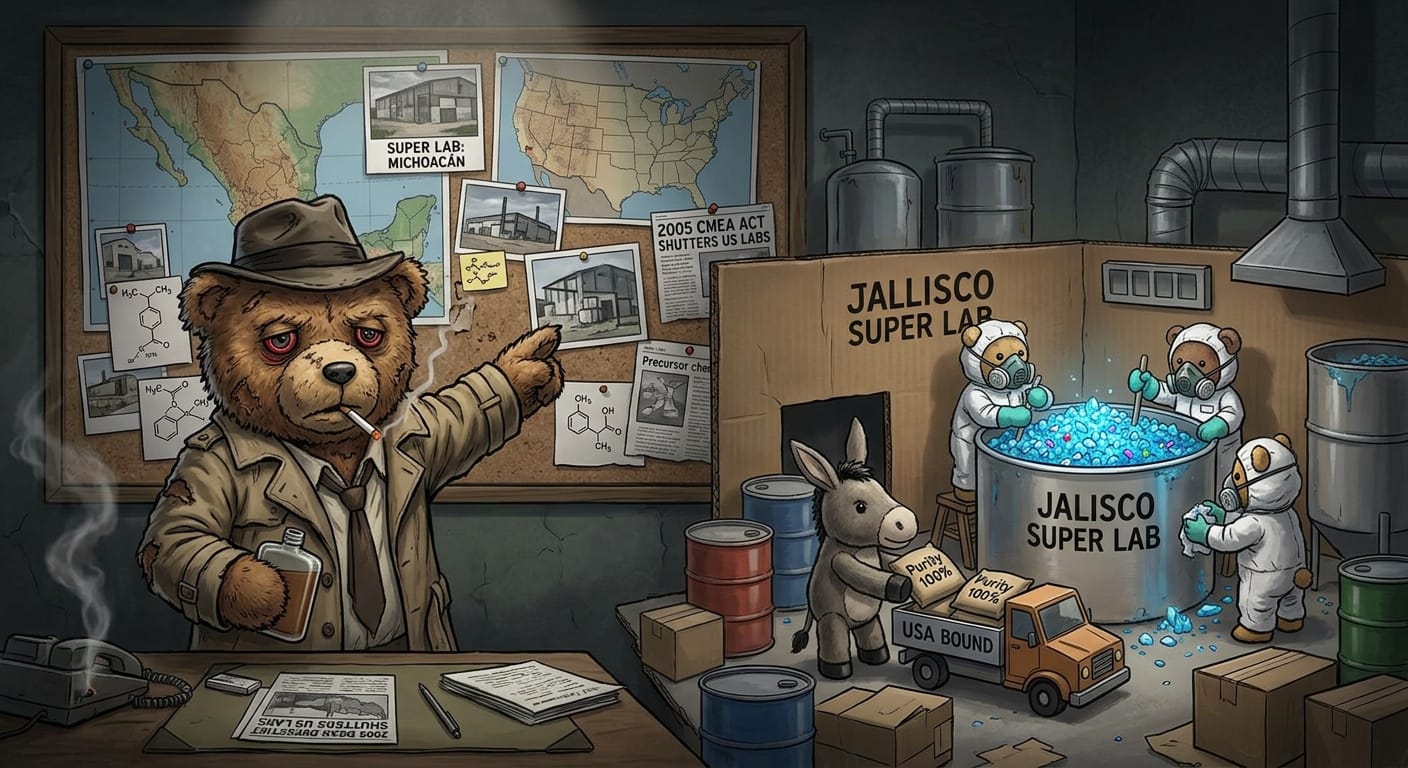
- Mexican Super Labs: How Meth Production Went Industrial — What happened after the Combat Methamphetamine Epidemic Act closed the domestic labs
- The Fentanyl Wave: When the Drug Supply Became Poison — 73,000 dead in 2022, counterfeit pills, and a supply chain that interdiction can’t stop
The Meth Response Was More Sympathetic Than Crack — and That Wasn’t Accidental
Methamphetamine’s American footprint in the 1990s was rural, Western, and predominantly white. The meth lab in Oelwein, Iowa, or Benton, Arkansas, did not look like the crack house in South Central Los Angeles. The people using it were often working — or had been working before the plant closed — not unemployed from the beginning. The drug offered something specific to agricultural and industrial communities that had lost their economic foundation: energy, weight loss, a few hours of the feeling that you could handle what the economy had taken from you.
The political response to rural meth was, on its face, more sympathetic than the response to urban crack. Politicians from meth-affected states described addiction as a disease, funded treatment programs, and passed legislation — the Combat Methamphetamine Epidemic Act of 2005 — that addressed supply rather than purely targeting users. The contrast with the crack era’s “just say no” and mandatory minimums is real. Some of the difference was the accumulation of evidence that enforcement-first approaches didn’t work. Some of it was that the people most visibly affected were white, rural, and voting Republican in states with more senators per capita than coastal cities.
Industrial Production Defeated Every Domestic Restriction
What the meth story reveals about drug supply chains is that domestic production restrictions are not elimination strategies. The Combat Methamphetamine Epidemic Act effectively ended the small domestic lab era — seizures fell from 12,000-plus annually to a fraction of that by 2010. But Mexican super labs, operating at industrial scale with pharmaceutical-grade chemistry, filled the gap so completely that meth became cheaper and purer than it had been in the domestic lab era. The drug is now a commodity. Enforcement collapsed one supply chain and handed the market to a more efficient one.
The fentanyl story makes the same point at greater scale and with more lethal consequences. Fentanyl entered the heroin supply around 2013 as a cost-reduction tool for distributors — more potent product for less money, smaller quantities to move. By 2021, synthetic opioids were involved in 66 percent of the 107,000 drug overdose deaths recorded that year.^1^ The entire trajectory — from prescription opioids to heroin to fentanyl — traces a market in which demand stayed constant and supply adapted around every intervention, each adaptation producing a more dangerous product.
Purdue Pharma Gave the Opioid Crisis a Corporate Origin
The opioid crisis has a corporate origin that neither the crack epidemic nor the meth epidemic had in the same explicit form. Purdue Pharma’s marketing of OxyContin — the misleading safety claims, the aggressive physician targeting, the deliberate cultivation of high-volume prescribers in rural Appalachia — was not a street drug market phenomenon. It was a legal product sold by a legitimate company through the normal pharmaceutical distribution system. The company’s owners, the Sackler family, generated personal fortunes estimated in the billions through the OxyContin era.
When the legal supply was restricted — through prescription monitoring, OxyContin reformulation, and physician behavior changes — people who had developed opioid dependence through legitimate prescriptions moved to illegal heroin and, then, fentanyl. The addiction Purdue Pharma created did not disappear when OxyContin became harder to get. It migrated into the illegal market, where fentanyl was waiting.
The Fentanyl Death Toll Rewrote the Scale of the Problem
The crack epidemic was measured in homicide rates, incarceration numbers, and crack baby stories. The opioid-fentanyl crisis is measured primarily in overdose deaths, which tells you something about who was dying and how. The overdose death toll from synthetic opioids — 73,000 in 2022, more than any other cause of accidental death — has produced a public health response that the crack era, with its different demographics, did not receive at equivalent scale. Naloxone is now widely available. Harm reduction programs are expanding. Medication-assisted treatment is more accepted than it has ever been.^2^
Whether that response is adequate to the scale of the crisis is a different question. The drug supply has become, in the fentanyl era, lethally unpredictable in ways that harm reduction tools developed for heroin do not fully address. The people most at risk are often using drugs they believe are something else. The market has outrun the intervention.
─────────
Sources:
- Reding, Nick. Methland: The Death and Life of an American Small Town. Bloomsbury, 2009.
- Quinones, Sam. Dreamland: The True Tale of America’s Opiate Epidemic. Bloomsbury, 2015.
- Centers for Disease Control and Prevention. Drug Overdose Deaths in the United States, 1999–2022. CDC NCHS Data Brief, 2023.
The Series