The Pullman Strike: When One Company Town Broke
Pullman cut wages 25-40% in 1894 but kept rents. Workers struck, 250,000 joined the boycott, and the federal government sent 12,000 troops to break it.
The Pullman Strike: When One Company Town Broke
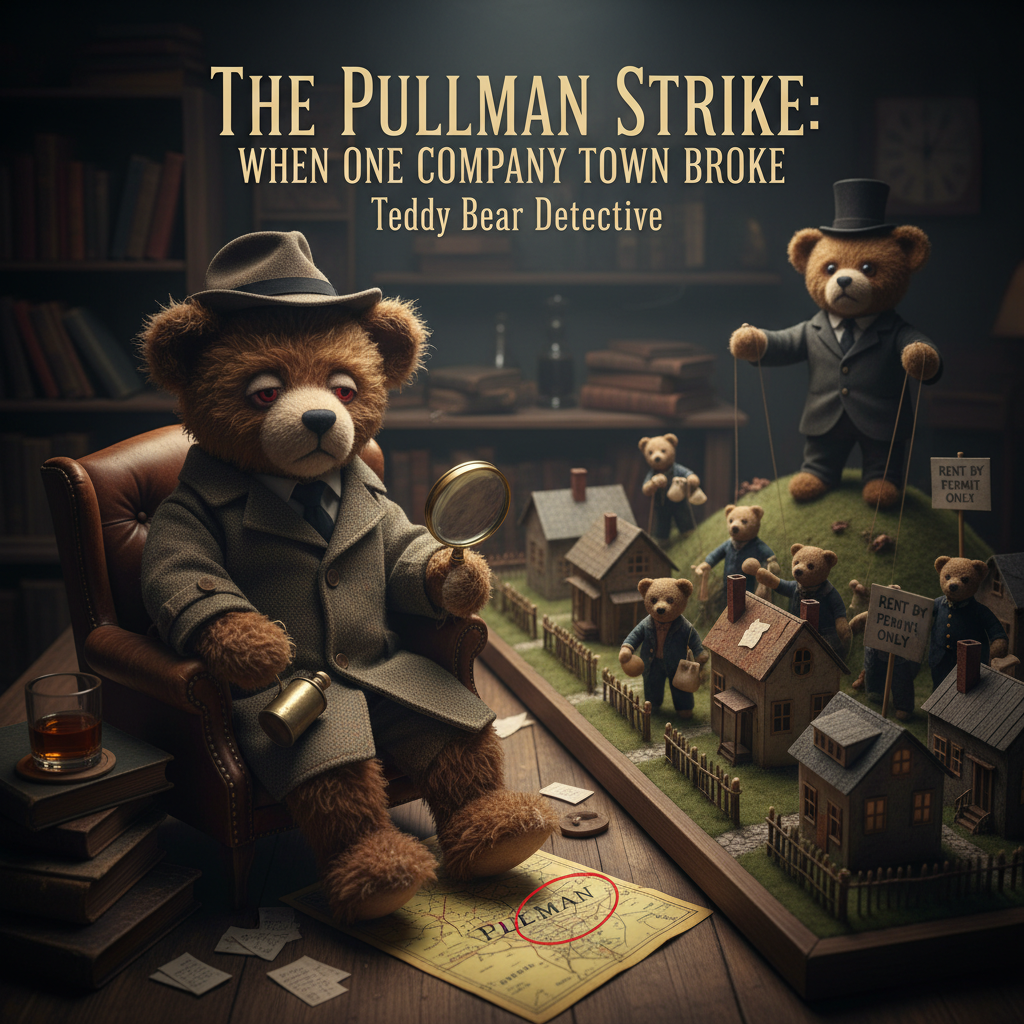
The Pullman Strike of 1894 established the federal government’s role as the default enforcer of corporate interests against organized labor. George Pullman built his workers a model town on the southern edge of Chicago — homes with indoor plumbing, a library, a church, parks, an arcade. He named it Pullman. He owned all of it, down to the bricks and the sod. In May 1894, facing falling revenue from the economic panic of 1893, Pullman cut wages between 25 and 40 percent without cutting rents or the prices at his company store. When workers walked out, the federal government sent 12,000 troops to Chicago over the explicit objection of the state’s own governor.
George Pullman’s Town Was Designed to Eliminate Independence, Not Discontent
The Pullman Palace Car Company had made George Pullman one of the wealthiest men in America. His sleeping cars, dining cars, and parlor cars were the gold standard of American rail travel, leased to railroads across the country. By 1893, the Pullman works employed about 5,500 workers and manufactured roughly half of all sleeping cars in service in the United States.
The town of Pullman, incorporated into Chicago in 1889, housed approximately 8,000 people and was designed to eliminate labor unrest by giving workers a clean, orderly environment. What it actually eliminated was any possibility of independence. Workers could be evicted for labor agitation. The church was rented only to denominations Pullman approved of. The library charged borrowing fees. Every dollar a Pullman worker earned was, in some sense, a dollar owed back to George Pullman.^1^
The depression that followed the panic of 1893 hit the company hard. Pullman’s response was to cut costs — wages went down, but fixed costs to workers did not. By May 1894, some workers were bringing home paychecks of less than a dollar after rent and debt deductions were taken out.
When a delegation of workers met with him on May 9 to protest, he promised there would be no retaliation. The next morning, he fired three of the delegation’s members. The remaining workers walked out.
How a Local Walkout Became a National Shutdown
The American Railway Union, founded just a year earlier by Eugene V. Debs, had become one of the fastest-growing labor organizations in the country by accepting all railroad workers regardless of craft or skill level — a radical departure from the AFL’s craft-union model. The ARU’s membership in the spring of 1894 was approximately 150,000.
When Pullman workers asked the ARU for help in late June 1894, the union put the question to its national convention. Debs urged caution. The convention voted for a sympathy boycott anyway: ARU members would refuse to handle any train with Pullman cars attached. Because nearly every long-distance passenger train in America used Pullman cars, the boycott effectively shut down rail traffic across 27 states. By July 2, some 250,000 workers had either struck or been laid off due to the disruption.^2^
The General Managers’ Association — a body representing 24 major railroads — coordinated the employers’ response. They attached U.S. mail cars to Pullman cars, then asked the federal government to intervene on the grounds that the strike was obstructing mail delivery.
What Did It Mean When a Railroad Lawyer Became Attorney General?
U.S. Attorney General Richard Olney — who was, before taking office, a railroad attorney and remained on the board of a railroad company throughout his tenure — obtained a sweeping injunction from federal court on July 2, 1894, ordering strike leaders to cease interference with the railroads or mail delivery.^3^ The injunction was drafted in language so broad that nearly any action supporting the strike could constitute a federal violation.
President Grover Cleveland sent 12,000 federal troops to Chicago on July 4, over the explicit protest of Illinois Governor John Peter Altgeld, who argued that the state’s own militia was sufficient and that the federal deployment was unconstitutional without his request. Cleveland ignored him.
The arrival of federal troops did not end the strike — it ignited violence. Over the following days, clashes between workers, soldiers, and police left at least 13 strikers dead and more than 50 wounded, primarily in Chicago. Rail yards were burned. Federal property was damaged. Debs and other ARU leaders were arrested for contempt of the federal injunction.
Debs Went to Jail a Labor Leader and Came Out a Socialist
Eugene Debs served six months in the Woodstock, Illinois jail for contempt of court. During his imprisonment, a lawyer friend sent him books, including works by Karl Marx. Debs emerged from prison a committed socialist. He ran for president five times on the Socialist Party ticket, receiving nearly a million votes in 1912 and, in 1920, nearly a million again while campaigning from prison — sentenced under the Espionage Act for opposing World War I.^4^
The American Railway Union was destroyed. Pullman employees who had been evicted from company housing were gradually rehired under yellow-dog contracts, signing pledges not to join any union. George Pullman died in 1897. He was buried in a lead-lined mahogany casket set in concrete reinforced with railroad ties, reportedly because his family feared his workers would desecrate the grave.
The Pullman Strike established what would become a consistent federal posture toward major labor actions for the next four decades: injunctions first, troops when necessary, and the near-automatic assumption that corporate interests aligned with national interests. The use of the federal injunction as a strike-breaking tool persisted until the Norris-LaGuardia Act of 1932 restricted it. A decade later, the same pattern appeared at Blair Mountain, when President Harding deployed the Army against striking coal miners — this time with aircraft.
Congress, in the aftermath of the strike’s violence, quickly established Labor Day as a national holiday — moving it from May 1, with its associations to the Haymarket martyrs, to the first Monday in September. The gift of a holiday was, in part, a way of not giving workers anything else.
─────────
Part of America’s Labor Wars — ← Back to series hub
Sources:
- Lindsey, Almont. The Pullman Strike: The Story of a Unique Experiment and of a Great Labor Upheaval. University of Chicago Press, 1942.
- Papke, David Ray. The Pullman Case: The Clash of Labor and Capital in Industrial America. University Press of Kansas, 1999.
- Ginger, Ray. The Bending Cross: A Biography of Eugene Victor Debs. Rutgers University Press, 1949.
- Salvatore, Nick. Eugene V. Debs: Citizen and Socialist. University of Illinois Press, 1982.