Infrastructure Failures: The Cost of Cutting Corners
Three American infrastructure failures — the Hyatt Regency collapse the I-35W bridge and the Flint water crisis — share the same pattern: errors that oversight should have caught and accountability that never reached the decision-makers.
Infrastructure Failures: The Cost of Cutting Corners
Infrastructure is supposed to be boring. It holds things up, moves water through pipes, carries cars across rivers. When it works, nobody thinks about it. The three events in this series — the Hyatt Regency walkway collapse in 1981, the I-35W bridge collapse in 2007, and the Flint water crisis beginning in 2014 — are what infrastructure looks like when the systems that are supposed to catch errors and enforce standards break down. Each one is different in mechanism. The pattern behind all three is the same.
← Back to Disasters With Dark Causes
In This Series
- The Hyatt Regency Walkway Collapse: A Design Change Made by Phone Call Killed 114 People
- The I-35W Bridge Collapse: When Infrastructure Fails
- The Flint Water Crisis: When the Government Poisoned a City
Errors That Were Sitting in the System for Years
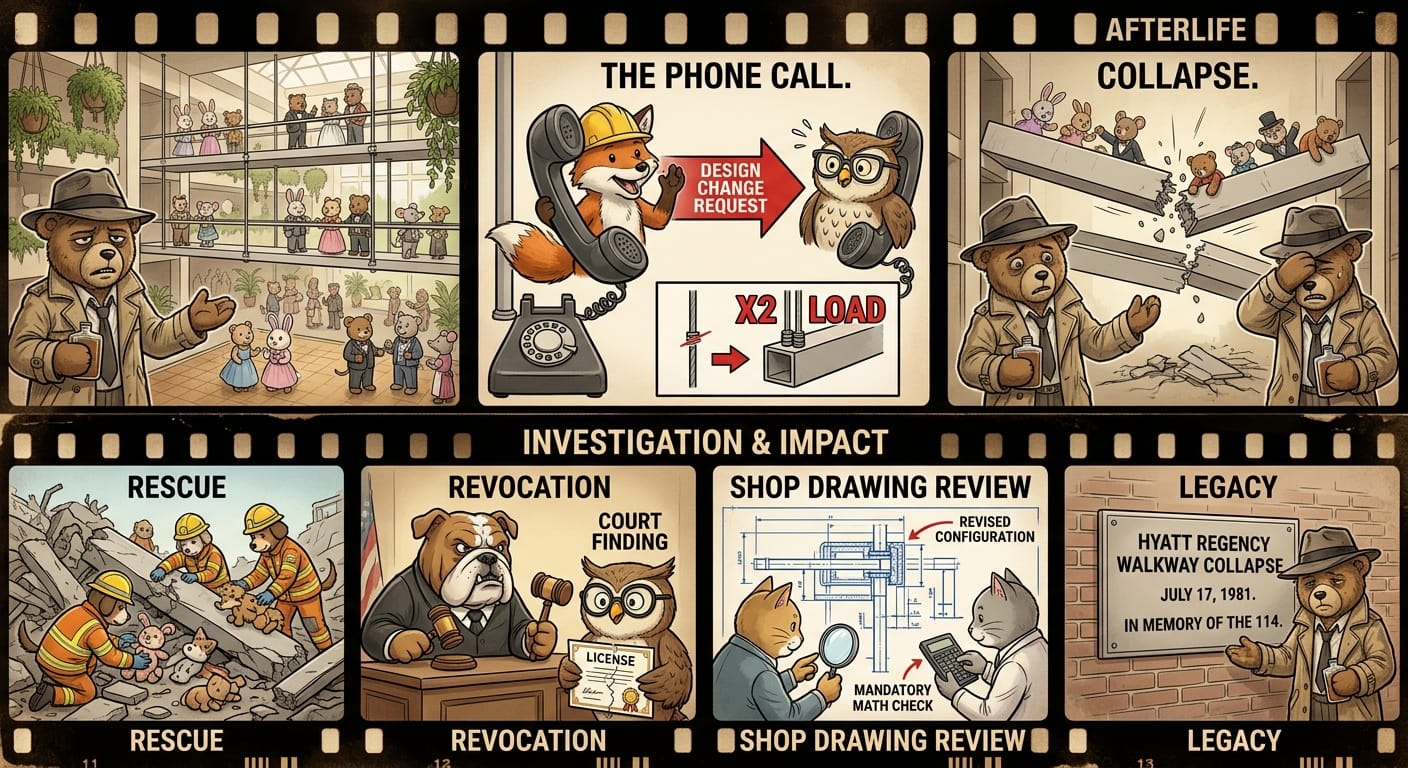
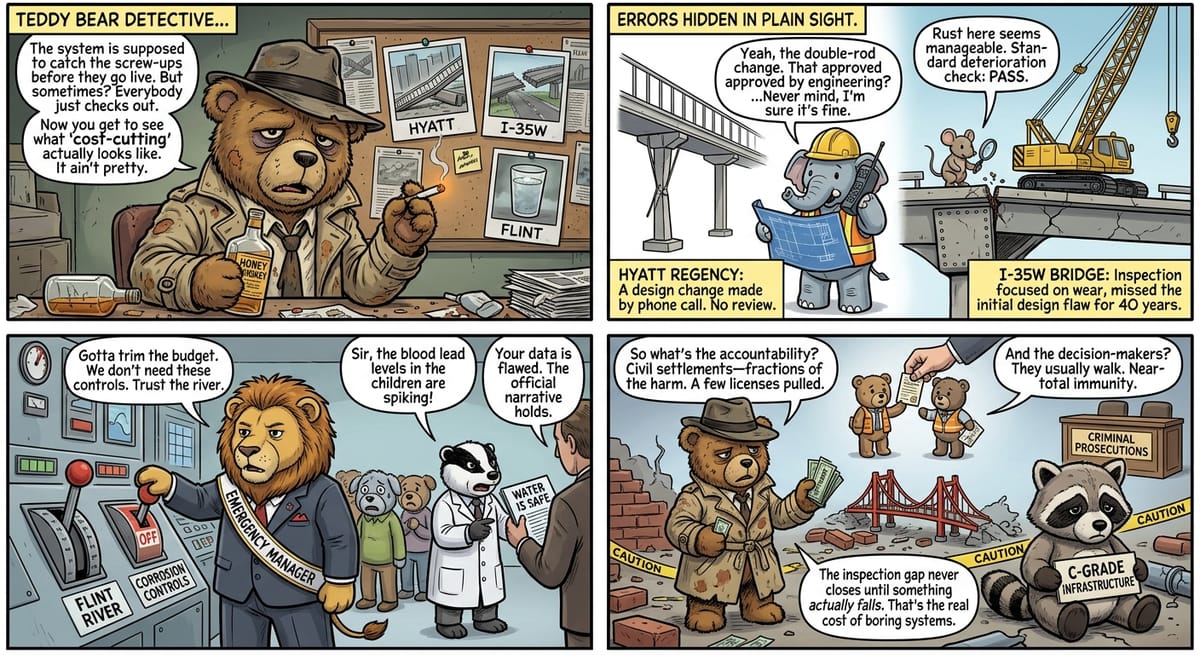
On July 17, 1981, two suspended walkways at the Kansas City Hyatt Regency fell onto a dance floor and killed 114 people. The structural failure traced to a design change made during construction — a change communicated by phone, never formally reviewed against the structural calculations, and never formally approved by a licensed engineer. The revised design, investigators found, violated the Kansas City building code even at its theoretical design load. No one checked.
On August 1, 2007, the I-35W bridge in Minneapolis collapsed during rush hour and killed 13 people. The National Transportation Safety Board traced the cause to gusset plates that had been undersized in the original 1967 design — an error that 40 years of inspection never caught because inspectors were checking for deterioration, not reviewing design specifications against actual loads. Construction equipment placed on the bridge that day pushed a marginally adequate (at best) structure past its limit.
Both failures share this characteristic: an error was present in the system for years before it became lethal, and the inspection and oversight mechanisms that were supposed to catch errors did not catch it. In the Hyatt, the review process for design modifications failed. In the I-35W bridge, the inspection framework was not designed to catch original design errors. In both cases, people were inside or on top of structures that had never actually been verified to be safe.
When Government Does the Harm Directly
The Flint water crisis differs from the first two in an important way: it was not a failure of private engineering oversight. It was a government decision — the 2014 switch to Flint River water by state-appointed emergency managers — followed by a government failure to apply legally required corrosion controls, and then an active government effort to suppress and deny the evidence that children were being poisoned.
Between 6,000 and 12,000 children in Flint showed elevated blood lead levels as a result of drinking water the state of Michigan knew was contaminated. The lead exposure these children suffered is permanent and irreversible. Governor Rick Snyder faced criminal charges that were ultimately dismissed on procedural grounds. The state paid $626 million in civil settlements. ^1^
The Flint crisis adds a dimension to the infrastructure failure pattern that the Hyatt and I-35W represent: the failure was not just technical. It was political. Flint was under state emergency management specifically because it was poor and the state had decided its elected government could not be trusted with its own finances. The cost-cutting decision that poisoned the water was made by a state-appointed official accountable to Lansing, not to Flint’s residents. The officials who then denied the problem and attacked the scientists who identified it were protecting a decision made by their institution.
Accountability Consistently Fell Short of the Harm Caused
In the Hyatt Regency case, two engineers lost their licenses — the first license revocations in Missouri history for a structural failure. No criminal charges were brought. Civil settlements totaled approximately $140 million. ^2^
In the I-35W case, the state of Minnesota settled civil claims for $62 million — capped by state liability limits. No individuals faced criminal consequences for the 17 years of inspections that missed a fatal design error.
In Flint, criminal prosecutions began, stalled, were dropped, were restarted, and continued through a decade of proceedings that as of 2024 had not produced any significant prison sentence for any official who had a decision-making role in poisoning the city’s water supply. The $626 million civil settlement was real money — but most of it went to compensate children for harm that cannot be undone.
The infrastructure failure pattern, across these three cases, produces a consistent accountability outcome: civil settlements that compensate victims at a fraction of the harm caused, engineering license revocations in the most egregious cases, and near-total immunity for decision-makers whose choices created the conditions for failure.
The Inspection Gap Doesn’t Close Until Something Falls
Every major infrastructure failure in American history is followed by the same observation: the inspection systems, design review processes, and regulatory frameworks that were supposed to prevent it were inadequate. This is always true. The gap between what infrastructure oversight is supposed to do and what it actually does is persistent precisely because the people who could close it have no strong incentive to do so before a catastrophic failure makes the cost of inaction visible.
In 2007, 12 percent of the nation’s bridges were rated structurally deficient. The I-35W bridge was one of them for 17 years. In 2023, the American Society of Civil Engineers gave American infrastructure — roads, bridges, water systems, dams — an overall grade of C in its Infrastructure Report Card. Not failing. Not collapsing. Just not reliably safe. ^3^
Flint had water pipes laid when lead plumbing was legal. So did thousands of other American cities. The difference between Flint and the cities that didn’t poison their children in 2014 was not that Flint’s pipes were uniquely old. It was that Flint’s emergency managers made a cost-cutting decision and the state of Michigan failed to apply corrosion controls. The pipes were everywhere. The decision was specific.
─────────
Sources:
- Hanna-Attisha, Mona. What the Eyes Don’t See: A Story of Crisis, Resistance, and Hope in an American City. Crown, 2018.
- National Bureau of Standards. Investigation of the Kansas City Hyatt Regency Walkways Collapse. NBS Building Science Series 143, 1982.
- American Society of Civil Engineers. 2021 Report Card for America’s Infrastructure. ASCE, 2021.
The Series