The Hyatt Regency Walkway Collapse
114 people died when two walkways collapsed at the Kansas City Hyatt Regency on July 17 1981 — because a design change made by phone call was never checked against structural load requirements.
The Hyatt Regency Walkway Collapse: A Design Change Made by Phone Call Killed 114 People
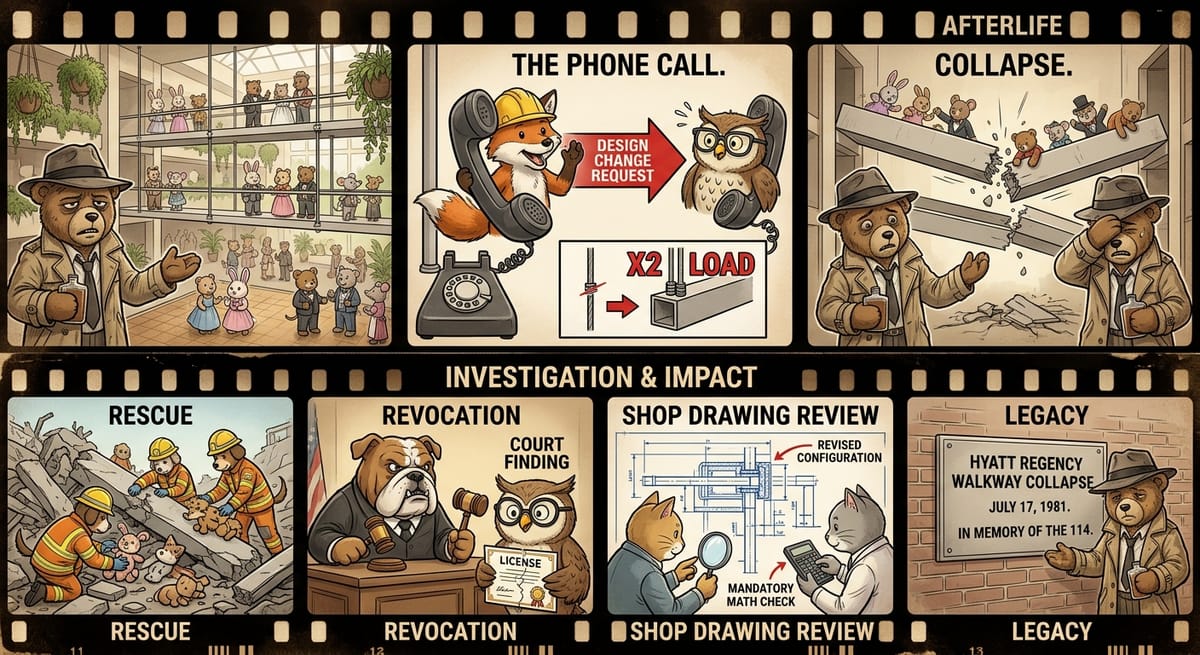
On July 17, 1981, two suspended walkways in the atrium of the Kansas City Hyatt Regency Hotel collapsed onto a crowded dance floor below, killing 114 people and injuring more than 200. At the time, it was the deadliest structural failure in American history. The walkways collapsed because a design change made during construction — communicated by telephone, never reviewed against the structural calculations, never formally approved by a licensed engineer — had doubled the load on a critical connection. The revised configuration violated the Kansas City building code before anyone even stood on it.
Part of Infrastructure Failures — ← Back to series hub
What Was the Kansas City Hyatt Regency?
The Kansas City Hyatt Regency, built in the late 1970s by Hallmark Cards subsidiary Crown Center Redevelopment Corporation, was a showpiece hotel at Crown Center, a large mixed-use development anchored by Hallmark’s headquarters. The hotel’s atrium — a soaring interior space four stories high — was one of its central architectural features. Suspended from the atrium ceiling by steel rods were three walkways crossing the atrium at the second, third, and fourth floor levels. The third-floor walkway was positioned directly below the fourth-floor walkway, with both hanging from the same sets of rods in a stacked configuration. The second-floor walkway was offset to the side.
On the evening of July 17, approximately 1,600 people had gathered in the atrium for a Friday evening tea dance. Many people were standing on the walkways, watching the dance floor below. At 7:05 p.m., the fourth-floor walkway failed, and both the fourth-floor and third-floor walkways fell onto the crowd. ^1^
The Phone Call That Doubled the Load and Was Never Checked
The original structural design called for each walkway rod to run continuously from the ceiling to the floor — meaning the fourth-floor walkway would hang from rods that passed through it and continued down to support the third-floor walkway as well. During construction, fabricators proposed a change: instead of a single continuous rod, they would use two separate rods — one from the ceiling to the fourth-floor walkway box beam, and a second from the fourth-floor box beam down to the third-floor walkway. This meant the fourth-floor box beam would now carry the full load of the third-floor walkway in addition to the fourth-floor walkway itself. The load on the fourth-floor box beam connection had been doubled.
The change was communicated to the engineering team via a telephone call and was not reviewed against the structural calculations. It was not formally approved by a licensed engineer before implementation. The revised configuration, investigators later determined, violated the Kansas City building code even before people stood on it — at full design load, the connection was only capable of bearing 60 percent of what the code required. ^2^
On the evening of July 17, the walkways held more than their design load as people crowded onto them to watch the dance. The connection between the fourth-floor box beam and the hanger rod pulled through the beam, and both walkways fell.
200 Tons of Concrete and Steel Fell on a Dance Floor
The collapse happened in seconds. The two walkways, each weighing approximately 64,000 pounds, fell onto the densest part of the crowd — the dance floor below and the people on the second-floor walkway. Rescue workers faced a scene of extraordinary horror: 200 tons of concrete, steel, and glass on top of more than 100 bodies, with survivors still trapped in the debris and injured people spread across a space the size of a ballroom.
Kansas City Fire Captain Robert Rogers, who led the early rescue operation, later testified that his crews worked for hours to lift debris and reach survivors without causing additional collapse. The Missouri National Guard was called in to assist. Bodies were removed through the night. ^3^ Among the 114 dead were guests from across the country — the Hyatt Regency was hosting multiple events that evening. Some of the injured sustained permanent disabilities from crush injuries and falling debris. The youngest victim was 16 years old.
Two Engineers Lost Their Licenses. No Criminal Charges Were Filed.
The investigation conducted by the National Bureau of Standards (now NIST) determined that the proximate cause of the collapse was the design change from a continuous rod to a two-rod system, which doubled the load on the fourth-floor box beam connection. The investigation also found that the original design, even if properly implemented, was already operating at the edge of code compliance — there was minimal safety margin in the engineering before the unauthorized change made it structurally deficient.
The Kansas City Board of Architects, Engineers, Land Surveyors and Landscape Architects revoked the engineering licenses of Daniel Duncan and Jack Gillum, the two engineers of record, in 1985 — the first license revocations in Missouri history for a structural failure. The finding was that the engineers had failed to exercise adequate oversight of the design change and failed to check the revised configuration against structural requirements. No criminal charges were filed. Hallmark Cards and the hotel settled civil lawsuits for approximately $140 million across more than 3,000 plaintiffs. ^4^
Shop Drawing Review Became Mandatory Because 114 People Died
The Hyatt Regency collapse produced specific changes in how structural engineering is practiced. The concept of “shop drawing review” — the process by which contractors propose modifications to approved designs — was significantly tightened as a result. Engineering professional organizations updated their standards to emphasize that any modification to a structural design, however communicated, requires formal review against the original structural calculations by the engineer of record. ^5^
The Kansas City Hyatt Regency continues to operate, now as the Kansas City Marriott Downtown, at the same location at 2345 McGee Street. The atrium was rebuilt. The 114 people who died on July 17, 1981, were killed by a phone call — someone proposed a simpler connection on a construction site, an engineer on the other end didn’t run the math, and a decision that took minutes to make produced a failure that took 200 tons of debris to make final. The same failure of oversight without consequence runs through the I-35W bridge collapse in 2007 and the Flint water crisis in 2014.
─────────
Sources:
- Luth, G. P., et al. “Chronology of the Design and Construction of the Hyatt Regency Hotel, Kansas City, Missouri.” Journal of Performance of Constructed Facilities, 2000.
- National Bureau of Standards. Investigation of the Kansas City Hyatt Regency Walkways Collapse. NBS Building Science Series 143, 1982.
- Pfatteicher, Sarah K. A. “Lessons Unlearned: The Hyatt Regency and Pedagogical Failures in the Ethics of Engineering.” Journal of Professional Issues in Engineering Education and Practice, 2000.
- Engineering News-Record. “Hyatt Settlement Reported at $140 Million.” ENR, 1985.
- American Society of Civil Engineers. ASCE Code of Ethics and Professional Standards. ASCE, 2017.