Gabriel Prosser: The Blacksmith Who Planned a Revolution
In 1800 Gabriel Prosser organized hundreds of recruits to seize Richmond Virginia — the most sophisticated slave conspiracy in American history ended two days before it launched.
Gabriel Prosser: The Blacksmith Who Planned a Revolution
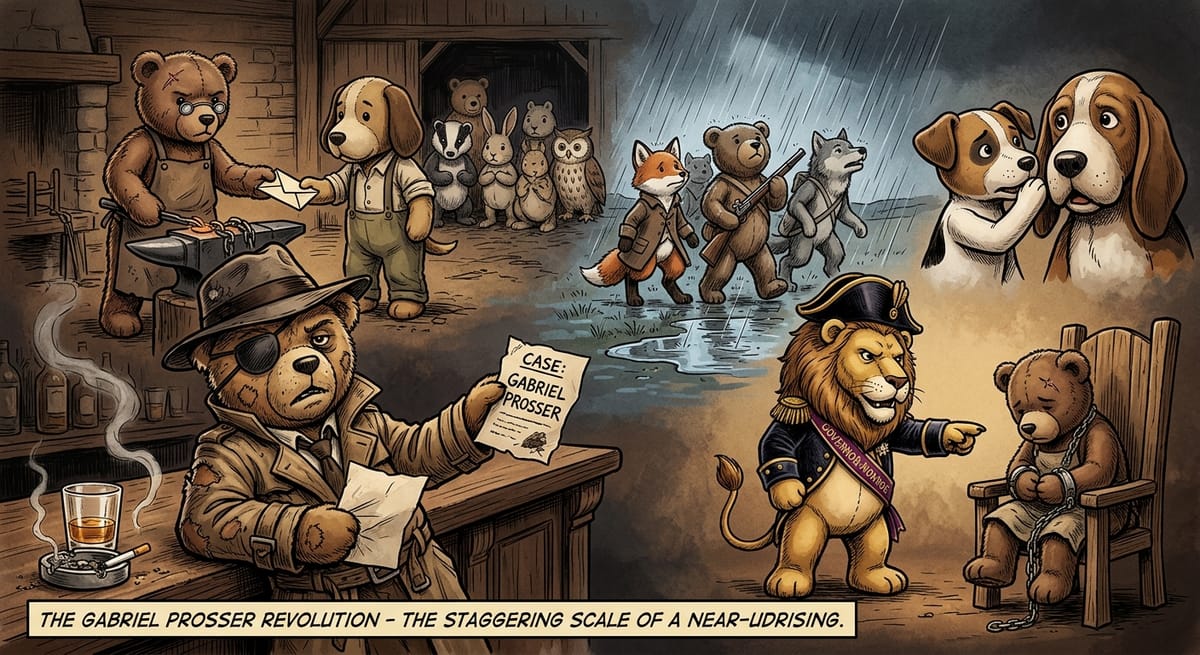
In the summer of 1800, Gabriel Prosser — a 24-year-old enslaved blacksmith — organized what would have been the largest slave revolt in American history. This was not a spontaneous uprising but a months-long strategic operation involving hundreds of conspirators across several Virginia counties. He was betrayed two days before it was supposed to begin, and by the time the governor of Virginia grasped the full scope of what Gabriel had planned, he wrote to President John Adams requesting federal assistance. The plan failed. The scale of it still staggers.
Part of Fighting Back: Slave Resistance in America — ← Back to series hub
How a Hired-Out Blacksmith Built a Statewide Conspiracy
Gabriel was the property of Thomas Prosser, a tobacco planter in Henrico County, Virginia, about six miles north of Richmond. Born in 1776 — the year of the Declaration of Independence, a fact Gabriel later invoked deliberately — he had been trained as a blacksmith, a skilled trade that gave him unusual mobility. Blacksmiths were hired out to other farms and businesses; they moved. They talked to people.^1^
By his mid-twenties, Gabriel was physically imposing — contemporary descriptions put him at well over six feet tall, with a distinctive scar on his head from a fight and two missing front teeth — and intellectually formidable. He was literate, had absorbed the rhetoric of the American Revolution, and had been watching. Virginia’s white artisan class had been agitating about liberty and equality for years. Gabriel noticed that the same arguments applied to him with considerably more force.
He began organizing in the spring of 1800. His brothers Martin and Solomon were among his earliest co-conspirators. The network spread through the tobacco plantations of Henrico County and into the city of Richmond itself, recruiting blacksmiths, coopers, and field workers. By summer, estimates put the number of recruits between 500 and 1,000, though the exact count was impossible to verify then and remains disputed by historians.^2^
Gabriel’s Plan Was Detailed, Ideologically Coherent, and Nearly Worked
Gabriel’s plan was genuinely sophisticated. On the night of August 30, 1800, three columns of men would converge on Richmond. One column would seize the state arsenal, taking its supply of muskets and ammunition. A second would take the penitentiary. A third would take the city’s powder magazine. Governor James Monroe would be taken hostage and used as a bargaining chip.
Gabriel believed — or calculated — that poor white Virginians, who had their own grievances against the planter class, might join the uprising or at least remain neutral. He reportedly told recruits that Quakers, Methodists, and Frenchmen would be spared. The French Revolutionary rhetoric of liberté was circulating through the Atlantic world, and Gabriel invoked it deliberately: he reportedly planned to carry a flag reading “Death or Liberty,” a direct inversion of Patrick Henry’s famous phrase.^3^
The plan required secrecy across hundreds of people for months. It almost held.
Two Informants and a Thunderstorm Ended It the Night It Was Supposed to Start
On the afternoon of August 30, a violent thunderstorm struck Henrico County. The bridges Gabriel’s forces needed to cross were flooded. The operation was postponed. That same afternoon, two enslaved men named Pharoah and Tom — both the property of planter Mosby Sheppard — informed Sheppard of the plot. Sheppard rode immediately to Governor Monroe.^1^
Monroe activated the state militia within hours. Patrols swept the roads leading into Richmond. The conspirators, finding their routes blocked by both floodwater and soldiers, dispersed. Gabriel fled, eventually making it to the schooner Mary and hiding below deck as it sailed down the James River toward Norfolk. He was turned in on September 24 by a fellow enslaved man named Billy, who had heard about the reward being offered. Gabriel was brought back to Richmond in chains. He refused to speak about the conspiracy during his interrogation — a detail Governor Monroe noted with a mixture of frustration and something resembling respect in his official correspondence.^4^ Gabriel was tried and hanged on October 10, 1800, along with at least 26 other conspirators. His brothers Martin and Solomon were among those executed.
Virginia’s Response Revealed the Trap That Skilled Enslaved Labor Had Set
Monroe was shaken enough to write multiple letters to President Adams and to Thomas Jefferson about the need for a place to transport free Black Virginians and rebellious enslaved people — an early form of the colonization argument that would occupy American political thinking for the next 60 years. Jefferson, who had once written movingly about the injustice of slavery, responded with concern about social order rather than about slavery itself.
Virginia tightened its militia structure, increased surveillance of free Black Virginians, and became more aggressive about restricting the hiring-out system that had given Gabriel his mobility. The irony was noted by nobody in power: the same economic logic that made it profitable to hire out skilled enslaved workers was the logic that had made it possible for Gabriel to organize across county lines. The same dynamic would recur in Denmark Vesey’s Charleston conspiracy 22 years later — skilled, mobile enslaved and free Black men using the access the slave economy required them to have in order to plot against it.
Gabriel Prosser left no written testament, no confessions, no published account. He did not talk in custody. What survives is the testimony of the conspirators who did speak, the panic in Governor Monroe’s correspondence, and the sheer scale of what nearly happened: a coordinated, literate, ideologically coherent assault on the capital of Virginia’s slaveholding order, organized by a man born the same year Thomas Jefferson declared all men were created equal.
He was 24 years old when they hanged him.
─────────
Sources:
- Douglas R. Egerton. Gabriel’s Rebellion: The Virginia Slave Conspiracies of 1800 and 1802. University of North Carolina Press, 1993.
- James Sidbury. Ploughshares into Swords: Race, Rebellion, and Identity in Gabriel’s Virginia, 1730–1810. Cambridge University Press, 1997.
- Winthrop D. Jordan. Tumult and Silence at Second Creek: An Inquiry into a Civil War Slave Conspiracy. Louisiana State University Press, 1993.
- Philip J. Schwarz. Twice Condemned: Slaves and the Criminal Laws of Virginia, 1705–1865. Louisiana State University Press, 1988.