Rod Blagojevich: The Governor Who Tried to Sell a Senate Seat
Rod Blagojevich was caught on FBI wiretaps calling Obama's Senate seat "a fucking valuable thing" he wasn't giving away for free — convicted on 17 counts and sentenced to 14 years in the fourth such Illinois gubernatorial corruption case in 50 years.
Rod Blagojevich: The Governor Who Tried to Sell a Senate Seat
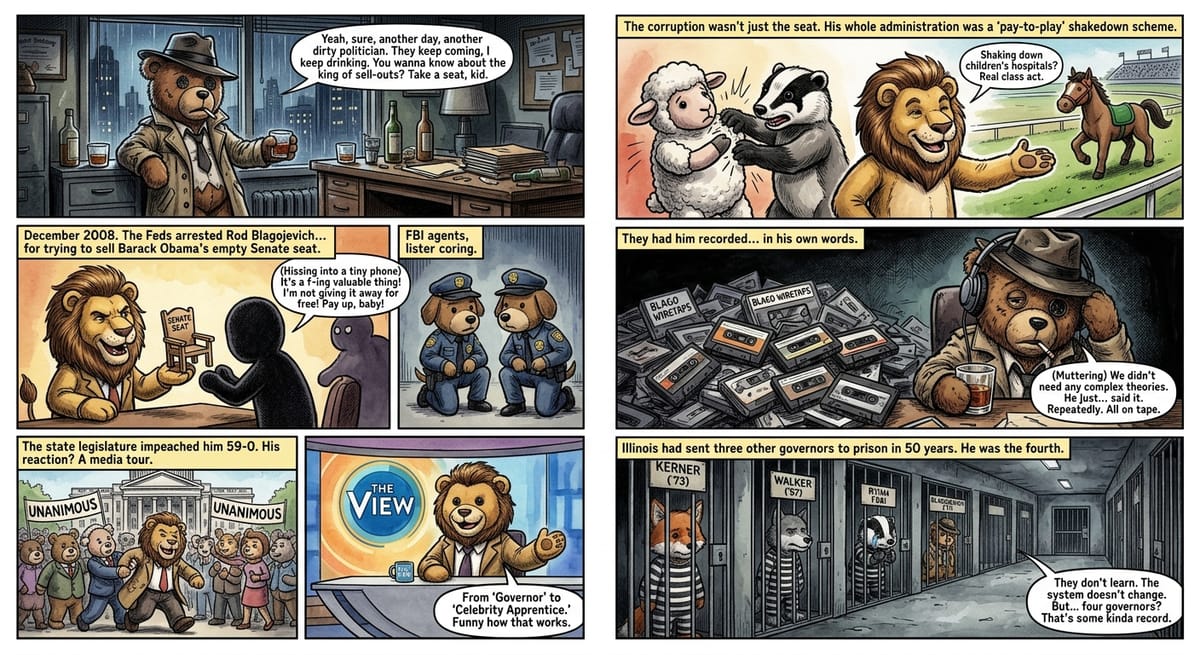
Rod Blagojevich was arrested in December 2008, caught on federal wiretaps describing Barack Obama’s vacated Senate seat as “a fucking valuable thing” that he wasn’t going to give away for free. He was convicted in 2011 on 17 of 20 counts of corruption and sentenced to 14 years in federal prison — the longest sentence ever given to an Illinois governor — and Illinois had already sent three other governors to prison in the preceding 50 years.^2^
On December 9, 2008, federal agents arrested Illinois Governor Rod Blagojevich at his home in Chicago. The timing was not incidental: three days earlier, Barack Obama had been elected president, vacating his U.S. Senate seat. Federal prosecutors had Blagojevich on tape discussing what he might extract from the Obama camp in exchange for the appointment — a cabinet position, a job for his wife, campaign cash. He received none of these things and was arrested before he could complete any transaction.
Part of Political Corruption — ← Back to series hub
Who Was Blagojevich Before the Arrest?
Rod Blagojevich was born in Chicago in 1956, the son of a Serbian immigrant steelworker. He was a state legislator, then a U.S. representative, then governor starting in 2003.^4^ His hair was extraordinary — a dense, dark, carefully maintained structure that became a late-night joke — and he cultivated a populist image while surrounding himself with allies and consultants who treated state government as a revenue stream.
The corruption in his administration wasn’t limited to the Senate seat. Federal investigators documented a pattern of shaking down companies and individuals seeking state contracts, regulatory approvals, or gubernatorial assistance. A children’s hospital in Chicago was reportedly pressured for campaign contributions before a $10 million state grant could be processed. A race track operator was allegedly shaken down for campaign funds in exchange for signing legislation favorable to horse racing. A highway contractor was pressured for contributions. Blagojevich and his associates treated the Illinois governor’s office as a pay-to-play enterprise with multiple revenue streams.
The FBI Wiretaps Caught Him Describing His Own Crimes
The FBI had been wiretapping Blagojevich’s phone since October 2008, authorized by a judge based on prior evidence of corruption. What they captured was extraordinary — not because it revealed unfamiliar behavior, but because it documented it in the governor’s own words with unusual specificity. Beyond the Senate seat discussions, Blagojevich was recorded complaining that Obama’s people wouldn’t give him anything and threatening to appoint himself to the Senate instead. He discussed using his authority to sign or block legislation as leverage for campaign contributions and expressed frustration that state contracts weren’t generating more cash for him personally.^1^
The recordings were introduced at trial and played for jurors. They eliminated the possibility that prosecutors were stretching ambiguous conduct into a criminal theory; the governor had described his own conduct, repeatedly, in terms that left no reasonable interpretive alternative. Compare this with ABSCAM, where the FBI had to manufacture the opportunity to capture politicians on camera. Blagojevich provided his own evidence.
The Impeachment Vote Was Unanimous
The Illinois state legislature impeached Blagojevich in January 2009, removing him from office 59-0 in the Senate — a unanimous vote that crossed all party lines. He became the first Illinois governor removed from office by impeachment.^3^ His reaction was to go on a media tour, appearing on The View, The Today Show, and Late Night with David Letterman, arguing his innocence. He also went on Celebrity Apprentice in 2010.
His first federal trial in 2010 resulted in a hung jury on most charges and a single conviction on one count of lying to federal agents. The government retried him in 2011 with a broader presentation of the evidence, and the second jury convicted him on 17 counts. His 14-year sentence began in March 2012. He was transferred to a lower-security facility and remained in prison until February 2020, when President Donald Trump commuted his sentence, noting that the 14-year term was excessive and expressing skepticism about the prosecutorial approach.
Illinois Sent Four Governors to Prison in 50 Years
Blagojevich’s case drew national attention partly because of the Obama-seat angle and partly because of the recordings, but Illinois’s record of gubernatorial corruption predates him substantially. Otto Kerner served as governor from 1961 to 1968, was subsequently appointed to the federal appeals court, and was convicted in 1973 of bribery related to race track stock. Dan Walker served as governor from 1973 to 1977 and was convicted in 1987 of bank fraud and perjury. George Ryan was convicted in 2006 of racketeering and fraud for a license-for-bribes scheme that investigators found contributed to a 1994 accident that killed six children when a truck driver who had bribed his way to a license lost a mudflap that struck another vehicle. Blagojevich was the fourth Illinois governor in 50 years convicted of corruption.^4^
Blagojevich’s conviction was swift relative to the typical timeline of political corruption cases. The recordings made prosecution relatively efficient. What they didn’t do was change the structural conditions of Illinois politics that had produced four corrupt governors in five decades — an extensive patronage system, weak oversight of state contracting, and a campaign finance environment that blurred the line between political donations and payments for favorable government action. Federal sentencing for political corruption has escalated over the decades, from Kerner’s three years in 1973 to Blagojevich’s original 14-year term in 2011. The deterrent effect on Illinois governors has been imperfect. For the structural version of this same exchange — the legal one — see Lobbying Scandals.
─────────
Sources:
- Coen, Jeff and Chase, John. Golden: How Rod Blagojevich Talked Himself Out of the Governor’s Office and Into Prison. Chicago Review Press, 2012.
- United States v. Blagojevich, Nos. 08-cr-888 and 09-cr-383 (N.D. Ill. 2011).
- Davey, Monica. “Illinois Governor Arrested on Federal Corruption Charges.” The New York Times, December 9, 2008.
- Simpson, Dick. Corrupt Illinois: Patronage, Cronyism, and Criminality. University of Illinois Press, 2015.