Abscam: When the FBI Caught Congress Taking Bribes
FBI agents posed as a fake Arab sheikh's representatives and caught one senator and six House members on videotape accepting cash bribes — the most successful congressional corruption sting in American history.
Abscam: When the FBI Caught Congress Taking Bribes
Between 1978 and 1980, FBI agents posing as representatives of a fictional Arab sheikh captured one U.S. senator, six U.S. representatives, and more than a dozen local officials on video accepting bribes — producing the most successful undercover political corruption sting in American history.^1^ The operation, codenamed ABSCAM, also produced a film, American Hustle (2013), that took significant creative liberties with the facts while capturing the political atmosphere of late-1970s Washington accurately enough to be instructive.
Part of Political Corruption — ← Back to series hub
How Did a Stolen Property Investigation Become a Congressional Sting?
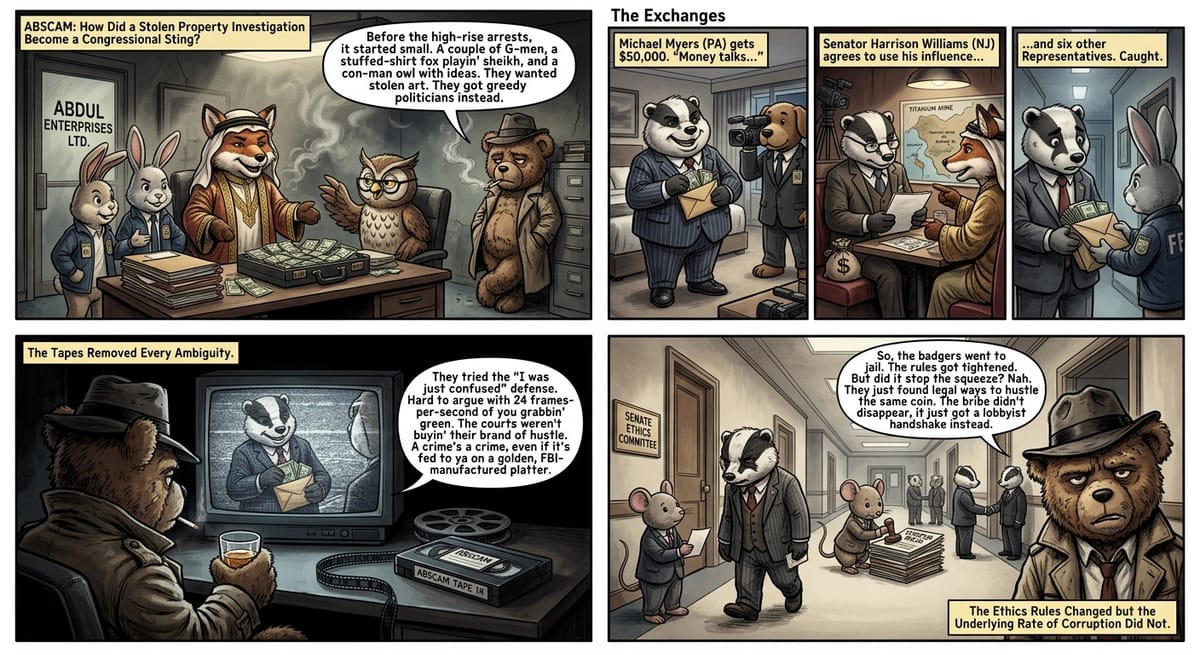
ABSCAM began not as a congressional sting but as a stolen property operation. In 1978, the FBI’s New York field office set up a front company called Abdul Enterprises Ltd., supposedly controlled by a wealthy Arab sheikh, to recover stolen art and other goods.^2^ As the operation expanded, an informant — a convicted con man named Melvin Weinberg — suggested that the fictional sheikh could be used to approach politicians willing to help the sheikh obtain residency in the United States in exchange for cash. The FBI’s Justice Department supervisors approved the expansion, and agents began approaching members of Congress.
The approach was straightforward: an FBI agent posing as an Arab business representative would meet with a politician, explain that the sheikh needed certain favors — help with immigration paperwork, assistance with casino licensing, real estate investments in their district — and offer cash payments ranging from $25,000 to $50,000 in exchange. The meetings were recorded on video.
The Members Who Took the Money on Camera
Six U.S. representatives accepted the money on camera. Congressman Michael Myers of Pennsylvania accepted $50,000 in cash from an undercover agent, saying “money talks in this business and bullshit walks” — a quote that became infamous. He was convicted in August 1980 and became the first House member expelled since 1861.^1^ Congressman Frank Thompson of New Jersey, John Murphy of New York, Raymond Lederer of Pennsylvania, John Jenrette of South Carolina, and Richard Kelly of Florida were also convicted. Senator Harrison Williams of New Jersey, who was captured on video agreeing to use his Senate influence to help the sheikh’s titanium mining business in exchange for a secret stake in the business, was convicted in May 1981 and resigned from the Senate the following month.
Congressman John Murtha of Pennsylvania was named as an unindicted co-conspirator. Murtha was taped telling undercover agents he was interested in bribery but wasn’t ready to act yet, wanting to develop the relationship further. He was not charged, and he later became one of the most influential members of the House Appropriations Committee — the same position that Duke Cunningham would exploit for actual bribes on the defense subcommittee.
Videotape Evidence Removed Every Ambiguity That Usually Protects Politicians
The videotapes were the prosecution’s central evidence and became a defining feature of the case’s cultural impact. Watching elected officials accept envelopes of cash while explaining how they could be helpful removed any ambiguity about intent that might have complicated prosecutions of more subtle forms of political corruption.^3^ The images were broadcast on national television during and after the trials.
Defense attorneys argued entrapment — that the government had manufactured a crime that wouldn’t otherwise have occurred by creating an artificial opportunity for officials who weren’t predisposed to accept bribes. Courts rejected the defense consistently, finding that the officials had been given opportunities to decline and had chosen to accept. The legal standard for entrapment requires showing that the government induced someone who would not otherwise have committed the offense, and prosecutors argued successfully that accepting cash in exchange for official acts was something these officials were ready and willing to do regardless of the specific circumstances presented.
The Ethics Rules Changed but the Underlying Rate of Corruption Did Not
The convictions produced genuine consequences for those convicted. Myers was expelled from the House. Williams resigned from the Senate. Several others left Congress voluntarily or were defeated in subsequent elections. All those convicted served prison sentences.
The House and Senate both tightened their ethics rules in the ABSCAM aftermath, creating more formal processes for investigating member conduct. The Senate Ethics Committee became a somewhat more active body. Whether these reforms reduced the underlying rate of bribery and corruption, versus reducing the rate at which it was detectably transacted in cash payments to fake Arab sheikhs, is a question the available evidence can’t answer.^4^
The Justice Department and FBI faced significant internal debate about the ethics of ABSCAM-style stings. Critics argued that the FBI was manufacturing crime rather than detecting it, that sending agents to approach politicians and offer bribes inevitably produces some convictions simply because a percentage of any large group of officials will be corruptible under the right circumstances. ABSCAM’s methodology — manufacture an opportunity, record what happens — is effective precisely because it bypasses the evidentiary problems of conventional corruption investigation. It’s also, by design, a method that selects for whoever happens to be approached, rather than systematically identifying the most corrupt actors. The members of Congress who weren’t approached didn’t get convicted. That doesn’t mean they weren’t corruptible. For how the legal version of the same exchange operates, see Lobbying Scandals.
─────────
Sources:
- Caplan, Gerald M. ABSCAM Ethics: Moral Issues and Deception in Law Enforcement. Ballinger Publishing, 1983.
- Greene, Robert W. The Sting Man: Inside ABSCAM. E.P. Dutton, 1981.
- United States v. Williams, 529 F. Supp. 1085 (E.D.N.Y. 1981).
- Clymer, Adam. “Harrison Williams Is Guilty on All 9 Counts in ABSCAM Case.” The New York Times, May 2, 1981.