Julius and Ethel Rosenberg: The Couple America Executed for Espionage
Julius Rosenberg ran a Soviet spy ring passing atomic secrets to Moscow. Ethel was convicted on testimony her own brother later admitted he fabricated. New York exonerated her in 2024.
Part of Cold War Spies — ← Back to series hub
Julius and Ethel Rosenberg: The Couple America Executed for Espionage
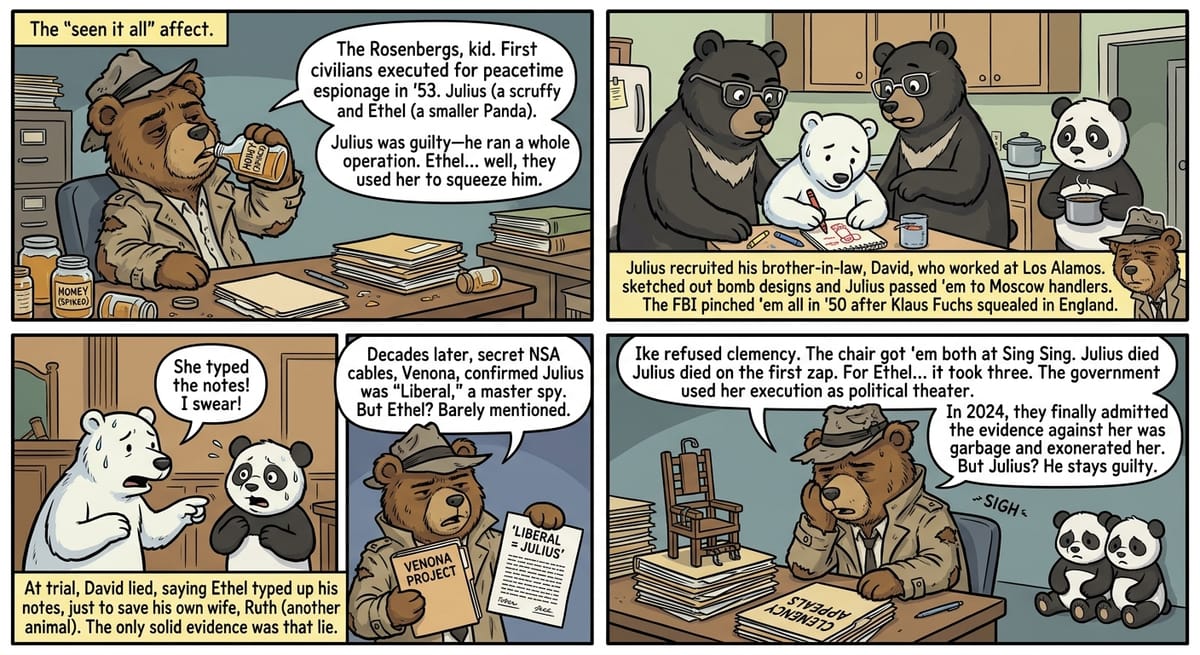
Julius and Ethel Rosenberg were executed at Sing Sing Prison on June 19, 1953 — the first American civilians put to death for espionage during peacetime. Julius died after the first application of the electric chair. Ethel required three. The core facts of the case are settled: Julius ran a Soviet spy ring that passed technical intelligence, including atomic bomb data, to Moscow handlers throughout the mid-1940s. Whether Ethel’s role warranted execution, and whether the prosecution was as much political theater as justice, has never been resolved — and in 2024, New York State gave a posthumous answer by exonerating her.
How Julius Rosenberg Built a Soviet Spy Ring
Julius Rosenberg was born in New York City in 1918 to a family of Jewish immigrants on the Lower East Side. He studied electrical engineering at the City College of New York, where he joined the Young Communist League in 1934. The Depression-era left was not fringe; it attracted lawyers, scientists, and engineers who saw capitalism as the thing that had broken the world. Julius married Ethel Greenglass in 1939. She was a labor organizer, a soprano, a woman who cared about causes. By 1943, Julius was working as a civilian employee of the U.S. Army Signal Corps at Fort Monmouth, New Jersey, with a security clearance.
Ethel’s brother, David Greenglass, was a machinist working at Los Alamos, New Mexico — the heart of the Manhattan Project. That connection would eventually destroy both families.
Julius recruited David Greenglass in 1944, tasking him with passing technical data about the atomic bomb’s implosion lens design to Soviet handlers. Greenglass sketched diagrams from memory and described the weapon’s configuration. Those sketches were passed to Harry Gold, a courier who moved information to Anatoli Yakovlev, a Soviet vice consul in New York. The intelligence was routed to Moscow.^1^
The FBI broke the ring wide open in 1950, following a chain of arrests that began with Klaus Fuchs, a British physicist at Los Alamos who confessed in January of that year to passing nuclear secrets to the Soviets. Fuchs named Harry Gold. Gold named David Greenglass. Greenglass named Julius Rosenberg.
Julius was arrested on July 17, 1950. Ethel was arrested on August 11, 1950 — a move prosecutors later acknowledged was partly intended to pressure Julius into confessing by holding his wife. Julius never confessed. Neither did Ethel.
At trial in March 1951, the Rosenbergs were convicted under the Espionage Act of 1917. Judge Irving Kaufman sentenced them to death, stating that they had “altered the course of history to the disadvantage of our country” and that their actions were “worse than murder.”^2^
Did the Rosenbergs Actually Give the Soviets the Bomb?
The Venona Project — a secret NSA program that decrypted Soviet intelligence cables from the 1940s — confirmed Julius Rosenberg’s espionage. The decrypted cables, made public in 1995, show Julius operating under the code name “Liberal,” actively coordinating multiple sources and passing technical data on radar, sonar, and aeronautics, in addition to the atomic information.^3^
Ethel’s role is harder to pin down. The primary evidence against her came from David Greenglass, who testified that Ethel had typed up notes from his sketches. Greenglass later admitted in a 2001 interview with journalist Sam Roberts that he had lied about Ethel to protect his own wife, Ruth, who had also been involved. The Venona cables contain only two oblique references to Ethel, neither of which establishes her as an active participant. Whether she knew is not in serious dispute. Whether she did anything actionable enough to warrant execution is a different question.
The U.S. tested its first atomic bomb in July 1945. The Soviets detonated their first — RDS-1, sometimes called “Joe-1” by Western intelligence — on August 29, 1949, four years ahead of most American estimates. The political shock was massive, and Washington needed an explanation. Physicist Richard Rhodes and others have since argued that the Soviet bomb program would have succeeded on roughly the same schedule regardless — Soviet scientists were brilliant and the Greenglass sketches were crude enough that Soviet scientists reportedly found them of limited value compared to what they already had from Klaus Fuchs.^4^ But in 1953, with the Korean War grinding toward armistice and McCarthyism at full pitch, the government needed a target. The Rosenbergs were that target.
Why Ethel Rosenberg Was Convicted on False Testimony
Clemency appeals went to President Eisenhower twice. He declined both. Protests erupted across Europe and in American cities. Pope Pius XII appealed for clemency. Eisenhower refused. At 8:06 p.m. on June 19, 1953, Julius was pronounced dead. Ethel followed at 8:15 p.m.^5^
Their sons, Michael and Robert Meeropol — they took the name of their adoptive family — spent decades advocating for their parents’ exoneration. In 2021, Robert Meeropol publicly asked that Ethel’s conviction be vacated, citing the revelation that David Greenglass had fabricated his testimony. The Manhattan District Attorney’s office eventually reviewed the case. In 2023, Manhattan DA Alvin Bragg wrote to Governor Kathy Hochul stating that the evidence against Ethel was insufficient and that she had been wrongly convicted. New York granted Ethel a posthumous exoneration in 2024.
Julius has not been exonerated. The Venona evidence against him remains substantial.
The Rosenbergs’ Legacy as Political Theater
The Rosenberg case became a lens through which two Americas saw themselves. The right saw a couple who had handed nuclear weapons to a totalitarian enemy and gotten what traitors deserved. The left saw a show trial that sacrificed two people — and possibly an innocent woman — on the altar of anti-communist hysteria.
Both things can be partially true. Julius Rosenberg was a Soviet spy. The espionage was real. The information passed was real. The same institutional failure that enabled Aldrich Ames to operate inside the CIA for nine years and Robert Hanssen inside the FBI for twenty-two was already visible in embryonic form here: the government had been running an intelligence community that did not vet its own people until a foreign chain of arrests collapsed the network from outside.
What the case left behind was a template: the spy trial as political theater, the execution as statement of national resolve. The FBI pursued the Rosenbergs not just because of what they did, but because of what punishing them would mean. That calculus — what the punishment communicates, not just what it costs — would define American espionage prosecutions for the next seventy years.
─────────
Sources:
- Roberts, Sam. The Brother: The Untold Story of Atomic Spy David Greenglass and How He Sent His Sister, Ethel Rosenberg, to the Electric Chair. Random House, 2001.
- Radosh, Ronald, and Milton, Joyce. The Rosenberg File: A Search for the Truth. Holt, Rinehart and Winston, 1983.
- Haynes, John Earl, and Klehr, Harvey. Venona: Decoding Soviet Espionage in America. Yale University Press, 1999.
- Rhodes, Richard. Dark Sun: The Making of the Hydrogen Bomb. Simon & Schuster, 1995.
- Meeropol, Robert. An Execution in the Family: One Son’s Journey. St. Martin’s Press, 2003.