Rayful Edmond: The Man Who Brought Crack to Washington and Dealt From Inside a Federal Prison
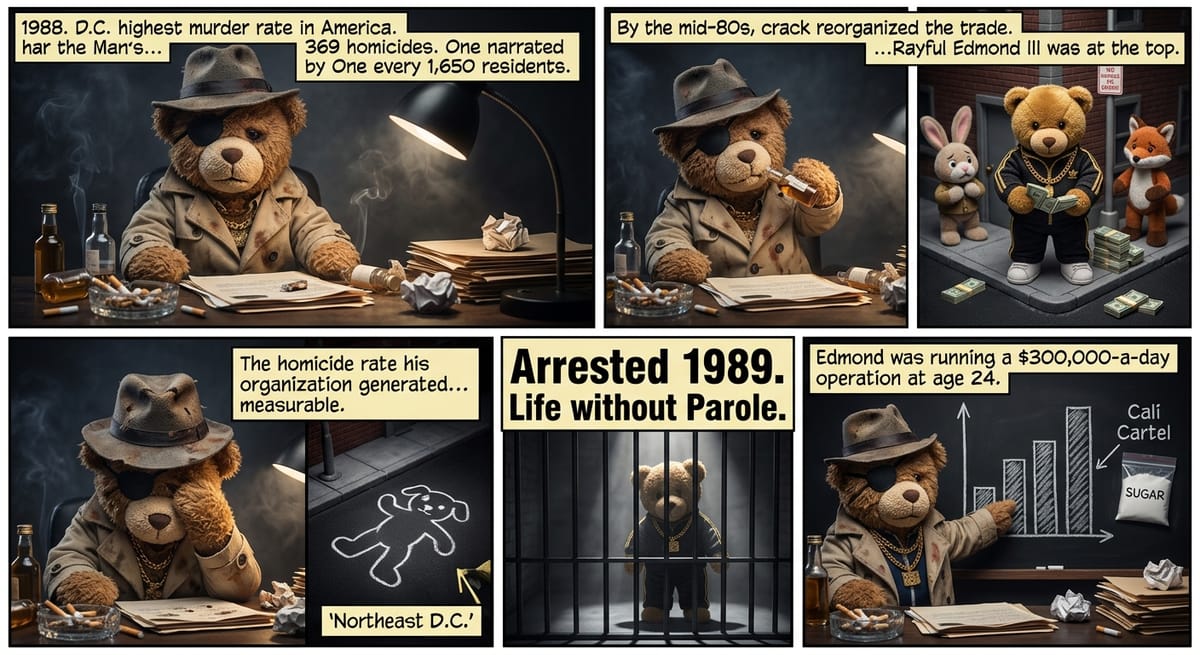
Rayful Edmond ran a $300000-a-day crack operation in Washington DC at age 24 — the same year the city hit 369 homicides. He was convicted in 1990 and has been under special restrictions ever since.
Rayful Edmond: The Man Who Brought Crack to Washington and Dealt From Inside a Federal Prison
The federal government was so afraid of Rayful Edmond III that it rebuilt a courtroom around him. For his 1989 trial, the U.S. District Court in Washington installed bulletproof glass between the gallery and the well, kept the jury anonymous, and housed Edmond not in the D.C. jail but at the Marine base at Quantico, flying him to court by helicopter. He was 24 years old. The government's theory, accepted by the jury, was that this affable, baby-faced son of Northeast Washington sat atop the cocaine operation that had turned the capital of the United States into its murder capital.
Then he did the thing that makes his case singular in the drug war's history: sentenced to life without parole, locked inside a maximum-security federal penitentiary, Edmond kept dealing, brokering large-scale cocaine connections from a prison phone, and when that was discovered, he began the longest cooperation arc of the crack era, one that ended with a dead man's release date.
A Family Business in Northeast D.C.
Edmond was born in 1964 and raised in the Trinidad neighborhood of Northeast Washington, in a family already wired into the drug trade; his mother, Constance "Bootsie" Perry, would eventually be convicted for her role in his operation. When high-purity powder cocaine and then crack hit Washington in the mid-1980s, the same conversion of powder into corner-ready product that was industrializing markets from New York to Detroit, Edmond's organization scaled faster than any competitor. Its retail heart was an open-air market in the blocks around Orleans Place and Morton Place in Northeast, streets that operated with the throughput of a wholesale exchange: lookouts on the corners, steerers working the lines, and customer traffic dense enough that police surveillance footage of the strip became a national symbol of the epidemic. Federal prosecutors estimated the network at its height employed more than a hundred people and moved hundreds of kilograms a month, supplied through a direct relationship with Colombian cocaine sources, the same cartel supply chains that fed the era's superlabs. Investigators put the operation's revenue in the hundreds of thousands of dollars a day, a scale in the same league as the Chambers brothers' factory model in Detroit, run with none of their paperwork and all of their market share.
The violence around that market share was not abstract. Washington recorded 369 homicides in 1988 and passed 400 the following year, and police attributed a substantial share of the killing to territorial wars radiating from the crack trade Edmond dominated. Edmond himself cultivated the opposite image: no convictions for violence, courtside seats at Georgetown games, famous friendships, cash spread through Trinidad. The Georgetown connection produced one of the era's defining Washington anecdotes, when coach John Thompson, hearing that Edmond had befriended his players, summoned the most dangerous man in the city to his office and told him to stay away from the program. Edmond complied. It was close to the only instruction he ever took.
The federal task force that took him down in April 1989 was uninterested in the charm. The resulting prosecution was the largest drug case the District had seen, sweeping in more than two dozen members of the organization, family included. Edmond was convicted in December 1989 on continuing criminal enterprise and conspiracy charges and sentenced to life without parole, a case whose appellate record, United States v. Rayful Edmond III, occupied the D.C. Circuit for years.
The Lewisburg Phone
At the U.S. Penitentiary in Lewisburg, Pennsylvania, Edmond discovered that a reputation is an asset prison cannot confiscate. The federal system had concentrated the drug war's losers in one place, which meant it had also concentrated the industry's best contact list. Colombian traffickers doing their own federal time respected Edmond's name and his history of paying Colombian suppliers on schedule; Dominican and Philadelphia-based dealers on the outside wanted exactly those introductions. From inside a federal cell, on monitored phones and through visiting rooms, he brokered deals between Colombian sources and street organizations moving cocaine by the hundredweight, taking a commission on product he never saw in a city he never entered. When the scheme was uncovered, it produced a second federal prosecution, a 1996 conviction in Pennsylvania and 30 more years, and a bureaucratic reckoning over how a man under a life sentence had operated a wholesale drug brokerage on monitored phones.
It also produced the pivot that defined the rest of his life. Caught dealing from prison, facing the certainty that the second case buried him forever, Edmond flipped. Beginning in the late 1990s, he spent two decades as a cooperating witness, providing information prosecutors credited in dozens of drug and homicide cases in Washington and beyond, work valuable enough that the government moved him into protective custody under an alias, the drug war's most famous defendant becoming its least visible asset. His mother's release, his own safety, and his sentence all became entangled with the quality of his cooperation, which the government itself eventually described as extraordinary. In 2019 the U.S. Attorney's office took the extraordinary step of moving to reduce his life sentence, and the District's attorney general formally surveyed Washingtonians, victims of the crack era included, on whether the man who symbolized it should ever come home, a process documented by the D.C. Office of the Attorney General.
The Long Arithmetic of Coming Home
In February 2021, U.S. District Judge Emmet Sullivan ruled. In a 72-page opinion weighing the cooperation against the crack era's body count, he cut the life sentence to 20 years, going beyond even the government's request, which had asked only for 40, as reported by NPR. The Pennsylvania sentence still stood between Edmond and the street, but the machinery kept turning in his favor: the Bureau of Prisons moved him to community confinement under its Nashville reentry office at the end of July 2024, a halfway-house arrangement with release projected for November 2025. He had served more than 35 years. The last step never happened. Rayful Edmond died on December 17, 2024, at age 60, months short of freedom, as reported by WTOP. He had spent 35 of his 60 years in custody, twenty of them working for the same government that had built a bulletproof courtroom to contain him.
Containment
Washington spent thirty years arguing about what to do with Rayful Edmond, and the argument was never really about him. It was about whether the city that absorbed the crack era's funerals owed its most famous dealer anything for the convictions his cooperation bought, and whether cooperation is redemption or just one more trade. The courts said twenty years plus thirty. The Bureau of Prisons said November 2025. The answer that arrived instead was the one nobody had standing to appeal. The man who brought crack to Washington left prison in a way that settled every docket and satisfied no one, and Trinidad, gentrified past recognition, no longer has corners that remember him.
Part of Drug Kingpins, back to the series hub