The Rajneeshees: The Cult That Poisoned a Town
In 1984, Rajneeshee followers poisoned 751 people in The Dalles, Oregon — deliberately contaminating salad bars to swing a county election in the largest bioterror attack in U.S. history.
The Rajneeshees: The Cult That Poisoned a Town
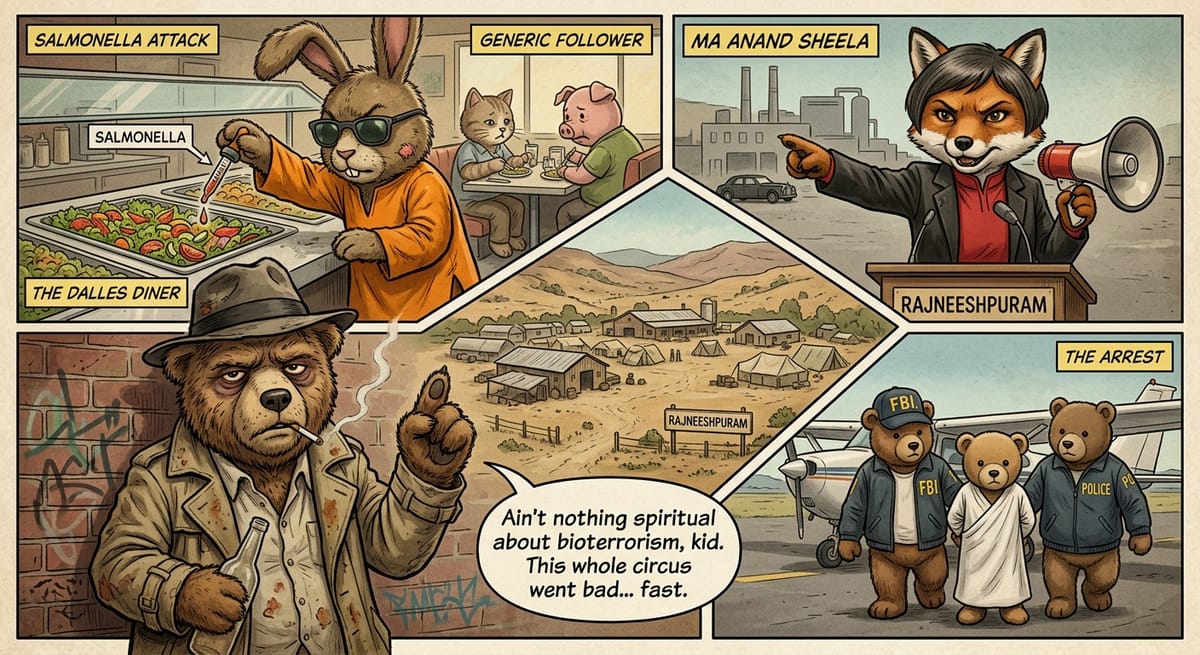
In September 1984, 751 residents of The Dalles, Oregon — a small city of eleven thousand people along the Columbia River — fell ill with Salmonella typhimurium after eating at ten local restaurants. The outbreak was the largest bioterror attack in American history, though no one called it that at the time. Public health officials investigated and attributed the contamination to unsanitary restaurant practices. It took a year before law enforcement established what had actually happened: members of the Rajneeshee commune, operating from a sixty-four-thousand-acre ranch in Wasco County, had deliberately contaminated restaurant salad bars with salmonella as a test run for a larger operation designed to incapacitate voters and influence a county election.^1^
The Rajneeshee story is the American cult case that sounds least like a cult story and most like a thriller — complete with bioterrorism, assassination plots, wiretapping, immigration fraud, a fleet of Rolls-Royces, and an armed compound in the Oregon high desert. It is also the case that most clearly demonstrates how a charismatic spiritual movement can evolve into a criminal enterprise when the mechanisms of control are combined with material resources, political ambition, and leaders who view the surrounding community as an obstacle to be neutralized rather than a population to be avoided.^2^
How Bhagwan Rajneesh Built an International Following
Bhagwan Shree Rajneesh — later known as Osho — was an Indian philosopher and spiritual teacher who built an international following during the 1970s through a synthesis of Eastern mysticism, Western psychology, and a frank embrace of sexuality that distinguished him from the ascetic traditions of most Indian gurus. His ashram in Pune, India, attracted thousands of Western seekers — predominantly young, educated, affluent Europeans and Americans — who were drawn to his charisma, his intellectual range, and his willingness to incorporate physical and emotional catharsis into spiritual practice. His followers wore orange and red, adopted Sanskrit names, and were known colloquially as “the Orange People.”^1^
In 1981, Rajneesh and several thousand followers relocated to the United States, purchasing the sixty-four-thousand-acre Big Muddy Ranch in rural Wasco County, Oregon. The stated intention was to build a self-sufficient spiritual community. What they built was a city — Rajneeshpuram — complete with its own fire department, airport, shopping mall, and bus system, constructed in the high desert with a speed and efficiency that astonished and alarmed the surrounding population.^3^
The arrival of thousands of orange-clad devotees in a conservative, sparsely populated ranching county created friction from the first day. Wasco County residents viewed the Rajneeshees with suspicion that ranged from cultural discomfort to genuine fear. The Rajneeshees viewed their neighbors with a combination of contempt and pragmatic hostility — the county government controlled the land-use regulations that could constrain or shut down Rajneeshpuram, and the political dynamics of the situation were clear to everyone involved.^2^
How Ma Anand Sheela Turned a Commune Into a Criminal Enterprise
The person who transformed the Rajneeshees from a spiritual community into a criminal operation was not Rajneesh himself — who spent much of the Oregon period in seclusion, observing a vow of silence, and accumulating Rolls-Royces (he eventually owned ninety-three) — but his personal secretary and the commune’s de facto chief executive, Ma Anand Sheela, born Sheela Ambalal Patel in Baroda, India.^1^
Sheela was sharp, combative, media-savvy, and possessed of a will to power that expressed itself through the commune’s administrative structure with the force of a corporate CEO and the ethics of a crime boss. She controlled access to Rajneesh. She controlled the commune’s finances. She ran the security apparatus — an armed force called the “Peace Force” that patrolled Rajneeshpuram and maintained surveillance on both internal dissidents and external critics. She authorized and directed the criminal operations that would eventually bring the commune down.^3^
The escalation from political conflict to criminal conspiracy happened in stages. The Rajneeshees first attempted to gain political control of Wasco County through legal means — busing in homeless people from cities across the country, registering them to vote, and housing them at the ranch in an operation they called the “Share-a-Home” program. The program generated national media attention and legal challenges, and when it became clear that the voter registration effort might not produce the electoral majority the commune needed, Sheela’s inner circle developed alternative approaches.^2^
The Bioterror Attack That Nobody Recognized for a Year
The salmonella attack was a pilot operation. Sheela’s team — a small group of inner-circle members with access to the commune’s medical laboratory — cultivated Salmonella typhimurium bacteria and deployed it at ten restaurants in The Dalles by contaminating salad bar items, coffee creamers, and other food products. The goal was to test the feasibility of a larger operation that would incapacitate enough Wasco County voters to allow Rajneeshee candidates to win the November 1984 county elections.^1^
Seven hundred and fifty-one people fell ill. Forty-five were hospitalized. No one died, though several elderly victims came close. The Wasco County public health department investigated and, finding no common food supplier or preparation practice linking the affected restaurants, attributed the outbreak to coincidental contamination. The possibility that the contamination was deliberate was raised and dismissed — the idea that a spiritual commune would poison a town’s restaurants was, at the time, outside the range of scenarios that public health officials were trained to consider.^3^
The bioterror attack was not discovered until 1985, when Sheela and several other top leaders fled the commune following a power struggle with Rajneesh, who had broken his silence and begun publicly criticizing Sheela’s leadership. Rajneesh himself told reporters that Sheela had committed crimes, and investigators who searched the commune’s facilities found the medical laboratory, salmonella cultures, and documentation that confirmed the deliberate nature of the attack.^2^
The Collapse and Osho’s Posthumous Rebrand
The commune unraveled rapidly after Sheela’s departure. Federal and state investigators descended on Rajneeshpuram. Rajneesh attempted to flee the country on a chartered jet and was arrested at the Charlotte, North Carolina, airport. He pleaded guilty to immigration fraud charges — specifically, arranging sham marriages to allow foreign followers to remain in the United States — and was fined and deported.^1^
Sheela was extradited from West Germany, convicted of assault (for the salmonella attack), attempted murder (for a separate plot to poison Rajneesh’s personal physician), wiretapping, and immigration fraud. She was sentenced to twenty years, served twenty-nine months, and was released. She moved to Switzerland, where she operates care homes for the elderly and has, in subsequent interviews, alternated between accepting responsibility and deflecting it.^3^
Rajneeshpuram was abandoned. The buildings were demolished or repurposed. The land was eventually acquired by a Christian youth organization. Rajneesh returned to India, resumed teaching at the Pune ashram under the name Osho, and died in 1990 at age fifty-eight. His teachings have experienced a posthumous revival — his books remain in print in dozens of languages, his quotes circulate on social media, and the Osho International Meditation Resort in Pune continues to attract visitors. The relationship between the globally popular spiritual brand and the Oregon criminal enterprise that preceded it is one that the brand’s current custodians prefer not to discuss.^2^
The Rajneeshee case is unique in the American cult canon because the harm it caused extended beyond the group’s membership to an entire community. The salmonella attack targeted not followers but civilians — county residents who had no connection to the commune and no involvement in the political conflict that motivated the attack. Wasco County is quiet now. The residents who were poisoned in 1984 have aged forty years. The restaurants have changed hands. The ranch is a summer camp. And the largest bioterror attack in American history was perpetrated not by a foreign enemy but by a spiritual community that decided the people living in the next town over were obstacles to be removed — and that had the resources, the organization, and the moral framework to act on that decision.
Part of Major Cults — ← Back to series hub
─────────
Sources:
- Zaitz, Les. “Rajneeshees in Oregon: The Untold Story.” The Oregonian, 2011 (25th anniversary investigation).
- Way, Chapman and Way, Maclain. Wild Wild Country (documentary series). Netflix/Duplass Brothers Productions, 2018.
- McCormack, Win. The Rajneesh Chronicles: The True Story of the Cult That Unleashed the First Act of Bioterrorism on U.S. Soil. Tin House Books, 2010.
- Torok, Thomas J. et al. “A Large Community Outbreak of Salmonellosis Caused by Intentional Contamination of Restaurant Salad Bars.” JAMA, Vol. 278, No. 5, 1997.
- U.S. Department of Justice. Federal prosecution records, United States v. Rajneesh and related cases, 1985-1986.