The LIBOR Scandal: How Banks Rigged the World's Most Important Number
Major banks falsified the benchmark rate for $350 trillion in global contracts from 2003 to 2012. Total fines exceeded $9 billion. Almost no individual traders in the U.S. were convicted.
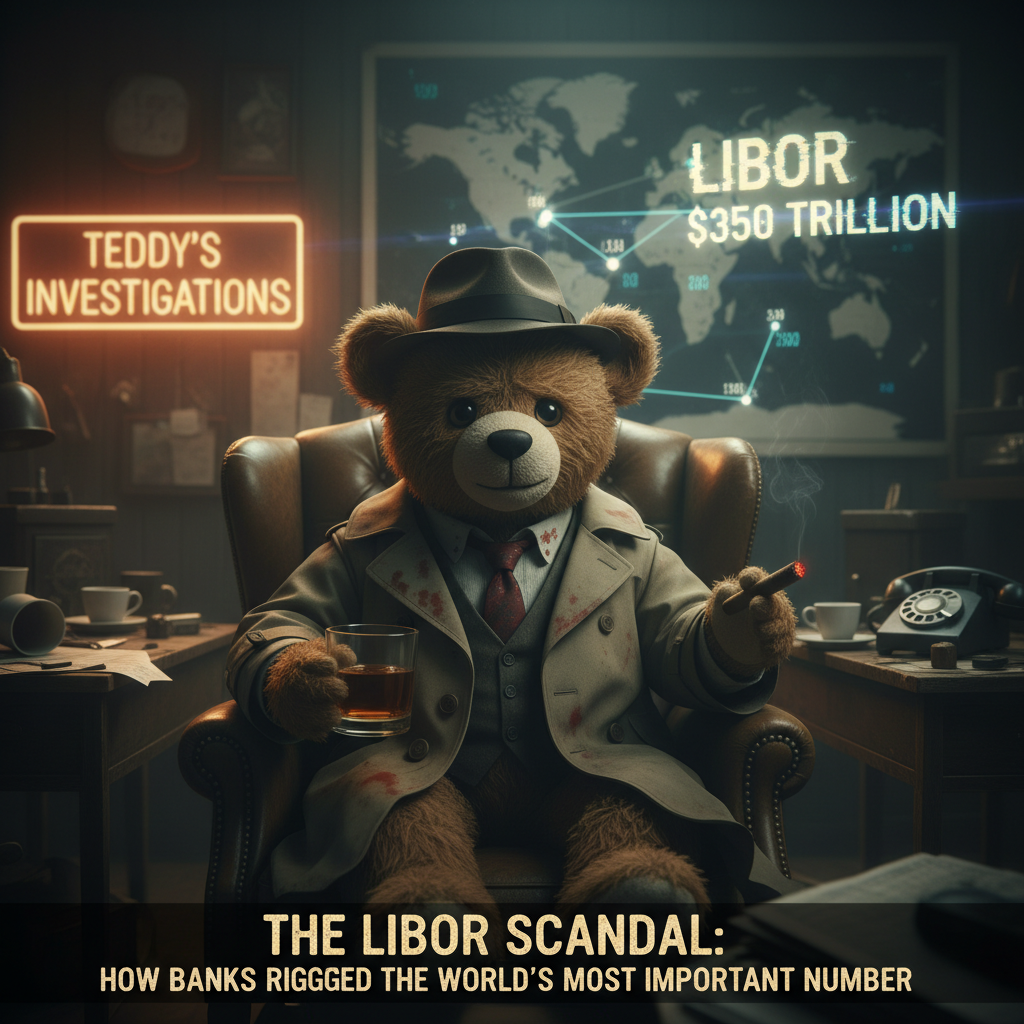
The LIBOR Scandal: How Banks Rigged the World’s Most Important Number
LIBOR — the London Interbank Offered Rate — was the benchmark interest rate that determined the cost of borrowing for an estimated $350 trillion in financial contracts worldwide: mortgages, car loans, credit cards, corporate bonds, municipal debt, derivatives. Between approximately 2003 and 2012, that number was routinely falsified by traders and rate submitters at multiple major banks, coordinating through emails and instant messages with a casualness that suggested they didn’t consider what they were doing to be particularly unusual. Total global settlements from LIBOR-related cases eventually exceeded $9 billion.
Part of Financial Crimes — ← Back to series hub
How LIBOR Worked and Why Self-Reporting Was the Vulnerability
Every business day, a panel of major banks submitted their estimates of the rates at which they could borrow in the interbank market for various currencies and maturities. The British Bankers’ Association collected the submissions, stripped the highest and lowest outliers, averaged the rest, and published the result. The number wasn’t based on actual transactions; it was based on what banks reported they believed they could borrow at.^1^
Banks had two strong incentives to manipulate their submissions. The first was profit: their trading desks held massive positions in derivatives and other instruments that paid off when LIBOR moved in particular directions — moving the rate by even a fraction of a basis point across $350 trillion in contracts produced enormous gains. The second was reputation: during the 2008 financial crisis, submitting a high LIBOR rate signaled that your bank was having trouble borrowing. Several banks suppressed their submissions to appear financially healthier than they were.
What the Internal Communications Actually Said
The internal communications uncovered by investigators are the clearest picture of what happened. Barclays trader Jay Merchant emailed colleagues in 2007 instructing them to submit a LIBOR rate that would benefit his trading positions, and a Barclays submitter responded: “For you, anything.” Deutsche Bank traders emailed each other requesting specific LIBOR submissions. UBS traders coordinated with submitters at other banks through an instant message network, asking them to move their rates in particular directions on specific dates. Rabobank traders maintained a spreadsheet tracking requests from trading desks and submitters at other institutions.^2^
The coordination was not incidental. Investigators at the Commodity Futures Trading Commission, the Department of Justice, and regulators in the United Kingdom, European Union, and Asia documented systematic manipulation at multiple institutions over multiple years. It was not a few bad actors. It was a practice that existed across institutions, currencies, and years.
How Much Did the Banks Pay?
The financial penalties in LIBOR-related settlements were unprecedented in scale. Barclays paid $453 million to U.S. and U.K. regulators in June 2012, the first institution to settle and the first to cooperate. UBS paid $1.5 billion in December 2012. Royal Bank of Scotland paid $612 million in February 2013. Rabobank paid $1 billion in October 2013. Deutsche Bank paid $2.5 billion in April 2015 — the largest fine in the history of the LIBOR investigation. JPMorgan, Citigroup, HSBC, and others paid additional hundreds of millions. Total global settlements exceeded $9 billion.^3^
The criminal convictions were harder to achieve. Several traders were convicted at trial in the United Kingdom, with sentences ranging from two to six and a half years. In the United States, a series of convictions were reversed on appeal when courts determined that the government had charged defendants under a wire fraud statute that required showing they had defrauded their own employers, not the broader market. The appeals court decisions in United States v. Connolly and related cases effectively ended U.S. criminal prosecutions of individual LIBOR manipulators.
Who Actually Got Hurt
The harm from LIBOR manipulation falls into two categories that pull in opposite directions. When banks suppressed LIBOR during the 2008 financial crisis to appear financially healthy, they pushed LIBOR below where it would otherwise have been — borrowers with variable-rate loans paid less interest than they should have, while investors in LIBOR-linked instruments received less return. When traders manipulated LIBOR upward or downward to profit on trading positions, the harm fell on whoever was on the other side of those trades.
Municipalities were among the most clearly harmed parties. Many American cities and counties had entered into interest rate swap agreements with banks — contracts in which the municipality paid a fixed rate and received a floating rate tied to LIBOR. When LIBOR was suppressed during the financial crisis, municipalities received less on the floating side than they should have. Baltimore, Maryland was among the first municipalities to file suit, eventually joined by dozens of others in class-action litigation that settled for hundreds of millions of dollars.^4^
Replacing LIBOR Fixed the Mechanism, Not the Incentive
LIBOR was replaced. In the United States, the Secured Overnight Financing Rate (SOFR), based on actual overnight Treasury repurchase agreement transactions, replaced LIBOR for new contracts beginning in 2023. The transition to transaction-based benchmarks addressed the self-reporting vulnerability that made LIBOR manipulation possible — change the mechanism so it doesn’t depend on honesty.^1^
What the reform didn’t change was the architecture of incentives that made manipulation attractive. The same banks that settled LIBOR cases continued to operate with the same basic compensation structures — traders paid on the profits their positions generated — that created the incentive to manipulate a rate on which those profits depended. The LIBOR scandal revealed that the global financial system’s most fundamental benchmarks had been entrusted to self-interested parties without verification. The same dynamic underlies insider trading at SAC Capital, Michael Milken’s junk bond network, and every other case in this series: the people with the most information about the system were also the people with the most to gain from exploiting it. Fixing the benchmark is necessary. Assuming it’s sufficient requires ignoring why the problem existed.
─────────
Sources:
- Hou, David, and David Skeie. “LIBOR: Origins, Economics, Crisis, Scandal, and Reform.” Federal Reserve Bank of New York Staff Reports, No. 667, 2014.
- U.S. Commodity Futures Trading Commission. Order Instituting Proceedings: Barclays PLC. CFTC Docket No. 12-25, June 27, 2012.
- McConnell, Patrick. “Systemic Operational Risk: The LIBOR Manipulation Scandal.” Journal of Operational Risk, 2013.
- Vaughan, Liam, and Gavin Finch. The Fix: How Bankers Lied, Cheated and Colluded to Rig the World’s Most Important Number. Wiley, 2017.