Griselda Blanco: The Godmother of Cocaine
Griselda Blanco ran Miami's cocaine trade in the late 1970s with at least 40 attributed murders — helping drive Miami's homicide rate to 70 per 100000 in 1980. She was later killed the same way she killed.
Griselda Blanco: The Godmother of Cocaine
Griselda Blanco ran cocaine through Miami in the 1970s and early 1980s with a combination of business acumen and casual violence that was unusual by any measure and extraordinary for the era. She built and maintained a distribution empire at a time when the Colombian cocaine trade was in its formative years, competed successfully with men who controlled far more territory, and ordered killings with a matter-of-factness that her associates remembered decades later in testimony and interviews.^4^ The Miami that popular mythology has softened into glamour was, during her years of dominance, a genuinely dangerous city — the most dangerous in the country by some measures — and Blanco was a significant reason why.
She Arrived in Miami as the Colombian Cocaine Trade Was Exploding
Griselda Blanco was born on February 15, 1943, in Cartagena, Colombia, and moved to Medellín as a child. She came to the United States in the late 1960s using fraudulent documents and began building a cocaine distribution network in New York before relocating to Miami in the mid-1970s as the Colombian cocaine trade was rapidly expanding. Her first serious run-in with federal law enforcement came in 1975, when a federal grand jury in New York indicted her on cocaine importation conspiracy charges. She returned to Colombia before she could be arrested and continued operating from Medellín, which was consolidating into the cocaine capital of the world as Pablo Escobar’s Medellín Cartel took shape. Blanco was connected to the cartel but operated with significant independence — her distribution network in South Florida was her own enterprise.
Blanco’s Miami Operation Turned the City Into America’s Murder Capital
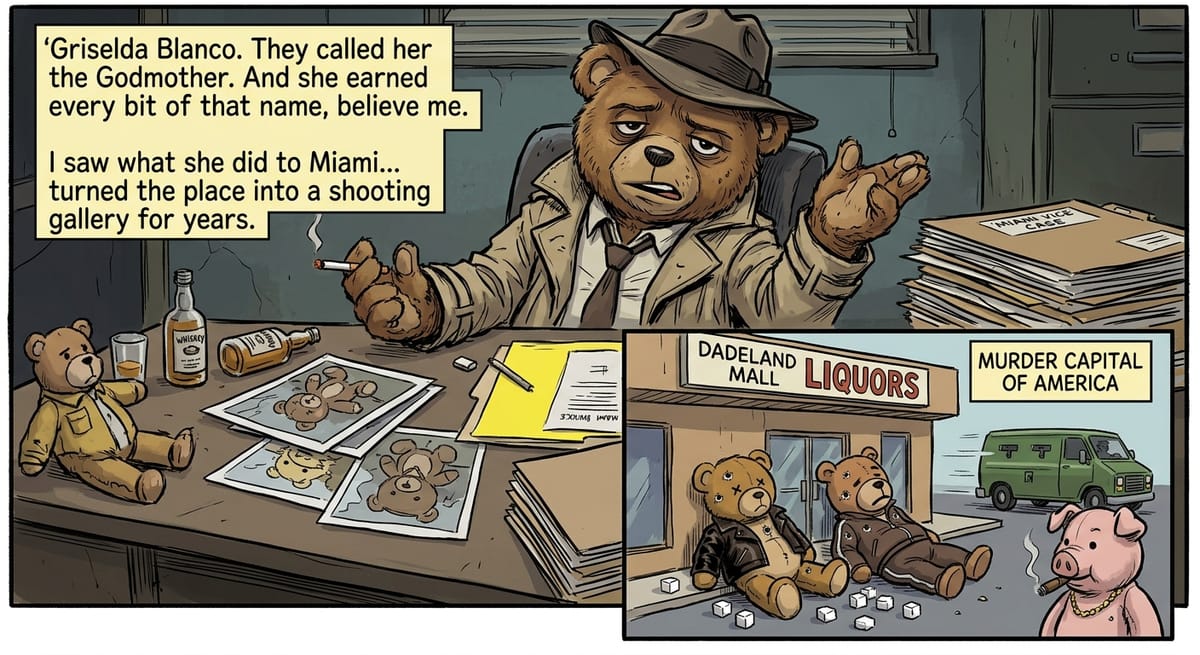
Blanco returned to Miami around 1979 and presided over what became known as the “Cocaine Cowboys” era — a period of extraordinary drug trade violence in South Florida that transformed Miami’s reputation and its murder statistics. Miami’s homicide rate climbed from 15.1 per 100,000 in 1975 to 70.1 per 100,000 in 1980, a rate that made it the murder capital of the United States.^2^ The Dade County medical examiner’s office was so overwhelmed in 1979 and 1980 that it temporarily stored bodies in a refrigerated meat truck borrowed from McDonald’s because the morgue was beyond capacity.
The violence was not random. It was commercial: turf disputes, rip-offs, double crosses, and the enforcement of debts in a business with no legal remedies. Investigators attributed at least 40 murders to her organization during the height of her Miami operation, with some estimates higher based on testimony from cooperating witnesses in later prosecutions.
One of the most notorious incidents was the Dadeland Mall massacre of July 11, 1979. Two men were shot and killed in a National Liquors store inside the Dadeland Mall in South Miami in a targeted assassination. The attackers fled in a van that was later found to contain weapons, ammunition, and what investigators described as a “war wagon” — custom-fitted with gun ports, a weapon locker, and police-band radio equipment. The sophistication of the operation was a marker of how professional the cocaine trade’s enforcement capacity had become.^1^
How Did a Woman Run One of Miami’s Most Violent Drug Empires?
At the peak of her operation, Blanco’s organization was reportedly moving between 1,000 and 2,000 kilograms of cocaine per month into the United States — generating revenues in the hundreds of millions of dollars annually, at late-1970s and early-1980s cocaine prices.^4^
She was notable for using women in operational roles — as couriers, as distributors, as money handlers — at a time when women’s participation in high-level drug trafficking was rare. She was also credited, in accounts by DEA investigators and prosecutors who worked her cases, with innovating the use of specially designed undergarments for body-carrying cocaine through airports — a method known as the “cocaine bikini,” which she reportedly developed before it became widely imitated.
Arrest, Prison, and a Death That Mirrored Her Methods
Blanco was arrested by the DEA in Irvine, California, in February 1985, following years of federal investigation and surveillance across multiple jurisdictions. She was convicted on federal drug charges and sentenced to 15 years in prison. Additional charges, including murder conspiracy, were complicated by the death of the primary witness against her — a former associate killed before trial.
She was released in 2004, after serving approximately 20 years, and was immediately deported to Colombia. She settled in Medellín, the city where she had grown up and which had changed dramatically since the death of Pablo Escobar in 1993. She was shot and killed outside a butcher shop in the Medellín neighborhood of Belén on September 3, 2012, by a motorcycle-mounted gunman — a method of killing that Medellín’s underworld had used for decades and which, investigators noted, was one that Blanco herself had reportedly pioneered.^3^
Blanco’s story attracted significant popular culture attention through the Netflix miniseries Griselda (2024), starring Sofia Vergara, which dramatized her rise in Miami’s cocaine trade. What it captured, and what the historical record confirms, is that Blanco operated in a male-dominated criminal world with as much authority and violence as any of her contemporaries.
Containment
Griselda Blanco was not the most powerful figure in the Colombian cocaine trade — that designation belongs to Escobar and the Medellín Cartel’s leadership. But she was the most consequential individual operator in South Florida’s cocaine era, and her methods — the systematic use of lethal violence as a business tool — contributed materially to making Miami what it was in 1980. The people who died in Dadeland, in apartment buildings in Hialeah, in parking lots in Coral Gables, were mostly also in the business. The city around them absorbed the violence and moved on. The morgue returned to normal capacity. The meat truck went back to McDonald’s.
Part of Drug Kingpins — ← Back to series hub
─────────
Sources:
- Corben, Billy, dir. Cocaine Cowboys. Rakontur, 2006.
- Miami-Dade County Medical Examiner Department. Annual Reports, 1979–1982. Miami-Dade County.
- Edna Buchanan. The Corpse Had a Familiar Face. Random House, 1987.
- Gugliotta, Guy and Jeff Leen. Kings of Cocaine: Inside the Medellín Cartel. Simon & Schuster, 1989.
- Shannon, Elaine. Desperados: Latin Drug Lords, U.S. Lawmen and the War America Can’t Win. Viking, 1988.