Frank Lucas: The Real American Gangster
Frank Lucas bypassed the Italian mob's wholesale heroin network by buying directly from Southeast Asian producers — and built a Harlem operation generating $1 million a day in the early 1970s.
Frank Lucas: The Real American Gangster
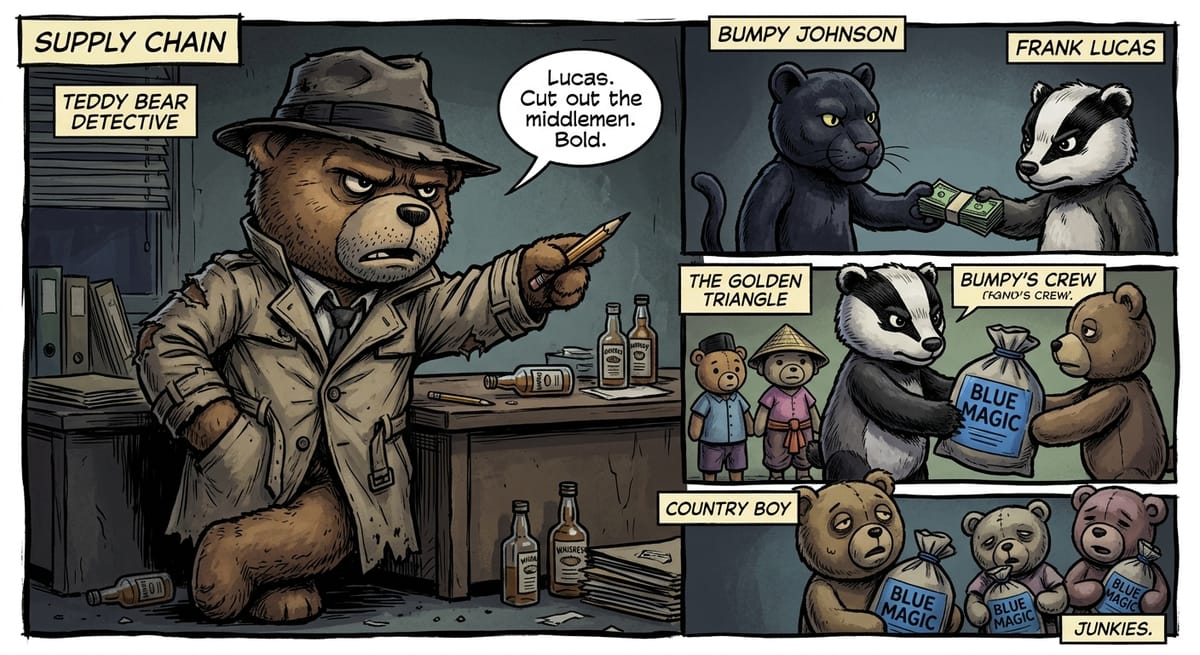
Frank Lucas grew up in La Grange, North Carolina, and by the late 1960s he was running the largest heroin distribution operation Harlem had ever seen. What made him different from every other man in his position was supply chain thinking: he looked at the existing structure of Harlem’s drug trade — controlled wholesale by Italian organized crime, purchased by Black dealers at inflated prices, cut repeatedly before it reached the street — and decided to go around it.^1^ He flew to Southeast Asia, built relationships with heroin producers, and for several years imported pure heroin directly into the United States, bypassing the Italian mob entirely and selling a better product at lower cost. The nickname for his heroin was “Blue Magic.” At the height of his operation in the early 1970s, he was generating an estimated $1 million per day.
Lucas Came Up Through Bumpy Johnson’s Harlem Network
Lucas was born in 1930 and moved north as part of the Great Migration wave that brought hundreds of thousands of Black Southerners to Harlem and other Northern cities in the mid-twentieth century. He became an associate of Harlem numbers operator Ellsworth “Bumpy” Johnson, working under Johnson through the 1960s and learning the fundamentals of illegal enterprise — territory, loyalty, violence as a last resort, and the importance of controlling supply.^1^ When Johnson died in 1968, Lucas was positioned to build something of his own.
His first move was geographic: he went directly to the source. Heroin in the late 1960s traveled from the Golden Triangle — the opium-producing region spanning parts of Myanmar, Laos, and Thailand — to Europe, where it was refined, and then to the United States through Italian-American organized crime’s wholesale distribution network. The mob charged Black Harlem dealers whatever the market would bear. Lucas decided to buy in Southeast Asia, where the price was dramatically lower, and ship it to the United States himself.
Blue Magic Undercut Every Competitor on Price and Purity
Lucas traveled to Bangkok and eventually to remote parts of Southeast Asia to develop direct supplier relationships. He is alleged to have worked with figures he called “the country boys” — producers in the Golden Triangle who could supply refined heroin at a fraction of what the mob charged. The exact logistics of his import operation have been disputed — Lucas himself told different versions at different times — but the core documented fact is not: he was importing Southeast Asian heroin directly and selling it in Harlem at prices that undercut his competitors while maintaining higher purity.^5^
The “Blue Magic” brand — his heroin, stamped with a blue label — sold for $10 per bag when competitors’ product sold for $15 and was significantly more potent. Addicted users came specifically for his product. That combination of price and quality drove volume that made his operation the dominant heroin distribution enterprise in Harlem by the early 1970s. He expanded into New Jersey, the South, and other markets through a network of relatives from North Carolina — a supply chain he trusted because they were family.
Federal prosecutors who later investigated Lucas’s operation estimated that at its peak, the organization was grossing between $500,000 and $1 million per day. Lucas lived in a way that made his wealth conspicuous: a fur coat worn to the 1971 Muhammad Ali-Joe Frazier fight at Madison Square Garden attracted the attention of a DEA agent in the crowd — one of the moments investigators later cited as drawing serious federal attention to him.^1^
How Did a Street Dealer Build a Supply Chain That Bypassed the Italian Mob?
Lucas was arrested in 1975 in a joint DEA and NYPD raid on his Teaneck, New Jersey, home. Agents recovered $584,000 in cash from a secret room behind a panel — a figure that represented a small fraction of what he had moved through his operation. He was convicted of federal drug charges and initially sentenced to 70 years in federal prison, later reduced to 40 years on appeal.
He chose to cooperate with federal prosecutors, providing information that led to more than 100 convictions — including 40 police officers who had been on his payroll. His cooperation substantially reduced his sentence. He was released in 1981, five years after his arrest. He was arrested again in 1984 on drug charges and spent additional time incarcerated before his final release.^2^
Ridley Scott’s 2007 film American Gangster, starring Denzel Washington as Frank Lucas and Russell Crowe as DEA investigator Richie Roberts, brought Lucas to mainstream cultural attention. The film took considerable liberties with the historical record — Lucas himself disputed several elements of it — but it cemented his status as one of the most recognizable figures in American drug trade history.
DEA investigator Richie Roberts, whose investigation led to Lucas’s arrest, described him as the most important drug trafficker he ever prosecuted — not because of violence, but because of his supply chain innovation. Going around the Italian mob’s wholesale system was, in Roberts’s assessment, as significant a disruption to the established order of American drug distribution as anything that happened before or after.
Containment
Frank Lucas died in May 2019, in Newark, New Jersey, at age 88. He had spent his post-incarceration decades as a figure of cultural fascination, speaking to journalists and filmmakers about his life with what observers described as a mixture of candor and self-mythologization. What he had actually accomplished — a supply chain bypass that gave one man control of a significant portion of Harlem’s heroin market for several years — was a feat of logistics and nerve that destroyed tens of thousands of lives through addiction. The pride and the ruin are not separable. He carried both.
Part of Drug Kingpins — ← Back to series hub
─────────
Sources:
- Roberts, Richie and John Bosco. American Gangster: Frank Lucas and the Untold Story of the Heroin Conspiracy. Morrow, 2007.
- Jacobson, Mark. “The Return of Superfly.” New York Magazine, August 2000.
- Courtwright, David T. Dark Paradise: A History of Opiate Addiction in America. Harvard University Press, 2001.
- Parenti, Christian. Lockdown America: Police and Prisons in the Age of Crisis. Verso, 1999.
- Valentine, Douglas. The Strength of the Wolf: The Secret History of America’s War on Drugs. Verso, 2004.