Charity Scams: When Generosity Gets Exploited
Four cancer charities raised $187 million and returned less than 3% to cancer patients — the rest went to cruise vacations and family salaries before the FTC and all 50 attorneys general shut them down.
Charity Scams: When Generosity Gets Exploited
Between 2008 and 2012, four cancer charities raised $187 million from donors and returned less than 3% of it to cancer patients — the rest went to family salaries, cruise vacations, gym memberships, and college tuition. In May 2015, the FTC and all 50 state attorneys general filed suit and shut them down.^1^ The fraud was legal in structure, impossible to detect from the outside, and built entirely on the trust people place in charitable names that imply their money will reach sick children.
Part of Healthcare and Religious Fraud — ← Back to series hub
How Does Charity Fraud Actually Work?
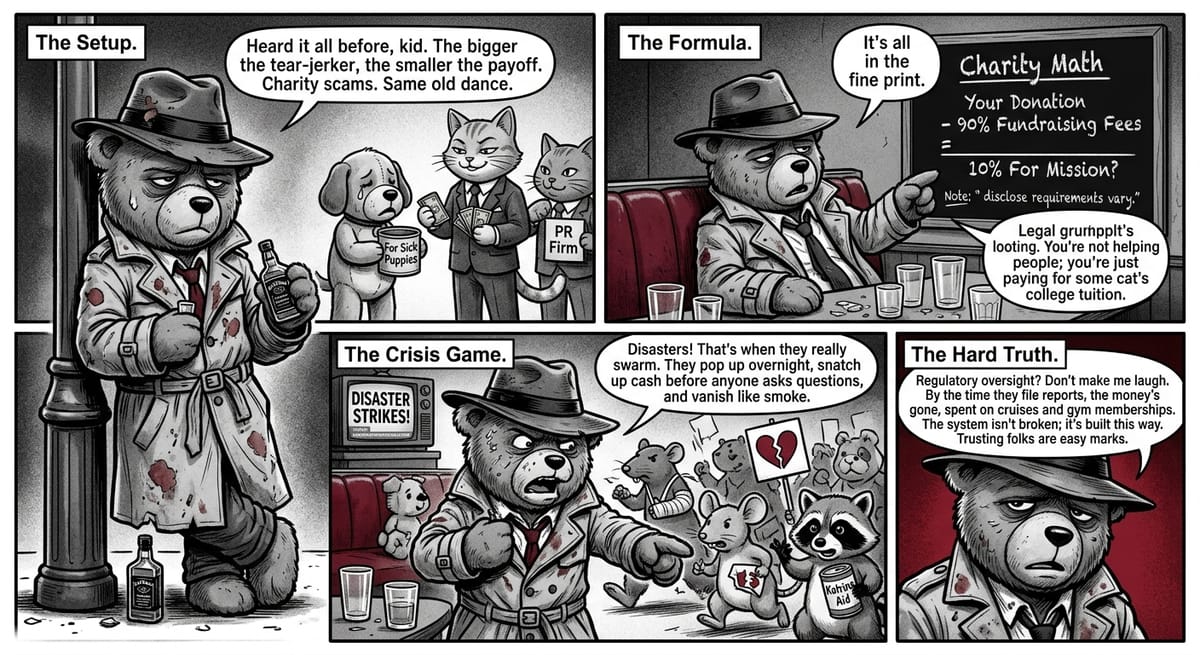
The most common form of charity fraud exploits the gap between a charity’s name or stated mission and its actual operations. Professional fundraisers — third-party companies contracted to solicit donations on a charity’s behalf — may collect 70-90% of each donation as their fee, leaving the charity with the remainder.^2^ The charity then uses its portion for administrative costs, leaving very little for the stated mission. This is legal as long as it’s disclosed, but disclosure requirements vary by state and are rarely understood by donors calling in response to a phone solicitation.
The Pennies for Charity report published annually by the New York Attorney General’s office has documented charities where professional fundraisers retained more than 90 cents of every dollar raised, leaving less than 10 cents for the charity’s programs. Some charities exist primarily as vehicles for professional fundraising fees, with the charity’s own staff being relatives or associates of the fundraiser. The distinction between legal low-efficiency charities and fraudulent charities is one of disclosure and intent. A charity that discloses to donors that 80% of each donation covers fundraising costs may be running an inefficient operation, but it’s not committing fraud if the disclosure is accurate. A charity that implies donations will reach sick children when most of the money goes to cruise vacations is committing fraud regardless of whether it makes technical disclosures in fine print.
The Wounded Warrior Project Shows How Legitimate Charities Can Also Fail Donors
The Wounded Warrior Project (WWP) is a more complex case than the cancer charities — it is not a fraud operation, but it illustrates how legitimate organizations can misuse donor funds. In January 2016, CBS News and the New York Times published investigations documenting that WWP had spent approximately 40-50% of its revenue on overhead and fundraising, compared to 15-25% for comparable veterans’ organizations, and that it had spent lavishly on staff conferences — including a 2014 event at a Colorado resort that cost $3 million, and a 2015 conference in Orlando that included zip lines, rock-climbing walls, and alcohol at a cost of approximately $26 million over two years.^3^
WWP raised approximately $342 million in 2015. The reports documented a culture of excessive spending on internal operations and staff entertainment while veterans who had contacted the organization for assistance reported difficulties accessing services. The CEO, Steven Nardizzi, and the COO were fired by the board in March 2016 following the investigations. A subsequent independent review found that the organization’s practices, while not fraudulent, had diverted resources from its stated mission.
Disaster Appeals Are Where the Most Opportunistic Fraud Concentrates
Charity fraud spikes following natural disasters and other highly publicized emergencies. After Hurricane Katrina in 2005, state attorneys general documented dozens of fraudulent organizations that had been created specifically to solicit donations using the Katrina name or similar names.^4^ Following the 2010 Haiti earthquake, the FTC identified numerous fraudulent text-message solicitation schemes. Following the September 11 attacks, more than 300 charitable organizations were established in the weeks following the attacks, with varying degrees of legitimacy and accountability for how donations were used.
The fraudulent organizations in these contexts typically operate briefly, collect as much money as possible from emotionally motivated donors, and dissolve before regulatory scrutiny catches up. The Red Cross and other established organizations face legitimate questions about how they use disaster funds — questions that are accountability issues, not fraud allegations — but the most egregious harm comes from the fake organizations that collect money and deliver nothing.
The Regulatory System Cannot Catch Fraud in Real Time
Charities in the United States are regulated primarily at the state level. Most states require charities to register and file annual financial reports, and state attorneys general have enforcement authority over charitable organizations. The FTC has authority over deceptive fundraising practices. The IRS grants and can revoke tax-exempt status. None of these regulatory mechanisms provides real-time oversight of how donated funds are used; they all operate retrospectively based on reported financial information.
The Better Business Bureau’s Wise Giving Alliance, Charity Navigator, and GuideStar (now Candid) provide evaluations of charity financial efficiency and governance. These ratings are based on publicly available financial information, which means they can’t catch fraud until the fraudulent organization has filed reports that reveal it — and fraudulent organizations often don’t file accurate reports. For comparison, see how Prosperity Gospel ministries exploit similar disclosure gaps through religious exemptions.
The cancer charity case produced lifetime fundraising bans, organizational shutdowns, and a small amount of restitution to donors from the organizations’ remaining assets.^1^ The FTC’s action was among the largest charity fraud actions in the agency’s history. State-level enforcement has increased following the case. But the underlying vulnerability — donors who cannot verify in real time how their money is used, emotional appeals that create urgency that bypasses careful evaluation — is structural. Charity Navigator’s ratings and the BBB’s reports are available to any donor who seeks them out; most donors who respond to phone solicitations or disaster appeals do not seek them out. The fraudulent organization that sounds like a real one and collects money quickly before anyone checks will continue to exist as long as people respond to emotional appeals about helping children, veterans, and disaster victims.
─────────
Sources:
- Federal Trade Commission v. Cancer Fund of America, Inc., et al., No. 2:15-cv-00884 (D. Ariz. 2015).
- New York Attorney General Charities Bureau. Pennies for Charity. Annual Report, 2014.
- Philipps, Dave. “Wounded Warrior Project Spends Lavishly on Itself, Insiders Say.” The New York Times, January 27, 2016.
- Hechinger, John, and David Evans. “Charity Fraud Surges After U.S. Disasters.” Bloomberg News, October 5, 2010.